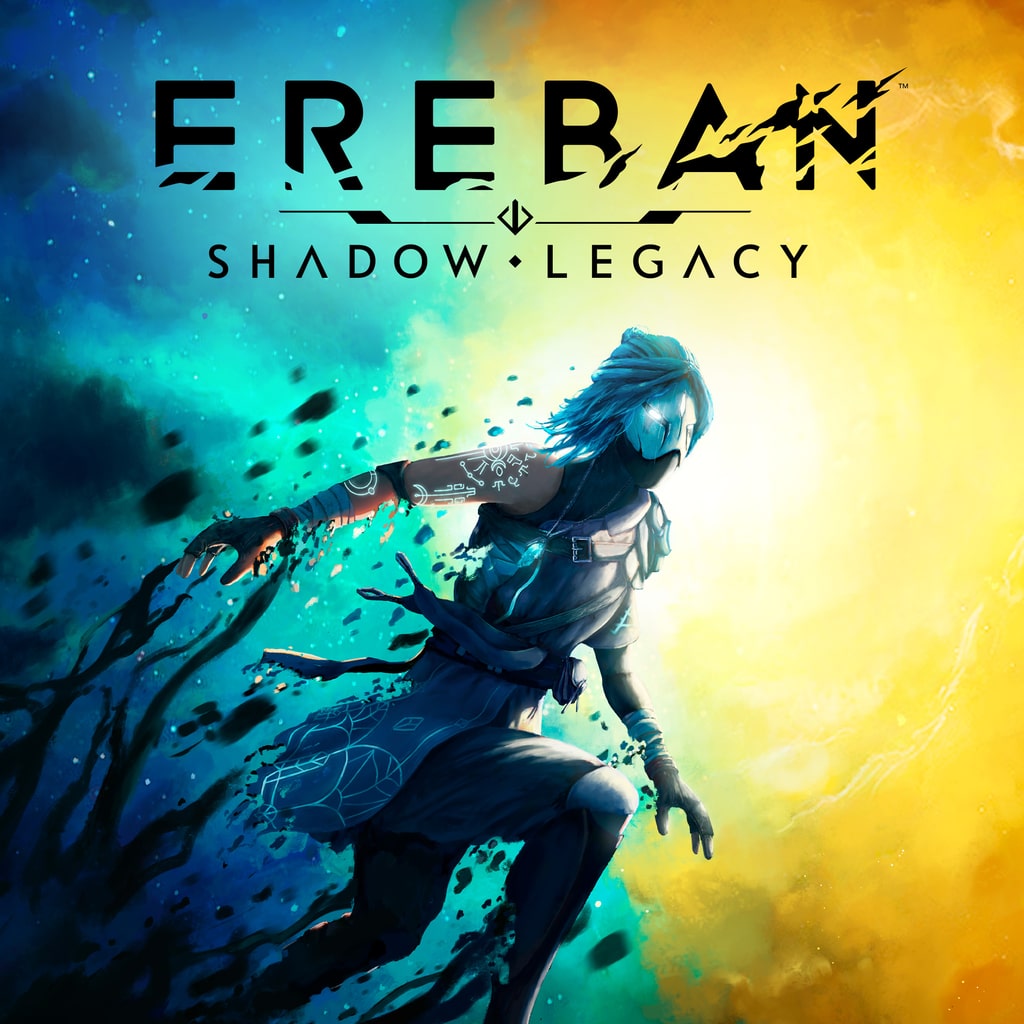
Some stealth games rely on systems, others on atmosphere, and a rare few manage to fuse both into something that feels genuinely expressive. Ereban: Shadow Legacy, originally released on PC in 2024 and arriving on PlayStation 5 and Xbox Series X|S on April 16, 2026, falls into that ambitious latter category more often than not.
Developed by Baby Robot Games, it presents a sci-fi stealth platformer built around mobility, environmental manipulation, and moral ambiguity. You play as Ayana, the last descendant of a forgotten lineage, navigating a dying universe shaped as much by corporate ambition as ancient myth. It is a game that wants to be agile in both movement and philosophy, and while it doesn’t always maintain perfect consistency, its core ideas are compelling enough to carry it through.
Story & Setting
At the heart of Ereban: Shadow Legacy is Ayana, a lone figure tied to a lost civilisation whose abilities blur the line between biology and something more arcane. The world she moves through is one in decline: fractured cities, abandoned megastructures, and hybridised environments where ancient architecture has been overtaken by sterile, futuristic infrastructure.
The dominant force in this universe is the Helios corporation, a technologically advanced power whose presence looms over every ruined skyline and sealed facility. Their motives are unclear at first, but as Ayana delves deeper, the truth becomes increasingly entangled with questions of identity, heritage, and survival.
Narratively, the game leans heavily on mystery rather than exposition. Information is drip-fed through environmental storytelling, intercepted communications, and optional narrative fragments. This approach works in its favour, reinforcing the feeling that Ayana is uncovering truths she was never meant to see. However, it also means pacing can occasionally feel uneven, especially in the early hours where context is deliberately withheld.
Gameplay & Core Stealth Systems
The defining mechanic of Ereban: Shadow Legacy is the Shadow Merge ability, a system that allows Ayana to literally dissolve into shadows and traverse them freely. This is not a simple invisibility mechanic; it is a full spatial system that redefines how movement works within each level.
Through Shadow Merge, players can climb vertical surfaces, slip through narrow environmental gaps, and reposition instantly between shadowed areas. It creates a fluid, almost parkour-like rhythm that distinguishes the game from more traditional stealth titles. Levels are designed around this mechanic, encouraging experimentation with verticality and timing rather than purely line-of-sight avoidance.
Combat and stealth are tightly interwoven. Players can choose to remain entirely undetected, or eliminate enemies using shadow-enhanced attacks. This duality is central to the experience. Killing is never mandatory, but it is always available, and the game consistently reminds you that power comes with consequence.
There is also a progression system built around absorbing “echoes,” which unlock new abilities and augment existing ones. These range from non-lethal traversal tools to more aggressive shadow-based attacks. The system encourages experimentation, though some abilities feel more situational than others, leading to uneven usage across playthroughs.
Level Design & Player Agency
One of the game’s strongest aspects is its approach to level design. Environments are layered, often offering multiple vertical routes, hidden pathways, and shadow-rich corridors that reward careful observation. Rather than funneling players through a single optimal stealth path, levels are constructed as open stealth playgrounds.
This design philosophy supports the game’s “play your way” ethos. You can complete missions as a ghost-like infiltrator, never engaging enemies directly, or as a lethal shadow operative who eliminates threats surgically. Both approaches are viable, though not always equally rewarded in terms of resource gain or narrative feedback.
Some missions shine more than others in this regard. The best levels feel like puzzles of movement and timing, where mastering Shadow Merge opens creative routes through heavily guarded spaces. Less successful sections rely too heavily on trial-and-error stealth patterns, which can slow momentum.
Movement & Combat Feel
Movement is where Ereban: Shadow Legacy feels at its most distinctive. Ayana is fast, responsive, and capable of chaining shadow transitions into fluid traversal sequences. When everything clicks, there is a satisfying rhythm to navigating environments that feels closer to a momentum-based platformer than a traditional stealth game.
Combat, by contrast, is more functional than expressive. Shadow-based kills are visually striking, but mechanically simple. The game clearly prioritises avoidance over confrontation, and while this reinforces its stealth identity, it does limit the depth of direct engagement.
Enemy AI is competent without being exceptional. Guards follow predictable patrol patterns and respond reliably to disturbances, but they rarely feel adaptive. This makes stealth more about spatial awareness than psychological tension, which may disappoint players looking for dynamic cat-and-mouse encounters.
World Design & Atmosphere
Visually, the game excels in contrast. Ruined urban environments sit alongside sleek, oppressive corporate facilities carved into ancient ruins, creating a visual language that constantly shifts between decay and artificial control.
Lighting plays a crucial role in both aesthetics and gameplay. Shadows are not just atmospheric but functional, forming the literal pathways through which Ayana moves. This integration of art direction and mechanics is one of the game’s most successful elements.
There is a melancholic beauty to the world, reinforced by its sense of abandonment. Even active areas feel hollow, as though humanity has already lost control of its own creations. The result is a setting that feels quietly oppressive rather than overtly hostile.
Audio & Presentation
Sound design supports the stealth experience effectively. Environmental audio cues, such as distant machinery, shifting guards, and ambient wind, help players navigate spaces without relying solely on visual information.
Music is understated, often fading into ambient textures rather than dominant themes. This works in favour of immersion, though it occasionally reduces the emotional impact of key moments.
Performance on modern consoles is stable, with the PS5 and Xbox Series X|S versions delivering smooth frame rates and responsive controls. The transition from PC to console feels well-handled, with only minor compromises in visual fidelity.
Replayability & Choice
The game encourages replayability through its branching approach to stealth and morality. Choosing between lethal and non-lethal approaches affects how certain encounters unfold, though narrative consequences are more thematic than dramatically divergent.
Unlockable abilities also incentivise experimentation across multiple runs, particularly for players interested in optimising traversal routes or refining stealth efficiency. However, once core mechanics are mastered, replay value becomes more about self-imposed challenges than structural variation.
Final Verdict
Ereban: Shadow Legacy is a stealth game defined by movement. Its Shadow Merge system elevates traversal into its central identity, creating moments of genuine fluidity and creative problem-solving. When its systems align, it delivers a stealth experience that feels fast, expressive, and mechanically distinct.
However, it is not without limitations. Enemy AI is serviceable rather than sophisticated, combat lacks depth, and some missions lean too heavily on repetition. Its narrative intrigue is strong, but occasionally held back by uneven pacing and restrained exposition.
Even so, its ambition is difficult to ignore. This is a game that understands stealth not as hiding, but as flow, movement, and spatial control. It may not fully realise every one of its ideas, but the ones it does execute well make it stand out in a crowded genre.