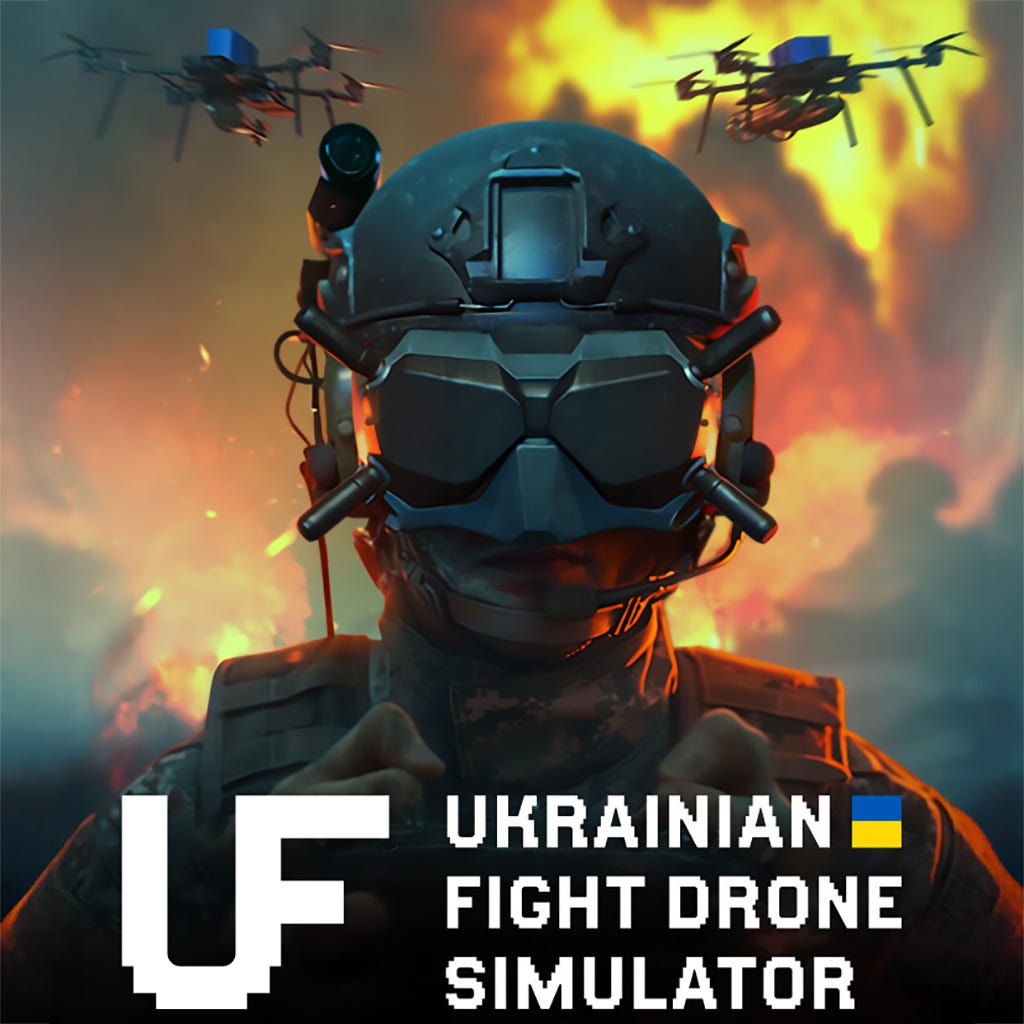
Ukrainian Fight Drone Simulator is not a comfortable game, nor does it attempt to be. From its title alone, it signals intent: this is a simulation rooted in modern conflict, drawing directly from real-world warfare that remains ongoing and politically charged. Unlike many military games that abstract conflict into spectacle or power fantasy, Ukrainian Fight Drone Simulator positions itself as something colder, more procedural, and far less romantic.
The result is a game that feels less like traditional entertainment and more like an interactive systems exercise—one that asks players to engage with modern drone warfare in a stripped-back, almost clinical manner. Whether that makes it compelling or problematic will depend heavily on player expectations.
Presentation and Tone
Visually, Ukrainian Fight Drone Simulator is utilitarian by design. Environments are functional rather than cinematic, often composed of open terrain, damaged infrastructure, and sparse urban or rural spaces. Texture work and lighting are serviceable rather than impressive, but the presentation suits the subject matter. This is not a game interested in dramatic sunsets or heroic framing. Everything feels deliberately muted, grounded, and observational.
User interface elements follow the same philosophy. HUD overlays resemble real-world drone feeds, complete with data readouts, targeting indicators, and camera distortion. The screen often feels cluttered, but intentionally so—replicating the cognitive load of operating surveillance or combat drones rather than presenting clean, player-friendly visuals.
This approach reinforces the game’s tone: detached, procedural, and emotionally distant. There is little narrative framing, no characters to bond with, and no attempt to contextualise events through storytelling. The game simply presents tasks and systems, leaving interpretation to the player.
Core Gameplay and Mechanics
At its heart, Ukrainian Fight Drone Simulator focuses on the operation of various combat and reconnaissance drones. Players are tasked with piloting unmanned aerial vehicles, managing altitude, speed, camera angles, and payload deployment while responding to environmental and tactical constraints.
Controls lean toward simulation rather than accessibility. Movement is deliberate and often unforgiving, particularly for players unfamiliar with flight-style control schemes. Precision matters, and small mistakes—misjudging distance, drifting too low, lingering too long over a target—can result in mission failure.
The game places significant emphasis on situational awareness. You are not simply flying toward objectives; you are monitoring feeds, scanning terrain, identifying threats, and making calculated decisions under pressure. This creates a constant sense of tension, even during quieter moments, as the player is always aware that exposure or hesitation can be costly.
Combat Without Glamour
Combat in Ukrainian Fight Drone Simulator is notably restrained. There are no bombastic explosions or exaggerated feedback loops. Strikes are quick, efficient, and often unsettlingly understated. Targets are identified, confirmed, and neutralised with minimal fanfare.
This lack of spectacle is one of the game’s most defining characteristics. Where other military titles glorify destruction, this simulator presents it as a mechanical outcome of system inputs. Pressing a button results in an action, and the game moves on. There is no score multiplier, no triumphant audio cue—only task completion or failure.
For some players, this restraint will feel refreshingly honest. For others, it may feel emotionally hollow or even uncomfortable. The game makes no effort to moralise, but its realism implicitly raises questions about distance, responsibility, and the nature of modern warfare.
Mission Structure and Progression
Missions are structured around specific operational goals: reconnaissance, target identification, strike execution, or area monitoring. Objectives are clearly defined, but the path to completion often requires patience and discipline.
Progression is functional rather than rewarding. New drones, tools, or mission types unlock gradually, but there is little in the way of traditional incentives. No flashy upgrades, no narrative milestones, and no sense of power escalation. Instead, progression is measured through player competence—missions become more complex, requiring tighter control and faster decision-making.
This design reinforces the simulator’s identity but also limits its appeal. Players accustomed to constant rewards or variety may find the experience repetitive over longer sessions, particularly once the core systems are understood.
Sound Design and Immersion
Sound design is subtle and effective. Mechanical hums, signal noises, and environmental ambience dominate the audio landscape. Music is minimal or absent, allowing operational sounds to take precedence.
This restrained audio approach enhances immersion, particularly during high-stakes moments where silence becomes oppressive. The absence of dramatic scoring further distances the experience from traditional military games, reinforcing its procedural tone.
However, this minimalism can also make extended sessions feel emotionally flat. Without dynamic audio variation, the experience risks blending together, especially for players not deeply invested in the simulation itself.
Ethical Weight and Player Reception
It is impossible to discuss Ukrainian Fight Drone Simulator without acknowledging its subject matter. By drawing so directly from a real and ongoing conflict, the game occupies an uneasy space between simulation and commentary.
The developers appear to approach the topic with seriousness rather than exploitation, but the lack of contextual framing means the experience can feel stark, even detached. Players are left alone with the mechanics and implications, which may be intentional—but it also places a burden on the audience to decide how they feel about participating in such scenarios.
This will inevitably limit the game’s audience. Ukrainian Fight Drone Simulator is not casual entertainment, nor is it designed to be. It is a niche title aimed at players interested in modern military technology, simulation systems, and grounded representations of conflict.
Technical Performance
From a technical standpoint, the game is generally stable, though modest in scope. Performance is consistent, and systems behave predictably, which is crucial for a simulator of this type. Visual polish is secondary to functionality, and while rough edges exist, they rarely interfere with gameplay.
Final Verdict
Ukrainian Fight Drone Simulator is a challenging, sobering, and highly specialised experience. It rejects spectacle in favour of realism, strips away narrative comfort, and asks players to engage with modern drone warfare in a direct, unemotional way.
For players seeking a thoughtful, systems-driven simulation with contemporary relevance, it offers a compelling—if unsettling—experience. For those looking for action, escapism, or traditional military gameplay, it will likely feel cold and uninviting.
This is not a game that entertains in the conventional sense. It informs, simulates, and unsettles. Whether that makes it worthwhile depends entirely on what you expect from interactive media—and how willing you are to engage with its implications.