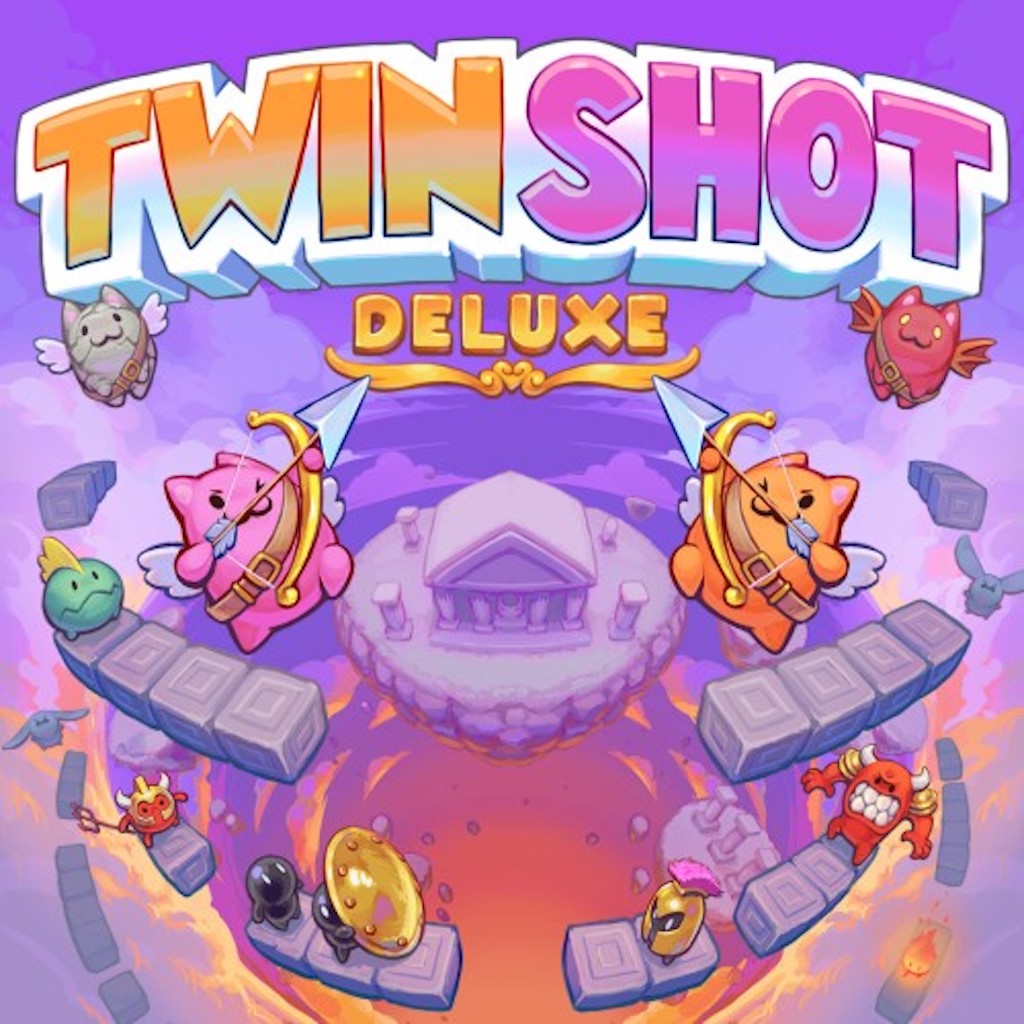
There is a certain kind of game that feels as if it was never meant to disappear. Not because it is ambitious or sprawling, but because it understands something fundamental about play. Twin Shot Deluxe is exactly that kind of return. A clean, confident revival of a 2009 arcade platformer that once lived in browser tabs and school computer labs, now rebuilt with care rather than reinvention.
Developed and published by Nitrome Limited, this remaster brings Twin Shot back as the first entry in the Nitrome Classics series. It is not a reinterpretation of the original so much as a preservation of it, updated just enough to sit comfortably on modern hardware without losing the immediacy that made it a cult favourite.
You still play as angel cats armed with bows. You still leap through compact levels filled with hazards, enemies, and environmental traps. And you still die often in ways that feel equal parts unfair and entirely your fault. That core loop has not been softened. If anything, it has been sharpened.
A Simple Loop That Refuses to Fade
At its heart, Twin Shot Deluxe is built on movement and reaction. You fire arrows, you dodge danger, you navigate tight platforming spaces where timing matters more than complexity. There are no sprawling systems to learn, no layered mechanics to unravel. Just clean inputs and immediate consequences.
What is surprising is how well that simplicity holds up. Even after years of more elaborate platformers, there is something refreshing about a game that trusts you to understand it within seconds. You see an obstacle, you respond. You fail, you try again. There is no friction between intention and action.
Later levels increase the pressure rather than the complexity. Hazards become denser, timing windows tighter, and coordination more demanding. But the language of the game never changes. It simply asks you to speak it faster.
Multiplayer Mayhem That Still Feels Untamed
If Twin Shot Deluxe has one defining strength, it is its local multiplayer. This is where the game stops feeling like a preserved classic and starts feeling alive in the present.
Up to four players can jump in, either cooperating or competing, and the result is usually controlled chaos. Platforms collapse under shared mistakes. Arrows fly across the screen in unintended directions. Someone always ends up responsible for something they swear was an accident.
The new “Tag” mode is a standout addition. It turns the core mechanics into a pursuit-driven scramble where momentum matters more than precision. Matches rarely settle into clean patterns. Instead, they spiral into unpredictable exchanges of survival and sabotage.
What makes it work is how quickly the game recovers from chaos. Rounds are short, resets are instant, and nothing lingers long enough to feel punishing. It is designed for laughter as much as for competition, and it succeeds at both.
Modern Touches Without Overcorrection
Many remasters struggle with balance. They either change too much or too little. Twin Shot Deluxe avoids both extremes by focusing almost entirely on refinement.
The improvements are technical rather than structural. Performance is smooth, controls are fully remappable, and the aspect ratio has been properly adapted for modern screens. Audio has been cleaned up, but not altered in a way that strips away its original character.
Even the expanded content feels carefully measured. Over 200 levels now span four worlds, including a new Atlantis-themed environment that blends naturally into the existing structure. It adds variety without disrupting the rhythm. Nothing here feels unnecessary. Everything feels considered.
The Strength of Straightforward Design
There is a temptation to mistake simplicity for limitation, but Twin Shot Deluxe makes a strong case for simplicity as clarity. The game never overwhelms you with systems or secondary mechanics. It stays focused on execution.
That focus creates a rhythm that becomes surprisingly engaging over time. Levels are short but dense with intent. You are not learning new mechanics so much as refining your responses to familiar ones under increasingly tight conditions.
This will not appeal to everyone. Players seeking mechanical evolution or long-term progression systems may find it repetitive. But for those who enjoy mastery through repetition, there is a quiet satisfaction in how cleanly the game delivers its challenges.
Visuals That Prioritise Readability Over Flash
The visual identity of Twin Shot Deluxe remains one of its strongest assets. Nitrome’s original art style has been refined rather than replaced, preserving its charm while improving clarity and fluidity.
Characters are expressive without being cluttered. Environments are detailed yet never noisy. Every hazard is legible at a glance, which is essential in a game built around split-second reactions.
The new Atlantis world is the most visually distinct addition, introducing cooler tones and layered backgrounds, while still respecting the overall design philosophy. Nothing exists purely for decoration. Everything serves gameplay clarity.
Sound That Knows Its Place
Audio design is understated yet effective. Sound effects carry just enough weight to make actions feel responsive without overwhelming the senses. Arrows hit with a clean snap, hazards feel distinct, and movement always has audible feedback.
The soundtrack leans into a light arcade energy, cycling between upbeat momentum and subtle tension. It is not designed to stand out. It is designed to keep you moving.
Final Verdict
Twin Shot Deluxe is a remaster that understands its identity. It does not attempt to modernise itself beyond recognition, nor does it cling rigidly to the past. Instead, it preserves what worked and smooths out what did not need to be there in the first place.
Its strength lies in immediacy. You can pick it up and understand it within moments, though mastery still takes time. Its multiplayer remains chaotic, unpredictable, and genuinely fun in a way few modern platformers can replicate.
It is not a deep or complex experience, and it does not pretend to be. But it is a focused one, and that focus is what makes it endure. For returning fans, it is a faithful revival. For newcomers, it is a reminder that simplicity, when done well, does not need embellishment.