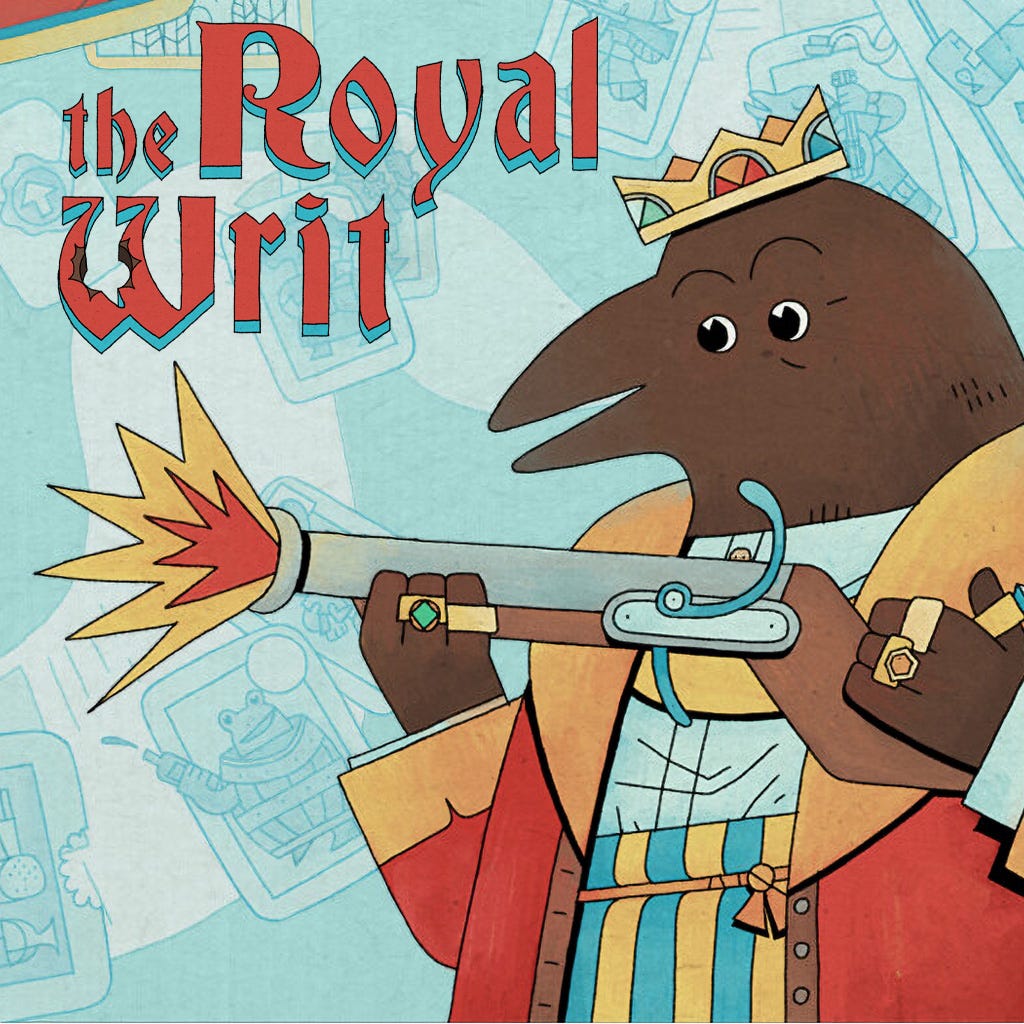
There are plenty of deckbuilders where your cards represent spells, weapons, abilities or mysterious powers. The Royal Writ takes a rather more personal approach. Here, every card represents one of your loyal subjects, and when you send them into battle, you are not simply playing a card. You are effectively sending a tiny animal warrior marching towards certain danger in the name of the crown. Naturally, the game treats this with considerably more humour than you might expect.
Developed by Save Sloth Studios and published by Yogscast Games, The Royal Writ is a wonderfully strange tactical roguelike deckbuilder that manages to make its central idea both charming and surprisingly ruthless. Your army consists of adorable animals with wonderfully silly personalities, but the battles themselves can be anything but cute. Every decision has consequences because a unit that reaches the enemy base and scores damage is permanently removed from your deck for the rest of the run. Victory therefore comes with a price, and sometimes the best strategy is to knowingly sacrifice one of your favourite soldiers for the greater good of the kingdom.
It is an idea that sounds simple when explained, yet becomes increasingly fascinating the more you play. The Royal Writ is constantly asking you to consider the value of a card, not just in terms of its abilities, but also in terms of how much you are willing to lose to secure victory.
Marching Into Battle
The Royal Writ’s battlefield is where the game really finds its personality. Rather than simply selecting cards and watching numbers appear above an enemy’s head, you deploy your animal warriors into lanes and watch them physically advance towards the opposing stronghold. Positioning matters enormously because the battlefield is filled with hazards, bonuses and environmental obstacles that can completely change the outcome of an encounter.
There is something wonderfully satisfying about watching a carefully assembled group of animals slowly make its way across the battlefield. One unit might be incredibly powerful but vulnerable, while another may have an unusual ability that makes it perfect for dealing with a particular obstacle. The challenge comes from understanding how your cards work together rather than relying on a single overpowered unit to carry the entire army.
The game also does a great job of making the battlefield feel like a place rather than simply a collection of spaces on a grid. Pits, poison swamps and other environmental hazards force you to consider where you deploy your troops and when you should move them forward. Suddenly, that seemingly harmless lane can become a death trap, and the clever little strategy you had planned can fall apart in spectacular fashion.
Heroes, Fools and Sacrificial Lambs
The animal army is arguably the star of the show. The Royal Writ has clearly had enormous fun coming up with its cast of ridiculous warriors, and that sense of humour carries through into their abilities and descriptions. You can find yourself relying on a wounded flamingo, a short sighted chicken archer or a lizard that has the rather useful ability to cheat death by sacrificing its tail.
Then there are the red ants, sacrificial lambs and all manner of other bizarre creatures that make up your increasingly eccentric army. The individual personalities give the cards a sense of character that many deckbuilders simply do not bother attempting. You start remembering particular units, which makes their eventual sacrifice surprisingly meaningful.
That is perhaps the game’s greatest trick. It is difficult to become emotionally attached to a playing card, yet The Royal Writ manages it. When a particularly useful animal reaches the enemy base and disappears from your deck, there is a genuine sense of loss. Of course, you could always replace them with another ridiculous creature, but that does not necessarily make watching your favourite soldier march to its doom any easier.
Sacrifice Has Never Been So Funny
The permanent card loss system is the mechanic that gives The Royal Writ its distinctive identity. Most deckbuilders encourage you to accumulate increasingly powerful cards throughout a run, turning your deck into an increasingly formidable collection of abilities. Here, however, success can actively make your deck smaller.
That creates some fascinating decisions. Do you send a powerful unit towards the enemy base and accept that you will never see it again, or do you hold onto it because its abilities could be vital later? Sometimes the answer is obvious, but often it is not. The best decision can depend entirely on what you expect to face in the next encounter.
It also makes every run feel like it is telling its own little story. A particular animal might become the unlikely hero of several battles before eventually making the ultimate sacrifice. Another might barely survive long enough to contribute anything useful. The game does not need elaborate cutscenes to create these stories because the mechanics naturally generate them.
The Kingdom Gets Stranger
The journey between battles is just as entertaining. The Royal Writ fills its world with peculiar characters and strange encounters, creating the feeling that you are travelling through a medieval kingdom where absolutely nobody is quite behaving normally. You might encounter a goat tactician, an impatient boar running a shop or even the wonderfully bizarre mantis dentist.
These encounters are more than amusing distractions. They can offer useful upgrades, relics and opportunities to alter your deck, giving you another reason to explore rather than simply marching from one battle to the next. The uncertainty of what you might discover adds nicely to the roguelike structure.
Relics are particularly important because they can fundamentally change the way your army operates. Finding the right combination can turn a mediocre collection of animals into a surprisingly efficient fighting force. As with any good roguelike deckbuilder, there is a lovely moment when the pieces suddenly click into place and you realise that your latest collection of ridiculous creatures has become far more powerful than it has any right to be.
Two Campaigns, Two Very Different Problems
The Royal Writ offers two campaigns, and they provide a welcome change of pace from one another. The first focuses on a rebellion within the kingdom, sending your army across environments filled with hazards and increasingly dangerous opposition. There is also a developing mystery beneath the surface, suggesting that the problems facing the kingdom may not be quite as straightforward as the royal propaganda would have you believe.
The second campaign introduces gunpowder, which naturally makes everything considerably more dangerous. Suddenly, it is not just about navigating environmental hazards and positioning your units correctly. Bullets enter the equation, forcing you to rethink your approach and react to a battlefield that feels considerably more hostile.
The two campaigns help prevent the central mechanics from becoming stale, while the different cards, bosses and challenges give each adventure its own identity. There is also a gradual difficulty curve and additional challenge modes for those who become sufficiently obsessed with mastering the system.
A Picture Book With a Dark Sense of Humour
Visually, The Royal Writ is a delight. Its hand drawn, picture book style gives the game an instantly recognisable personality, with expressive animals and colourful environments that contrast wonderfully with the often rather grim business of sending your subjects to their deaths.
The artwork never takes itself too seriously, which is exactly what the game needs. A serious medieval strategy game populated entirely by animals would be amusing enough, but The Royal Writ goes considerably further by giving those animals ridiculous personalities and putting them into increasingly absurd situations.
The audio presentation complements the visuals nicely. The soundtrack provides a suitably playful medieval atmosphere, helping maintain the game’s cheerful personality even when the battlefield becomes an absolute disaster. It is a good example of presentation serving the gameplay rather than trying to overwhelm it.
A Deckbuilder With a Personality of Its Own
What makes The Royal Writ stand out is not simply that it combines cards with tactical movement. There are plenty of games doing interesting things with the deckbuilder formula these days. What makes this one memorable is the way its mechanics, presentation and humour all reinforce the same central idea.
You are a monarch. Your cards are your subjects. You send them into battle, watch them fight and sometimes knowingly sacrifice them because doing so benefits the kingdom. The game then has the cheek to present all of this through a wonderfully charming storybook aesthetic populated by flamingos, chickens, goats, boars and other creatures who probably should never have been trusted with military responsibilities.
It is ridiculous, but it is also surprisingly strategic. Beneath the humour is a game that demands planning, adaptation and a willingness to accept that sometimes your best card needs to die so that the rest of your army can survive.
Final Verdict
The Royal Writ is a refreshing addition to the roguelike deckbuilder genre and one that manages to establish its own identity remarkably quickly. The lane based combat works beautifully with the card system, while permanent card loss creates a constant sense of tension that keeps you thinking about every decision.
The animal characters provide the game’s heart, while the bizarre encounters and dark humour give it a personality that is difficult to resist. It can be punishing when a run goes badly, and the randomness inherent in any roguelike deckbuilder can occasionally leave you feeling as though the kingdom itself has decided to conspire against you. Yet those frustrations are part of what makes a successful run feel so satisfying.
Most importantly, The Royal Writ understands that strategy does not have to be completely po faced. Sometimes the best way to create a memorable tactical game is to populate it with adorable animals, give them increasingly ridiculous abilities and then make you genuinely care about them before asking you to send them off to their glorious doom.
Long live the king. Long live the fallen. And perhaps spare a thought for that poor flamingo who never made it home.