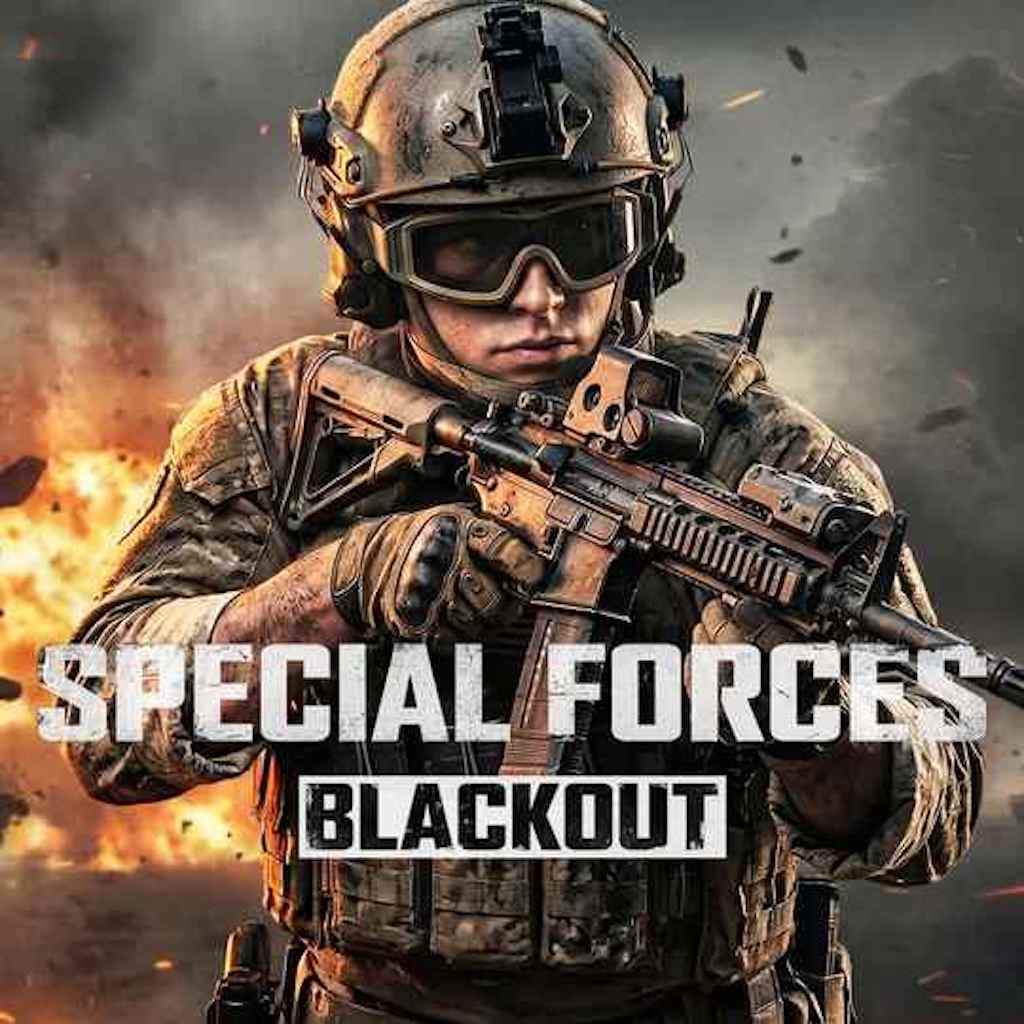
There is something undeniably appealing about a good military shooter. Give me a rifle, a dangerous battlefield, a few objectives, and the freedom to make things explode, and I am usually quite happy to get stuck in. Special Forces: Blackout clearly wants to tap into that appeal, positioning itself as a next-generation tactical FPS in which elite soldiers battle through a war-torn Middle Eastern city while futuristic military technology threatens to trigger global catastrophe. It sounds wonderfully ambitious on paper, promising huge battlefields, tactical freedom, vehicles, tanks, specialist classes, and photorealistic visuals. Unfortunately, what we actually get is a much more modest shooter that struggles to match the scale and ambition of its own marketing.
Developed and published by FORZA GAMES, Special Forces: Blackout drops players into a city consumed by fire, smoke, and sandstorms. A mysterious armed force has seized control of a major energy hub and entrenched itself in an old underground military facility, where it intends to activate the devastating Apophis System. With the world’s major powers unwilling to intervene openly, a group of secret elite agents is sent into the chaos to stop the weapon from being activated. It is a suitably dramatic premise for a military shooter, though the story ultimately feels more like a backdrop for shooting things than a compelling reason to keep pushing forward.
Into The Heart Of The Battlefield
The opening moments aim to establish an atmosphere of desperation. Burning buildings, dusty streets and ruined military installations create the impression of a city that has been through hell, while the constant threat of enemy soldiers gives the player a clear sense of purpose. There is a potentially interesting game hiding within this setup, particularly the idea of conducting covert operations in an environment where visibility is constantly disrupted by smoke and sand.
The trouble is that Special Forces: Blackout rarely capitalises on that premise. Rather than presenting the player with a genuinely open battlefield where decisions have meaningful consequences, most of the action unfolds along fairly predictable routes. You move through streets, corridors and underground facilities, encounter groups of enemies and clear the area before advancing towards the next objective.
That is not necessarily a problem for a straightforward arcade shooter, but it clashes badly with the game’s claims of tactical freedom. There is very little sense that you are actually planning an infiltration or choosing your own approach to an objective. The game instead feels much more comfortable when it stops pretending to be a military simulation and simply lets you shoot your way through another room.
Four Classes, One Basic Approach
Special Forces: Blackout offers four character classes to introduce tactical variety. Assault, Engineer, Support and Recon each come with their own equipment and weapons, theoretically allowing players to choose a role that suits their preferred style of combat. It is a sensible foundation and certainly the sort of feature you would expect to find in a modern squad-based shooter.
Unfortunately, the classes do not have enough depth to make choosing between them particularly meaningful. The differences are largely tied to their equipment rather than fundamentally changing the way you approach an encounter. There is no sophisticated team system that requires you to coordinate abilities, manage ammunition or build a carefully balanced squad.
Consequently, playing as one class can often feel much like playing as another. The weapons may differ, but the underlying gameplay remains largely unchanged. A deeper system of class interactions could have made the tactical side of the game much more interesting, particularly if Engineer abilities could alter the battlefield or Recon equipment could provide genuinely useful intelligence.
Shooting Through The Sandstorm
At its core, Special Forces: Blackout is a shooter, and thankfully the basic act of pulling the trigger is at least functional. Weapons respond quickly enough, and enemies generally react when hit, allowing you to move through encounters without wrestling with completely broken controls. There is an immediate arcade quality to the gunplay that makes it easy to pick up.
The problem is that there is very little substance beneath that basic functionality. Weapon recoil is minimal, enemy encounters tend to follow familiar patterns, and there is little need to think about ammunition, positioning or realistic ballistics. Instead, most firefights boil down to finding cover, pointing your weapon at the enemy and continuing to fire until the opposition disappears.
That can still be enjoyable in short bursts. Sometimes there is nothing wrong with an uncomplicated shooting gallery, particularly when you are in the mood for something that does not demand too much of you. The issue here is that the game repeatedly tells you it is something much more sophisticated, making the simplicity of the actual combat feel less like an intentional design decision and more like a limitation.
Where Are The Open Battlefields?
Perhaps the biggest disappointment is the gap between the advertised experience and what is delivered. Special Forces: Blackout promises an enormous open battlefield where players can forge their own routes and shape how engagements unfold. That sounds like a fantastic proposition, especially when combined with vehicles and multiple specialist classes.
In practice, the environments are considerably more restrictive. The desert city may look sizeable from a distance, but the playable spaces generally funnel you through linear streets, corridors and enclosed facilities. There are occasional moments that suggest freedom, but the overall experience is much closer to a traditional corridor shooter.
This makes the game’s tactical promises particularly difficult to swallow. There is little opportunity to flank an enemy position, establish a long-range vantage point, or decide whether to attack from above or below. The game largely tells you where to go, who to shoot and what to destroy, leaving very little room for the kind of emergent battlefield decisions its description suggests.
Tanks And Vehicles
Vehicles are another feature that sounds considerably more exciting than it ultimately proves to be. The idea of taking control of modern military machinery and using mobility to seize strategic positions could have provided a welcome change of pace from the infantry combat.
Instead, the vehicle sequences are brief and heavily scripted. They function more as interruptions to the standard shooting sections than as fully developed systems of their own. There are moments when controlling a tank or manning a powerful turret provides a satisfying sense of destruction, but these sequences are over before they have a chance to become particularly memorable.
That is a shame, because the combination of infantry combat and vehicle warfare could have been one of the game’s strongest features. A more ambitious implementation might have allowed players to choose when and where to deploy vehicles, giving them genuine strategic value. Here, they feel more like arcade set pieces.
A Battlefield That Struggles To Look Next Generation
The visual presentation is where the game’s ambitions arguably fall furthest short. The description promises photorealistic next-generation graphics capable of delivering overwhelming immersion, but the reality is much more modest. Environmental assets lack the detail you would expect from a modern military FPS, character models are repetitive, and animations can look stiff.
The war-torn environments occasionally manage to create a convincing atmosphere, particularly when fire, dust and smoke combine to make an area feel suitably hostile. There are flashes of a more attractive game buried beneath the rougher assets. Unfortunately, muddy textures, visible pop-in and generally low detail prevent the presentation from achieving the realism it promises.
This is especially noticeable during quieter moments, when there is less action to distract you from the environment. Instead of feeling like you are exploring a living battlefield, you are often reminded that you are moving through a collection of game spaces designed to funnel you towards the next firefight.
Sound That Rarely Finds Its Rhythm
The audio does little to rescue the presentation. Gunfire is functional but lacks the punch and weight you would expect from a game trying to sell itself as a realistic modern military experience. Weapons simply do not have the sonic presence needed to make combat feel genuinely dangerous.
Enemy voices and alert calls also become repetitive fairly quickly. The same warnings and reactions crop up often enough to feel like background noise rather than part of a living combat environment. The music adds some atmosphere, but it is fairly generic and rarely creates the kind of tension you would associate with a desperate special forces operation.
Good sound design can make even relatively simple graphics feel more convincing. Unfortunately, Special Forces: Blackout misses that opportunity, leaving both its visual and audio presentation feeling decidedly underpowered.
The Problem With Promises
There is a perfectly serviceable arcade shooter hiding inside Special Forces: Blackout. Strip away the talk of next-generation realism, limitless battlefields and deep tactical cooperation, and what remains is a basic FPS that lets you run around, shoot enemies, complete objectives and occasionally climb into a vehicle.
The problem is that games should ultimately be judged by what they deliver, and the gap between the pitch and the finished product is simply too large here. Players expecting a tactical military experience are likely to be disappointed by the linear missions, basic classes and shallow combat. Even those approaching it as a budget shooter may find the repetition and technical roughness difficult to overlook.
There is certainly an audience for uncomplicated shooters, and Special Forces: Blackout is not completely devoid of entertainment. Put it on for a short session, and there are moments when blasting through a bunker or taking control of a tank can provide a bit of harmless arcade fun. Unfortunately, those moments are not enough to support the enormous ambitions that surround them.
Final Verdict
Special Forces: Blackout aims to be a next-generation tactical war experience, but it never comes close to delivering on that promise. The concept has plenty of potential, with its desert-city setting, futuristic military technology, specialist classes and a mix of infantry and vehicle combat providing the ingredients for something considerably more ambitious.
What we get instead is a basic budget FPS with linear environments, repetitive firefights and a presentation that looks several generations removed from the photorealistic battlefield promised in the description. The shooting is functional, and the occasional vehicle sequence adds a little variety, but neither feature has enough depth to carry the experience for long.
There is a certain guilty pleasure in simply picking up a rifle and charging through another enemy-filled corridor, and players looking for an uncomplicated arcade shooter may find a few hours of entertainment here. However, the lack of tactical depth, limited environmental freedom and technical shortcomings make it very difficult to recommend over the many stronger military shooters available today.
Special Forces: Blackout is not a disastrous idea. In fact, there is the foundation of a decent shooter buried beneath all the hype. It simply needed considerably more time, polish and ambition in the places that actually matter. The battlefield may promise to be limitless, but the game’s own limitations become apparent remarkably quickly.