There is something rather lovely about a game that can look at the remains of a vanished civilisation and see possibilities instead of despair. The Merlies takes the familiar idea of a post-apocalyptic world and turns it on its head, replacing ruined cities, bleak survival and endless misery with tiny birds, colourful landscapes and a community determined to make the best of what has been left behind. It is a gentle adventure about rebuilding, cooperation and finding value in things others might consider worthless. More than anything, it is a game that feels genuinely hopeful.
Developed by Darjeeling, Blue Ramen and ARTE France, The Merlies describes itself as a “wholesomevania”, which is a wonderfully accurate way of explaining what you are getting. There is the exploration and gradual unlocking of a Metroidvania, but without the combat that normally comes with the territory. Instead, your biggest enemies are thorns, rocks, awkward terrain and the occasional problem of simply working out where you are supposed to go next. That might sound like a small distinction, but it completely changes the rhythm of the adventure.
A Tiny World With a Big Heart
The story begins with disaster. A huge storm has scattered the Merlies across the land, leaving these tiny birds separated and vulnerable to the world around them. Your task is to explore, find your lost companions, and gradually bring the community back together.
It is a simple premise, but The Merlies does not need an epic narrative to make the journey meaningful. There is something inherently endearing about watching these little creatures work together after being thrown into such a difficult situation. They are fragile, but not helpless, and the game’s emphasis on cooperation gives the adventure a warmth that carries through almost everything you do.
The world itself is also fascinating because humanity has disappeared, leaving nature to reclaim the landscape. Rather than presenting this as a depressing vision of civilisation’s downfall, The Merlies looks at it from the perspective of creatures discovering this strange abandoned world for themselves. What might once have been an everyday human object can suddenly become an enormous piece of useful equipment.
Everything Looks Bigger When You’re Tiny
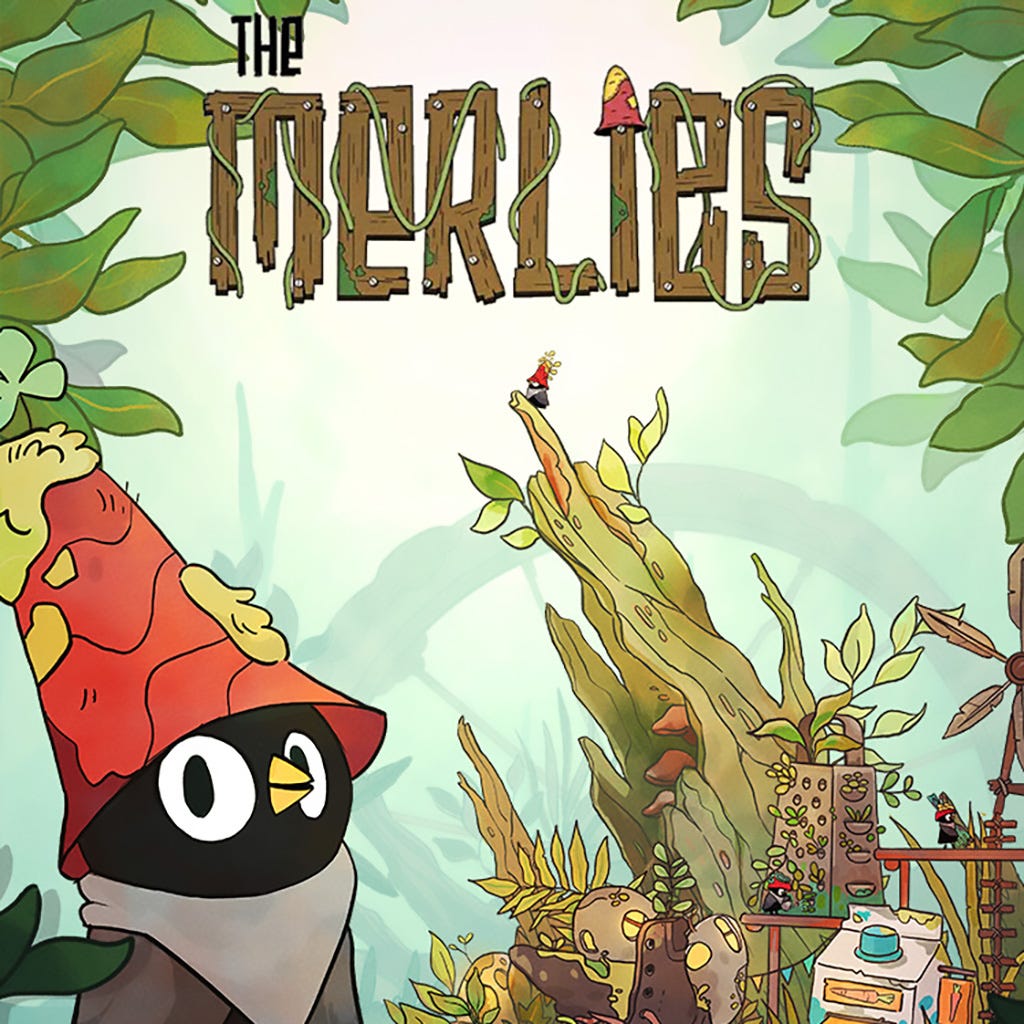
Size is one of the game’s most charming ideas. For a Merlie, an ordinary lamp can become a house, an old slate a gigantic map, and an ice cube tray a perfectly respectable storage facility. It is a lovely example of environmental storytelling, because the game rarely needs to explain how strange these objects would seem to such tiny creatures. You simply see the world through their eyes and start to understand it.
That perspective gives exploration a real sense of personality. Electric cables become climbing routes, fallen billboards become platforms, and discarded pipes become tunnels waiting to be investigated. Mushrooms can launch your little birds upwards, while seemingly insignificant pieces of human junk can hide an entire new route.
There is a childlike quality to the way The Merlies looks at the world, and I mean that as a genuine compliment. It captures the feeling of looking at an everyday object and imagining it as something completely different. The game understands that wonder often comes from perspective, and its tiny heroes make an ordinary abandoned landscape feel surprisingly magical.
A Metroidvania Without the Violence
The most interesting thing about The Merlies is perhaps what it leaves out. There are no enemies waiting around corners, no weapons to collect, and no boss battles standing between you and the next region. Instead, progression comes from expanding your little squad and making use of the different abilities your Merlies bring to the adventure.
That changes the entire experience. You are not exploring because you expect something to attack you. You are exploring because you are curious about what lies around the next corner. A previously inaccessible passage might suddenly become reachable once you have the right bird with you, creating that familiar Metroidvania satisfaction without requiring a single punch, sword swing or projectile.
There is still a sense of challenge, particularly when the environment itself starts getting in your way. A thorn can be just as important as a monster in a game like this because your Merlies are deliberately fragile. Losing one of your companions gives those seemingly harmless obstacles a little more significance, even if the overall experience remains wonderfully relaxed.
Learning to Work Together
The individual abilities of the Merlies are central to exploration, and this is where the game finds some of its most satisfying moments. Rather than relying on a single all-purpose protagonist who eventually becomes capable of doing everything, your progress depends on understanding what each member of your growing community can contribute.
That gives the group a sense of identity. You begin to think of your Merlies as a little team rather than simply a collection of interchangeable characters. Finding another member of the community is therefore more than ticking something off a list. It expands what you can do and gives you another reason to return to areas you have already explored.
The design also encourages patience. You are not constantly being told exactly where to go or bombarded with objective markers, and sometimes the pleasure comes from recognising that something that previously looked decorative is actually part of a route. The game trusts you to look around, experiment and make connections for yourself.
Building Something From Nothing
Exploration is only part of the experience because The Merlies also gives you a village to develop. As you discover scraps from the remains of human civilisation, you can use them to construct and decorate your community, creating a home for the birds you have rescued.
The recycling theme could easily have become a heavy-handed environmental lecture, but thankfully it does not. Instead, the game presents reuse and upcycling as simply the sensible thing to do when you are a tiny bird living in a world filled with abandoned human objects. A discarded item is not rubbish if it can become a roof, a shop, a storage area or a place for your community to gather.
There is something particularly satisfying about that idea because it mirrors the game’s broader philosophy. The Merlies do not need vast resources or advanced technology to rebuild. They need one another, a little creativity and the willingness to see potential in what is already there.
A Bright Take on the End of the World
The term “solarpunk” is increasingly useful for describing The Merlies, because it is a post-apocalyptic setting without the misery normally associated with the genre. Humanity is gone, nature is reclaiming the world, and the remnants of our civilisation are scattered across the landscape, yet the atmosphere is remarkably comforting.
There is no obsession with explaining exactly how civilisation collapsed or filling every corner with tragedy. Instead, the game focuses on what happens afterwards. Nature is healing, the Merlies are rebuilding, and the emphasis is on cooperation rather than competition.
That optimistic perspective gives the game its emotional identity. The world may be the remains of something that has ended, but it is also the beginning of something new. Watching the Merlies create their own little society from the scraps of the old one is surprisingly uplifting.
A Storybook Come to Life
Visually, The Merlies is beautiful in a deliberately handcrafted way. The artwork draws heavily on graphic novels and children’s picture books, giving the environments a warmth that would be difficult to achieve with a more conventional visual style.
There is a softness to the presentation that perfectly complements the game’s subject matter. Colours, shapes and character expressions all contribute to the feeling that you are wandering through an illustrated storybook rather than a conventional platform adventure.
The narration and overall presentation enhance that feeling, giving the journey a gentle storytelling quality. It is the sort of game where you can imagine settling down with a cup of tea and simply allowing yourself to be carried along by the atmosphere.
When Gentle Means Very Gentle
Of course, The Merlies will not appeal to everyone. Players who crave combat, constant danger, or a demanding challenge may find the lack of traditional stakes a little too passive. The platforming can also occasionally feel loose, particularly when precise movement matters, and there are moments when the path forward is not immediately obvious.
Yet I am not convinced these are necessarily flaws in the traditional sense. They are more accurately the consequences of a game that has deliberately prioritised relaxation and discovery over difficulty. The Merlies is not trying to compete with Hollow Knight or Ori in terms of mechanical intensity, and judging it by those standards would miss what makes it special.
Its greatest strength is knowing when not to push. There is room to breathe here, room to explore, and room to simply enjoy being surrounded by a world that constantly offers small discoveries.
Verdict
The Merlies is an incredibly charming little adventure with a surprisingly big heart. Its blend of exploration, environmental puzzles, village building and gentle progression creates an experience that feels welcoming from the moment you meet its tiny feathered heroes. The lack of combat will inevitably make it a more specialised experience, but for players who enjoy cosy exploration and games that prioritise atmosphere over adrenaline, that restraint is part of the appeal.
What really stayed with me is the game’s attitude to the world it presents. This is technically a post-apocalyptic adventure, but there is very little doom and gloom. Instead, The Merlies looks at what remains and asks what can be built from it. There is something beautiful about that message, especially in a world where games so often treat the end of civilisation as an excuse for misery.
The result is an adventure that feels almost like a warm illustrated story you can step into. The Merlies are tiny; their world is enormous, and the obstacles in front of them can sometimes seem daunting, but together they find ways forward. That spirit of cooperation is ultimately what gives the game its soul.
The Merlies may not offer the complexity or challenge of a traditional Metroidvania, but it does something considerably more unusual. It creates a peaceful, optimistic adventure about resilience, friendship and making something beautiful from what has been left behind. Sometimes, that is more than enough.