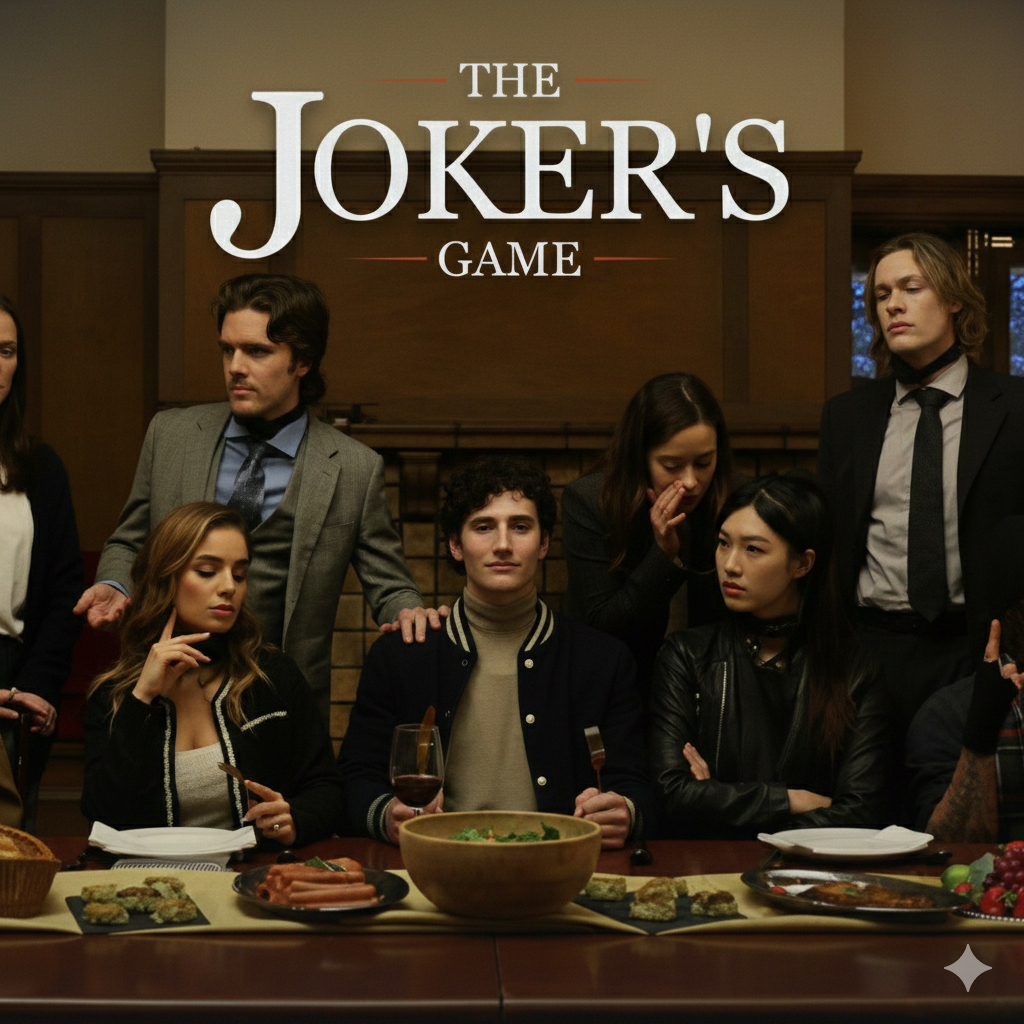
From the moment the title screen ignites — bold typography against a backdrop of unsettling ambience — The Joker’s Game makes one thing abundantly clear: this is a game designed to disturb, to provoke, and to challenge players not through physical contest but through psychological tension. Developed by All In Game Co, The Joker’s Game presents itself as a narrative-driven psychological thriller that blends moral ambiguity, puzzle mechanics, and unsettling narrative choices into a cohesive but thematically abrasive experience. At its core, this is a game about manipulation, uncertainty, and the uneasy spaces between reason and absurdity — a structure that rewards patient engagement but risks alienating players seeking more traditional gameplay rhythms.
Like all ambitious psychological thrillers, The Joker’s Game succeeds when it maintains atmosphere and tension; it falters when it prioritises style over substance. In the round that follows, we explore how its narrative ambition, mechanics, pacing, and thematic resonance coalesce into a unique if uneven interactive experience.
Narrative Premise and Thematic Ambition
The Joker’s Game opens with a deceptively simple conceit: you awaken in a locked room with no memory, a cryptic message from an enigmatic figure known only as “The Joker,” and a series of locked doors between you and freedom. The Joker, an unseen antagonist, communicates through a mixture of recorded messages, taunting riddles, and a livestream audience that can influence your available options. Gradually, it becomes clear that The Joker’s Game is less about escaping physical imprisonment and more about confronting moral dilemmas, logical puzzles, and the psychological frameworks that govern decision-making when the rules are in flux.
The narrative ambition here is substantial. Writers clearly intend to evoke classic psychological thrillers, where the antagonist serves less as a physical threat and more as a catalyst for introspection and ethical testing. Plot beats are interwoven with philosophical inquiry: when presented with a choice that sacrifices one group to save another, what informs your decision? Are your motives strategic, empathetic, self-preserving, or performative? The Joker’s voice, delivered through chilling audio logs, prods at these questions with a merciless blend of cynicism and theatricality.
This thematic scaffolding is the game’s greatest strength. When it works, The Joker’s Game doesn’t just challenge players — it unsettles them. It juxtaposes empathy and logic, freedom and consequence, inviting reflective engagement and making narrative tension a psychological force rather than a decorative layer.
At the same time, this ambition can outpace execution. The narrative sometimes substitutes obfuscation for depth, leading players through scenes of deliberate confusion rather than meaningful revelation. While ambiguity can be a powerful tool for psychological engagement, The Joker’s Game occasionally veers into narrative opacity that feels like a barrier rather than an invitation to reflection.
Gameplay Mechanics and Puzzle Design
From a mechanical standpoint, The Joker’s Game trades traditional action in favour of cerebral challenge. Levels are built as interconnected rooms or scenes, each presenting a blend of riddles, logic puzzles, environmental cues, and choice-based interactions. Unlike straightforward escape room games that focus purely on item collection and code cracking, this title integrates narrative context directly into puzzle structure: dialogue choices, moral dilemmas, and incomplete information alter what clues are available or how they behave.
This integration rewards players who take time to observe and interpret rather than rush toward the next objective. Puzzle design ranges from pattern recognition and symbolic logic to social deduction influenced by evolving narrative threads. Some puzzles feel truly inspired, encouraging lateral thinking and careful synthesis of clues scattered across text logs, audio fragments, and environmental detail.
Yet this complexity is also the game’s Achilles’ heel. While some players will relish the challenge, others will find the escalation steep and occasionally unsystematic. In certain segments, difficulty spikes feel less like deliberate design and more like arbitrary gates — prolonged infuriating waits for understanding rather than satisfying breakthroughs. The presence of a frequently updated hint system mitigates this to an extent, but it also undermines the weight of discovery when used too liberally.
Perhaps most importantly, puzzles often carry narrative consequence. The choices you make, and the order in which you uncover clues, can materially affect later scenes and outcomes. This design encourages replayability and invites players to revisit decisions — but it also risks confusion when narrative causality is opaque. Some plot threads feel under-elaborated or prematurely abandoned, leaving questions hanging without satisfying resolution.
Presentation, Audio, and Atmosphere
Atmosphere is where The Joker’s Game consistently excels. Visually, the game adopts a stark, moody palette that reinforces claustrophobia and unease. Rooms are meticulously detailed with contextual artefacts that enrich immersion without overwhelming the player. Lighting and shadow interact in ways that serve both aesthetic and functional purposes — subtle illumination can signal points of interest or mislead players into overconfidence.
Sound design is equally considered. Ambient audio ranges from unsettling hums to abrupt silence, heightening emotional tension. Voice-acting, especially for The Joker’s recordings, strikes a compelling balance between theatricality and menace. Music is minimalistic but judiciously applied; in moments where it emerges, the score underscores emotional beats without crowding the mix. This restraint enhances immersion and prevents sensory overload, which is crucial in a game designed around psychological engagement rather than sensory spectacle.
Pacing, Engagement, and Replayability
Pacing in The Joker’s Game is deliberately uneven — a design choice that mirrors narrative intent but also challenges player stamina. Early segments proceed briskly, encouraging curiosity and loyalty. Mid-game, however, pacing often slows as puzzles accumulate narrative weight and interpretive demands intensify. These slower stretches are fertile ground for tension, but they also risk disengagement for players accustomed to more linear progression.
That said, The Joker’s Game is not designed for a single pass. Its branching outcomes and multiple endings are tied to narrative choices and interpretive paths explored during play. Achieving alternate endings requires not only different decisions but different interpretations of the same clues — a structural form of replayability that rewards careful attention over repetition alone.
For players willing to return and explore alternate narrative threads, the game reveals layers of nuance that are not immediately apparent on first playthrough. However, the same complexity that makes replay rewarding can also make it intimidating for those seeking closure rather than open-ended inquiry.
Strengths and Limitations
Strengths:
- Psychological narrative ambition: The game’s thematic examination of morality and choice is bold and engaging.
- Atmospheric presentation: Visuals, sound design, and pacing create a palpable sense of tension.
- Integrated puzzle–narrative design: Puzzles tie meaningfully into story beats and moral themes.
- Replayability: Multiple endings and branching paths invite re-examination.
Limitations:
- Narrative opacity: Too often, ambiguity feels like obfuscation rather than insight.
- Difficulty spikes: Some puzzles lack smooth escalation or clear logical progression.
- Pacing inconsistency: Mid-game lulls may challenge player engagement without mechanical payoff.
Final Verdict
The Joker’s Game occupies an intriguing space between psychological thriller and interactive puzzle. It is a title that invites reflection, insists on attention, and — at its best — creates genuinely unnerving moments of introspection and consequence. Its narrative ambition and atmospheric execution elevate it above many contemporaries in the psychological puzzle genre. However, its uneven difficulty, narrative opacity, and episodic pacing limit its appeal to players who prize clarity and momentum over thematic depth and ambiguity.
Ultimately, The Joker’s Game is a compelling experience for those who appreciate games that challenge not just reflexes but reasoning and moral intuition. It is the kind of game that lingers after the credits roll — not because it ties every thread neatly, but because it asks questions that resist easy answers.