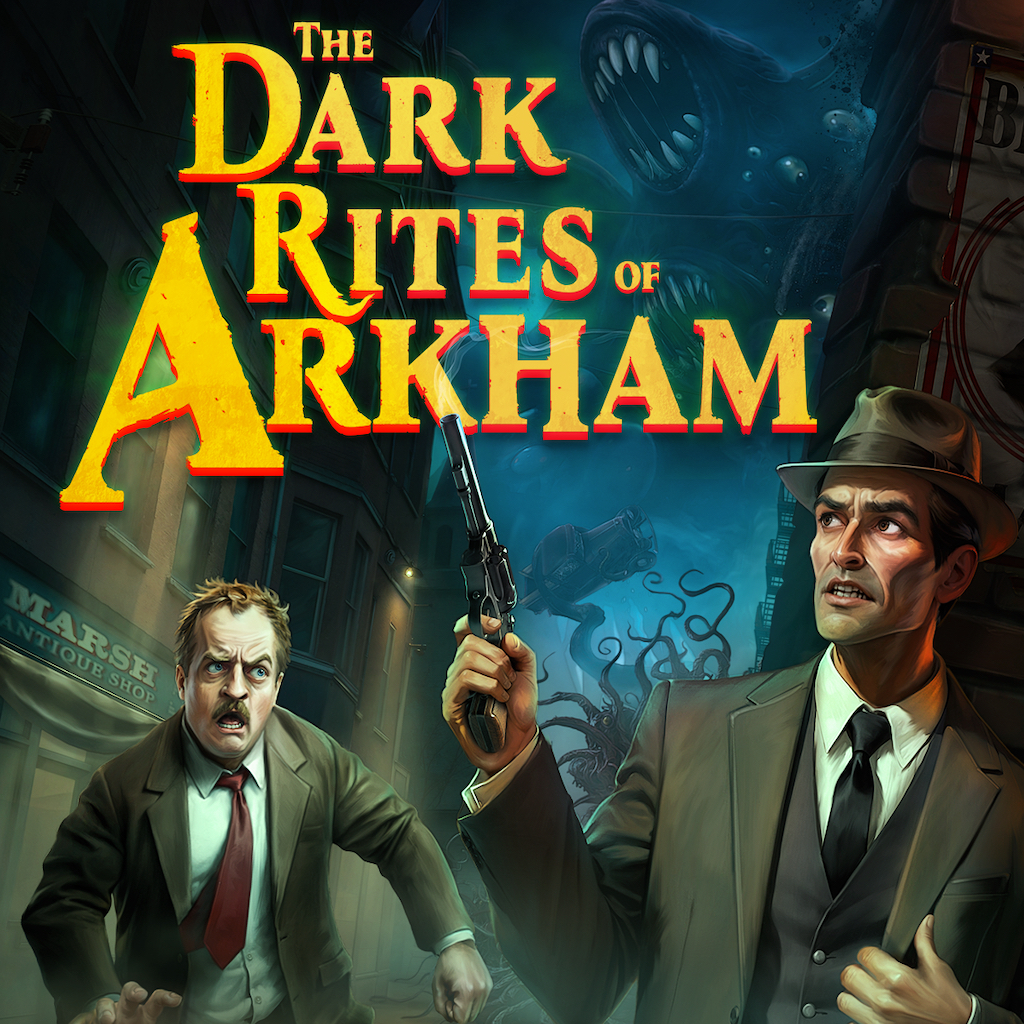
Arkham has always been a city where the rain smells like old books and bad ideas. In The Dark Rites of Arkham, Postmodern Adventures return to the point-and-click genre they explored so lovingly in Nightmare Frames and An English Haunting, but this time they trade haunted Hollywood and English folklore for full-blooded Lovecraftian dread. The result is a detective yarn that feels part 1930s pulp serial, part occult nightmare—an adventure game that understands that cosmic horror is most effective when filtered through human frailty.
You step into the shoes of Detective Jack Foster, newly returned to the Arkham Police Department after a personal trauma that’s left more scars than his superiors care to discuss. What begins as an investigation into routine political blackmail quickly mutates into something far worse: a ritual murder committed inside a sealed room, impossible by all rational accounts. Partnered with Harvey Whitman, a soft-spoken cult expert with too many books and not enough optimism, Foster descends into a case that reaches back to the Salem witch trials and forward to the possible end of the world.
Old-School Clicks, New-School Confidence
At its mechanical core, The Dark Rites of Arkham is classic inventory-driven adventuring. You explore over 70 meticulously crafted pixel-art locations, gathering clues, combining items, and interrogating a gallery of eccentrics who all seem to know more than they admit. The interface is refreshingly clean, favoring logic over moon-math; puzzles generally make narrative sense rather than feeling like sadistic brainteasers imported from another genre.
The design philosophy recalls the best of LucasArts and Wadjet Eye titles. Solutions often rely on observation and character motivation instead of arbitrary experimentation. When the game does lean into traditional adventure absurdity—using an unlikely trinket in an unlikely place—it at least has the decency to justify the leap through dialogue or environmental hints.
Exploration is the star. Arkham is portrayed not as a cliché haunted town but as a living Depression-era city: jazz leaking from bars, damp boarding houses, the scholarly gloom of Miskatonic University. Visiting the Arkham Museum of the Unusual, wandering Pickman’s grotesque gallery, or sitting in on Maxwell Fontaine’s radio show quiz about 30s horror cinema gives the world texture beyond the main plot.
Lovecraft Without the Dust
Adapting Lovecraft is a dangerous game. Too reverent and you end up with pastiche; too modern and the atmosphere evaporates. Postmodern Adventures strike a clever balance by treating the Mythos as history rather than spectacle. Familiar names—Herbert West, Keziah Mason, Doctor Carl Hill, Henry Armitage—appear not as fan-service mascots but as believable citizens with their own agendas.
The script is surprisingly humane. Foster isn’t a fearless pulp hero; he’s tired, guilty, and occasionally wrong. Whitman provides intellectual counterpoint, his academic detachment slowly cracking as the evidence mounts. Their partnership, prickly yet respectful, becomes the emotional spine of the game.
The central mystery—linking a modern murder to three witches who escaped Salem in 1693—unfolds with satisfying patience. Rather than drowning the player in tentacles early on, the narrative lets dread accumulate: a symbol here, a whispered testimony there, a painting that seems to breathe when you’re not looking.
Atmosphere You Can Almost Smell
Visually, the pixel art is sumptuous. Postmodern Adventures have a talent for lighting: streetlamps haloed by mist, museum halls glowing like underwater cathedrals, tenement rooms where wallpaper peels like old skin. Animation is restrained but expressive, letting your imagination fill the gaps in true horror tradition.
The jazzy ambient score by Matías J. Olmedo deserves special mention. Saxophones drift through alleyways, pianos tinkle in seedy lounges, and ominous drones creep in as sanity frays. The music never overpowers; it seduces, like a cultist offering tea before the sacrifice.
Sound design complements this beautifully—typewriters clack, radios hiss, rain taps windows with accusatory fingers. Played with headphones, the game achieves a moody intimacy rare in modern adventures.
Where the Stars Misalign
Not everything aligns under the same constellation. Pacing can sag in the middle chapters, with several fetch-heavy sequences that feel like padding between revelations. A few puzzles rely on period knowledge that may stump players without a hint system consult.
Dialogue, while generally strong, occasionally lapses into exposition dumps where characters lecture instead of converse. The game also commits the classic sin of point-and-click logic once or twice—solutions that make sense only after you already know them.
Technically the experience is solid, though movement speed is a tad leisurely and hotspot visibility could be clearer. None of these issues derail the adventure, but they keep it from transcendent greatness.
A Pulp Heart Beating Beneath Cyclopean Stone
What lingers is mood and character. The Dark Rites of Arkham understands that Lovecraftian horror isn’t just about monsters—it’s about curiosity turning into obsession, knowledge into infection. By filtering cosmic dread through the routines of police work—coffee, paperwork, bad jokes—the game grounds the impossible in the everyday.
Fans of narrative adventures will find a thoughtful mystery; Mythos devotees will appreciate the respectful, research-steeped approach. Most importantly, it feels like a story told by people who love the genre rather than merely borrowing its furniture.
Pros
- Rich, atmospheric pixel art with superb lighting
- Strong, humanized portrayal of Lovecraftian lore
- Logical, narrative-driven puzzles
- Excellent jazz-infused soundtrack
- Compelling detective duo with believable chemistry
Cons
- Mid-game pacing drags with fetch sequences
- Occasional obscure puzzle logic
- Expository dialogue spikes
- Movement and hotspot UX could be smoother
Final Verdict
The Dark Rites of Arkham is a confident slice of modern point-and-click horror that treats the Lovecraft mythos with intelligence rather than carnival spectacle. Its greatest strength lies in atmosphere—an Arkham that feels lived in, damp, and morally tired, populated by characters more frightened than heroic. A few pacing stumbles and old-school design quirks prevent perfection, yet the mystery pulls with the gravity of a black star. For anyone who misses adventures where story, place, and puzzle form a single ritual circle, this is an invocation worth answering. Postmodern Adventures continue to prove they’re among the most thoughtful custodians of interactive horror.