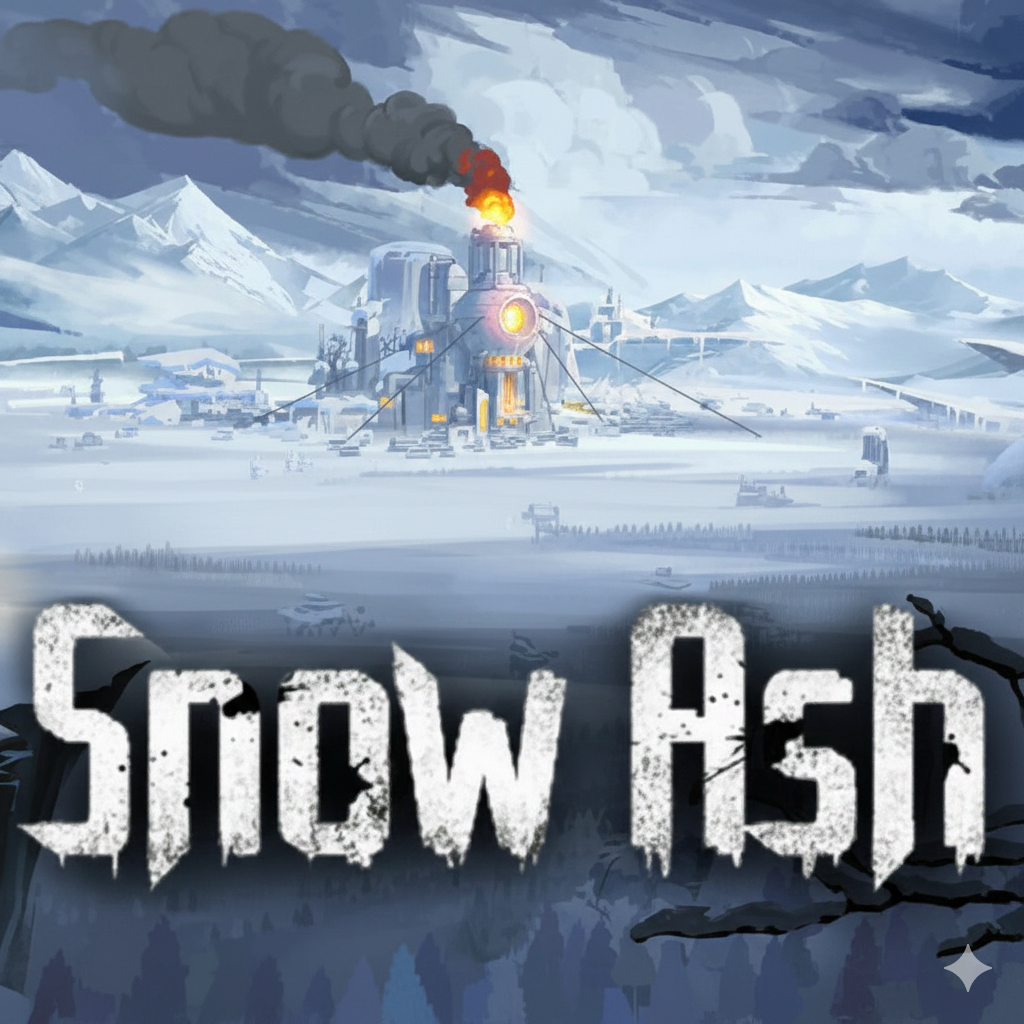
In a landscape crowded with spectacle and high-octane action, Snow Ash chooses silence instead of noise, introspection over combat, and atmosphere over spectacle. From its first steps across a frost-bitten expanse, the game announces its intent: this is not about domination or accumulation — it’s about experience, mood, and the quiet beauty that emerges from solitude.
Snow Ash asks players to explore an austere yet gorgeous world where snowdrifts swallow landscapes and the horizon seems endlessly mute. It eschews overt narrative exposition and relies on environmental storytelling, minimal mechanics, and precise pacing to evoke feelings that linger long after play sessions end. While not universally accessible, this is a profoundly artistic game that rewards patience, curiosity, and reflection.
World and Atmosphere: A Quiet Masterpiece
From the first frame, Snow Ash impresses with its visual design. The game’s world is stark — a tapestry of whites, greys, and subdued colours. Far from feeling barren, the environment feels alive in its desolation. Snowflakes drift lazily in the wind, distant storms cast shifting shadows, and abandoned structures hint at stories long forgotten.
The art direction consistently makes deliberate design choices that serve both mood and clarity. The contrast between harsh snowfields and warm light sources — like a lone campfire or a candle in an empty hut — draws focus naturally, guiding players without overt handholding.
Sound design complements this with remarkable subtlety. Ambient wind, cracking ice, and distant creaking woods form a soundscape that is never intrusive yet always present. Music is used sparingly, appearing only at moments that amplify emotional resonance rather than dictate it.
This fusion of visual and audio design invites players to immerse themselves fully. It’s a rare achievement: a world so quiet that it amplifies every footstep, every gust, and every heartbeat.
Exploration and Encounter Design
Exploration is the beating heart of Snow Ash. While most exploration games rely on combat or fetch quests, Snow Ash encourages movement through space itself — through hidden caves, forgotten ruins, icy plains, and other evocative environments.
Navigation rarely feels aimless. Points of interest are hinted at through environmental cues: a plume of smoke in the distance, footprints in the snow, or a broken sign pointing toward an abandoned settlement. Each clue invites curiosity rather than frustration.
Encounters — when they occur — are rarely confrontational in the traditional sense. Instead, they challenge players’ understanding of the world’s lore or push them to interpret the environment. Puzzles are subtle, often requiring observation more than memorisation. There are no enemies to grind or hit-points to deplete; instead, tension arises from weather hazards, dwindling resources, and the ever-present cold.
This design reinforces Snow Ash’s core philosophy: survival here is about adaptation and awareness, not memorising enemy patterns or mastering combat combos.
Mechanics: Minimalist but Meaningful
Where many modern games rely on bloated mechanics, Snow Ash keeps systems purposefully minimal. There is no inventory clutter, no branching skill trees, and no compounding stat numbers. Instead, gameplay hinges on a few key systems:
- Stamina & Cold Management: Walking, climbing, and running consume stamina, and the frozen environment drains warmth. Players must seek shelter, fires, and appropriate gear to mitigate this.
- Environmental Interaction: Structures, tools, and landmarks often have dual meanings — both practical and narrative — encouraging players to think contextually.
- Subtle Puzzles: Most confrontations with game mechanics are atmospheric or environmental. Unlocking a door might involve clearing debris, realigning runes, or interpreting visual hints rather than button sequences.
Some players will welcome the purity of this approach, while others may miss more overt gameplay hooks. But within Snow Ash’s design intent, minimal mechanics are a strength: they allow the world itself to be the star.
Narrative and Emotional Engagement
Narrative in Snow Ash isn’t delivered through cutscenes or dialogue boxes. Instead, it emerges from fragments: a broken diary page found in the snow, a crashed cart beside a dried campfire, or a crescent carved into a tree trunk. These elements combine like pieces of a storytelling mosaic, inviting players to interpret meaning rather than simply receiving it.
This approach fosters a deeper emotional engagement. Rather than telling players what to feel, Snow Ash lets them discover why a place matters. The result is a narrative that feels personal, open to interpretation, and rich with subtext.
For many players, this will be one of the game’s biggest draws: a world that feels lived in, even when it’s abandoned.
Atmospheric Challenge and Pacing
Pacing in Snow Ash is deliberate. It understands that silence can be as powerful as noise, and that slow, thoughtful exploration can carry emotional weight. However, this pacing may not appeal to everyone. Players accustomed to constant action or tightly scripted encounters might find the quiet stretches too drawn out.
That said, tension persists. Traversing a snowy ridge when a storm approaches, or crossing a frozen lake that creaks ominously, instills a sense of vulnerability that few action sequences can match. The environment becomes a character in its own right — indifferent, relentless, and majestic.
Survival mechanics aren’t brutal, but they’re always present. Ignoring warmth or stamina has consequences. Resource management feels natural rather than punitive: it enhances atmosphere without derailing immersion.
Visuals and Performance
Visually, Snow Ash doesn’t need flashy effects to be compelling. Its lighting — especially dawn and dusk cycles — plays beautifully with snow and shadow. Frost clings to tree limbs realistically, and wind-sculpted drifts evoke genuine chill.
Performance is stable across extended sessions. Frame rates hold steady, even in more expansive environments, and the game scales well across a range of hardware without breaking visual coherence.
Some textures and distant object pop-ins are noticeable, but these rarely detract from the experience. When the world feels this cohesive, minor technical imperfections become part of its charm rather than jarring distractions.
Replayability and Longevity
Snow Ash isn’t a game you rush through twice in a weekend, but it is one that rewards revisits. Optional paths, hidden locales, and narrative fragments that eluded you on your first run invite a second (or third) journey through its frozen realm.
Because the experience is more about feeling and discovery than achievement lists or unlock trees, replayability stems from curiosity rather than compulsion. What did you miss? How do these ruins relate to that ruined watchtower? These unanswered questions provide natural incentives to return.
Final Verdict
Pros:
- Beautiful, atmospheric world design
- Immersive survival and exploration mechanics
- Subtle and rewarding environmental storytelling
- Deep emotional resonance without heavy dialogue
Cons:
- Deliberate pacing may not suit all players
- Minimalist mechanics may feel light to those seeking action
- Sparse combat might disappoint fans of more kinetic games
Summary:
Snow Ash is a thoughtful triumph — a game that understands how to evoke emotion through environment, mood, and player agency. It doesn’t chase spectacle; it lets atmosphere dominate. Its survival systems feel purposeful without becoming a chore, and its world unfolds in ways that feel personal and evocative.
This is not a game you simply finish — it’s one you experience. Those willing to surrender to its quiet rhythms and stark beauty will find an adventure that lingers long after the controller is set down.