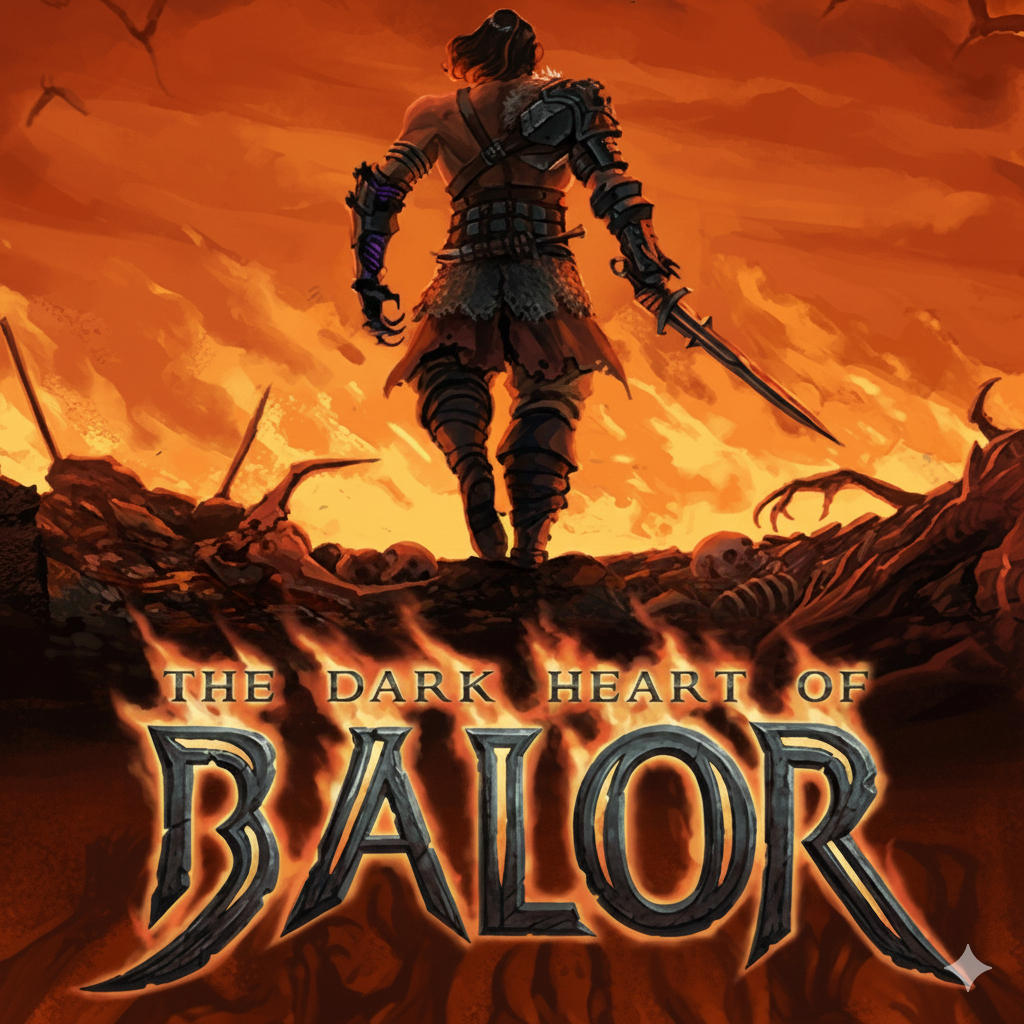
In an era of fantasy action-adventures where sprawling open worlds and cinematic spectacle often dominate headlines, The Dark Heart of Balor arrives as a refreshing blend of atmospheric worldbuilding, tactical combat, and myth-infused narrative. Available on PC, the game stakes its claim as a story-driven action RPG that marries Celtic mythology with dynamic encounters and layered progression systems. Over the course of many hours in its central campaign — plus side quests, exploration, and optional boss encounters — The Dark Heart of Balor proves itself an ambitious title that largely succeeds in immersion and depth, even as it occasionally falters in pacing and structural balance.
At its core, The Dark Heart of Balor is less a traditional hack-and-slash adventure and more a mythic odyssey of consequence and choice. Its strengths lie in evocative environmental design, strategic combat mechanics, and a narrative that valorises player agency. Its weaknesses grow from periodic pacing issues, occasional combat repetition, and a somewhat sprawling map that can blur motivation at times. Nonetheless, for players who appreciate dense lore, calculated combat, and an evocative fantasy universe, this title offers a rich and rewarding journey.
Setting the Scene: Myth, Mystery, and Narrative Identity
The Dark Heart of Balor draws its foundational inspiration from Celtic mythos, reimagining the elemental conflict between mortal ambition and ancient power through a narrative that blends personal stakes with cosmic consequence. You assume the role of Aeron, a once-humble scout whose life is irrevocably altered when an artefact tied to Balor — a primordial force of destructive wrath — becomes fused to your spirit.
Rather than drowning players in lore dumps, the game unfolds its world through environmental storytelling, NPC dialogues, and quest design that rewards curiosity. Each settlement, ruined tower, and sacred grove tells a fragment of the overarching myth, and uncovering these narrative layers becomes one of the game’s greatest rewards. The story is rich without being obscure; it never burdens the player with excessive exposition, but it offers depth for those who choose to probe its many side paths.
This narrative strategy — guiding without dictating — gives The Dark Heart of Balor a rare poise. It respects player intelligence yet pads its world with enough mystery and folklore that discovery feels organic rather than obligatory.
Environmental and Visual Design: A Living Mythscape
Visually, Balor is striking. The world is diverse without feeling disjointed: mist-shrouded forests give way to rolling highlands, craggy peaks loom over hidden valleys, and ancient ruins echo with arcane architecture that feels rooted in mythic memory. This unity of aesthetic reinforces the impression that the world is not simply a backdrop for conflict, but a character in its own right.
Lighting and weather systems play crucial roles in reinforcing atmosphere. Dusks feel haunting, dawns promise renewal, and thunderstorms underscore moments of narrative tension. Motion and sound combine to give life to foliage, wildlife, and ambient cityscapes that evolve as day transitions to night, enhancing presence in both casual exploration and combat engagements.
Technical performance across platforms is solid, with frame rates remaining stable even in visually dense environments. While some textures and polygon details occasionally fall short of flagship open-world titles, the overall presentation coheres into a compelling visual identity that prioritises mood and immersion over sheer graphical excess.
Combat Mechanics and Tactical Engagement
Combat in The Dark Heart of Balor is one of its most distinctive strengths. It isn’t a simple button-masher; rather, the game demands spatial awareness, strategic use of abilities, and thoughtful resource management. Aeron’s toolkit includes melee strikes, ranged attacks, elemental magic drawn from Balor’s fractured essence, and tactical dodges that reward timing over reflex alone.
Each enemy class — from woodland spectres and barbaric marauders to elemental horrors and shadow-tainted giants — has distinct patterns and resistances that encourage players to adapt rather than default to a single playstyle. Boss encounters, in particular, elevate these mechanics; they require players to anticipate attack windows, exploit environmental cover, and manage stamina against prolonged offense. Victories feel earned, and the gradual refinement of tactics across encounters is deeply satisfying.
Progression systems support this combat depth. Skills are unlocked through experience, quest milestones, and relic infusions tied to Balor’s fractured heart. These upgrades are neither trivial nor gratuitous; each feels earned and impactful. However, the pacing of skill acquisition can feel uneven — bursts of powerful ability gains are sometimes followed by stretches where enemies scale faster than player capability. This tension amplifies challenge but can occasionally disrupt momentum.
Despite this, the combat loop remains compelling: approach an area cautiously, study enemy behaviour, engage with purpose, and adapt your strategy when the predictable becomes unpredictable.
Exploration, Quests, and World Structure
Balor’s world encourages exploration without inducing aimless wandering. Main quests drive the narrative forward, but optional quests — often grounded in local mythology or NPC backstory — enrich context and reward curiosity. Traversal is facilitated by horses, skill-unlocked teleports between shrines, and environmental mechanics that make natural landmarks useful navigation beacons.
That said, the world’s size occasionally works against itself. Without a consistently clear minimap or explicit waypoint guidance, players can lose track of narrative urgency while traversing extended distances between objectives. Some quests feel like fetch tasks with little narrative payoff, and a handful of side activities recur with predictable design patterns rather than memorable goals.
Still, the sense of scale reinforces the theme: Aeron’s journey is not a sprint, but a pilgrimage through realms haunted by history and consequence. For players attuned to deliberative progression, this pacing suits the world well.
Narrative and Emotional Engagement
The emotional impact of The Dark Heart of Balor arises less from scripted cutscenes and more from situational immersion. NPCs are broadly written but carry personal stakes, quests often hinge on ethical decisions with consequences that ripple outward, and moments of revelation are paced to let narrative tension build rather than burst. The fractured soul of Balor is a compelling narrative anchor — one that pulls Aeron toward existential questions as much as physical confrontation.
Some players may find the overall plot arc less theatrical than blockbuster shooters; it is more meditative and mythic than loud. However, this tone suits the game’s conceptual roots and gives it a thematic consistency many high-budget titles lack.
Accessibility and Player Comfort
Aerosurfer performs admirably in accessibility considerations. Difficulty settings are adjustable without gating content, combat prompts are readable without overwhelming the screen, and optional hints help players stuck on particular puzzles or enemy encounters. Controllers and UI are responsive and clear, with tooltips that respect player attention without saturating interaction space.
Nonetheless, players seeking fast travel conveniences or ultra-streamlined quest tracking may find the experience deliberately grounded in exploration rather than acceleration. The game’s design philosophy privileges presence and discovery over shortcuts — a trade-off that will appeal to some and frustrate others.
Final Verdict
The Dark Heart of Balor is a rich, atmospheric fantasy adventure that blends mythic narrative, tactical combat, and evocative worldbuilding into a compelling experience. Its immersive environments and thoughtful attention to mood distinguish it from run-of-the-mill action RPGs, and its combat and progression systems reward strategic engagement. While pacing and quest variety occasionally falter, these are minor blemishes on an otherwise robust title.
For players who embrace mythic storytelling, calculated combat, and exploration that feels meaningful rather than perfunctory, The Dark Heart of Balor is an outstanding adventure — one that invites not just play, but presence.