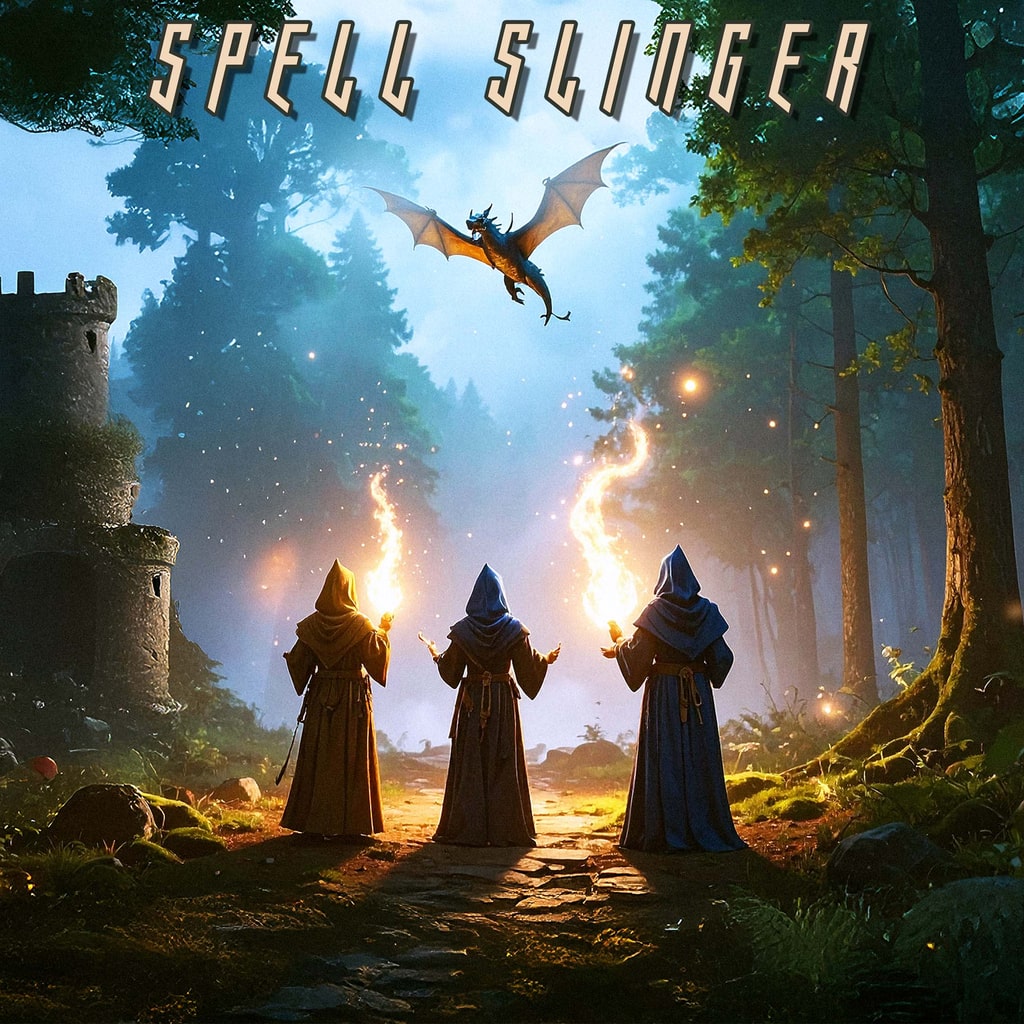
Spell Slinger arrives on PlayStation 5 with a clear mechanical hook: fast-paced magical combat built around precision casting, enemy management, and sustained momentum. It is a game that foregrounds action above all else, asking players to react quickly, think spatially, and master a growing arsenal of spells in increasingly hostile arenas. From the outset, Spell Slinger communicates its priorities clearly—this is not a narrative-driven epic or a slow-burn RPG, but a reflex-heavy action experience designed to test execution and adaptability.
At its best, Spell Slinger delivers satisfying moment-to-moment gameplay that makes smart use of its spell systems and responsive controls. At its weakest, it struggles to meaningfully evolve beyond its core loop, leaving long-term engagement dependent on player tolerance for repetition.
Core Gameplay and Combat Design
Spell Slinger’s combat is built around fluid spellcasting rather than traditional melee or gunplay. Players cycle through elemental and arcane abilities, each with distinct properties, ranges, and cooldowns. Success depends on selecting the right spell for the situation and chaining actions efficiently under pressure.
Controls on PS5 are tight and responsive, an essential quality given the speed at which encounters unfold. Spell aiming feels precise, and the DualSense controller provides subtle haptic feedback that reinforces impact without becoming distracting. Combat arenas encourage movement, positioning, and awareness, rewarding players who stay mobile rather than relying on static strategies.
Enemy variety is serviceable but uneven. Early encounters introduce basic threats that establish mechanics effectively, while later stages increase difficulty through density rather than complexity. As a result, combat becomes more about crowd control and resource management than learning new behaviours. While this escalation keeps tension high, it also exposes the limits of enemy design over time.
Spell Systems and Progression
Spell Slinger’s defining feature is its spell system. Each ability has a clear role—damage, control, area denial, or utility—and understanding how they interact is key to survival. Cooldowns and resource constraints prevent spamming, forcing players to rotate abilities thoughtfully.
Progression unlocks new spells and modifiers that slightly alter playstyle. However, progression tends to be incremental rather than transformative. New abilities often feel like variations on existing tools rather than fundamentally new mechanics, which limits experimentation.
There is satisfaction in refining loadouts and improving execution, but the game rarely forces players to rethink their approach in meaningful ways. Builds converge quickly, and optimal strategies become apparent early on, reducing the sense of discovery later in the game.
Presentation and Visual Identity
Visually, Spell Slinger embraces a stylised fantasy aesthetic that prioritises readability over detail. Spell effects are vibrant and clearly differentiated, ensuring players can parse chaotic encounters quickly. Environments are functional, with distinct layouts that support combat flow, though they lack memorable identity.
On PS5, performance is stable, with smooth framerates even during effect-heavy encounters. Visual polish is solid rather than striking, and while the art direction is cohesive, it rarely surprises. Spell Slinger looks competent and clean, but it does not attempt to push visual boundaries.
Menus and UI elements are clear and unobtrusive, reinforcing the game’s focus on action. Information is communicated efficiently, and players are rarely pulled out of the experience by interface friction.
Sound Design and Feedback
Sound design supports combat effectively. Spell effects have appropriate weight, with audio cues that reinforce timing and impact. Enemy attacks are clearly telegraphed through sound, aiding situational awareness during intense moments.
The musical score leans toward energetic fantasy themes that maintain momentum without overpowering gameplay. While serviceable, the soundtrack lacks distinct motifs, blending into the background over extended sessions.
Voice work, if present, is minimal, reinforcing the game’s mechanical rather than narrative emphasis.
Pacing and Structure
Spell Slinger is structured around a series of combat-focused stages that gradually increase in intensity. Pacing within individual encounters is strong, maintaining pressure without overwhelming players outright. However, the broader structure suffers from repetition.
Stages follow a familiar rhythm: enter arena, defeat waves, advance, repeat. While this loop is initially engaging, the lack of meaningful variation becomes increasingly apparent. Environmental hazards and enemy combinations attempt to introduce novelty, but these changes rarely alter the fundamental experience.
The game benefits from shorter play sessions. Extended sessions tend to highlight repetition rather than mastery, making Spell Slinger best enjoyed in focused bursts rather than prolonged play.
Difficulty and Accessibility
Difficulty scaling is fair but firm. Early sections are accessible, introducing mechanics gradually, while later stages demand precision and efficient spell use. Failure is usually attributable to player error rather than unfair design, reinforcing a sense of mechanical integrity.
Accessibility options are limited, however. Players struggling with fast-paced action or precise input timing may find the experience unforgiving. Spell Slinger makes few concessions to different playstyles, reinforcing its identity as a skill-driven action game.
Replayability and Longevity
Replay value hinges almost entirely on mechanical enjoyment. There are few narrative incentives, alternate modes, or significant branching paths to encourage revisiting content. Players who enjoy refining performance, chasing efficiency, or experimenting with loadouts will find some longevity here, but those seeking broader variety may disengage quickly.
Without additional modes or deeper progression systems, Spell Slinger risks exhausting its appeal once the core loop is mastered.
Final Verdict
Spell Slinger on PS5 is a focused, mechanically competent action game that delivers satisfying spell-based combat and responsive controls. Its strengths lie in moment-to-moment execution, where fast reactions and smart ability use create a sense of flow and intensity.
However, the game’s narrow focus and limited evolution prevent it from reaching greater heights. Enemy variety, progression depth, and structural diversity fall short of sustaining long-term engagement. Spell Slinger excels as a short-form action experience but struggles to justify extended commitment.
For players seeking a stylish, reflex-driven magic combat game to dip into between larger releases, Spell Slinger offers solid value. For those looking for deeper systems or long-term progression, its limitations will become apparent quickly.