There’s something inherently joyful about momentum.
Whether it’s carving down a halfpipe, chaining tricks in a Tony Hawk combo, or boosting through a perfectly designed 2D platforming gauntlet, movement-focused games live or die by how they feel in your hands.
Seafrog understands that better than most.
Originally launched on PC in April 2025, the game has resurfaced today on Nintendo Switch—bolstered by a massive 2.0 overhaul and publishing support from Grumpyface Studios. The update isn’t cosmetic polish; it’s a fundamental refinement of flow, balance, and clarity that transforms what was once a promising indie experiment into a confident, kinetic action-platformer.
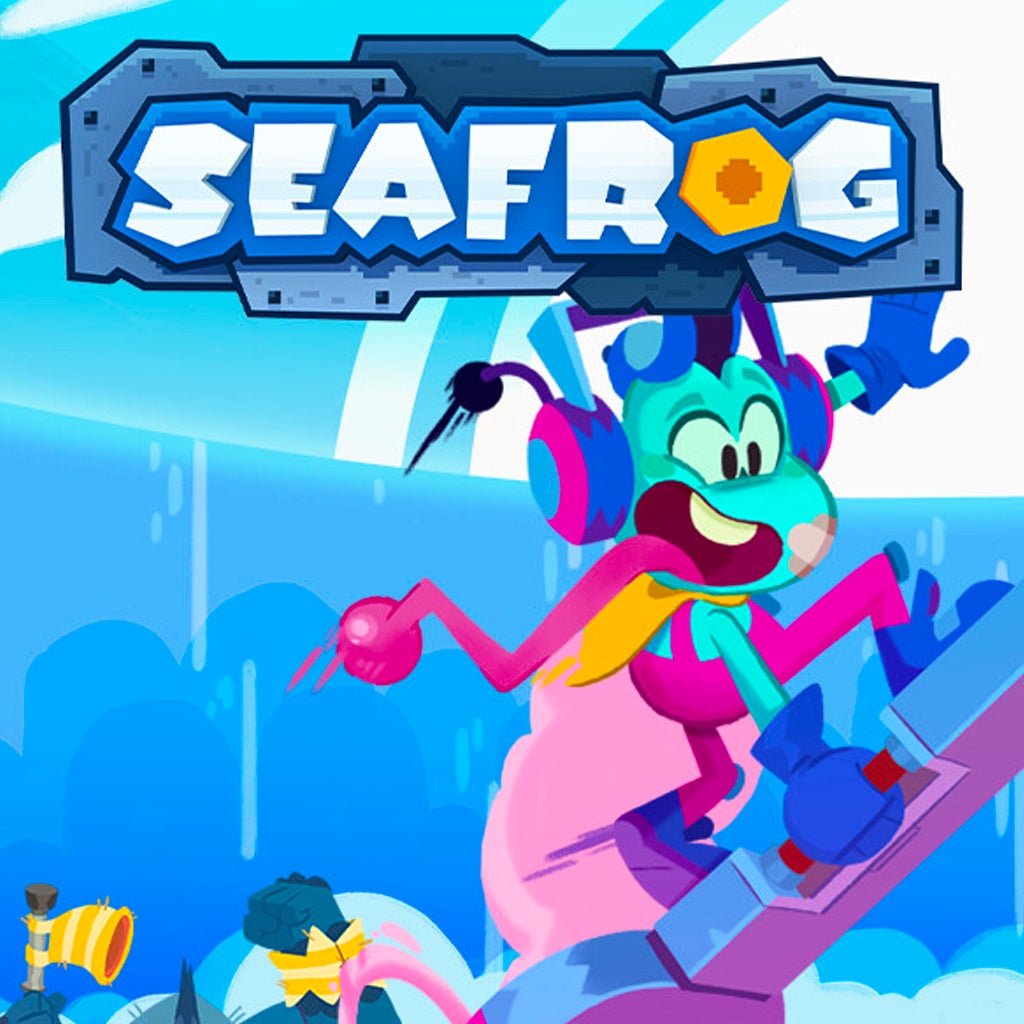
At its core, Seafrog is a skate game disguised as a Metroidvania, wrapped in pirate-flavored absurdity.
And it works.
The Rocket-Powered Wrench: Movement Is the Message
You play as a silent amphibian mechanic trapped in a massive oceanic sinkhole known as the Seahole. Armed with a motorized, rocket-powered wrench that doubles as a hoverboard, you grind across rusted pipes, kick-flip over enemy heads, and boost through walls with fuel-powered bursts.
The control scheme is deceptively simple:
- Land grinds to build fuel.
- Use fuel to boost.
- Chain tricks automatically via an “auto-trick” system.
- Maintain momentum to survive.
It’s often described as “skateboard-lite,” and that’s accurate—but it’s also smarter than it sounds. Rather than overwhelming players with manual trick inputs, Seafrog focuses on flow. The auto-trick system lets you concentrate on trajectory and timing instead of button memorization.
And once it clicks? It clicks hard.
Grinding along a ceiling pipe, boosting off an enemy’s helmet, wall-riding upward, then sticking to the underside of a platform feels fluid and expressive. There’s a constant sense that you’re sculpting your path rather than simply reacting to it.
A Ship Graveyard Playground
The setting is one of the game’s strongest hooks.
The Seahole is a giant, spiraling sinkhole littered with derelict ships stacked like nesting dolls. Each ship is its own self-contained biome and theme:
- A Viking ghost-infested vessel (The Sea Dragon).
- The grotesque and absurd Chunky Chacken ship.
- The bizarre Sweater Factory run by apes.
- And more.
These aren’t just visual reskins—they introduce new hazards, enemy types, and mechanical challenges. Rusty pipes double as grind rails. Leaks flood areas that must be repaired. Industrial machinery becomes kinetic skate-park architecture.
The level design smartly encourages vertical thinking. You’re rarely just moving left to right. Instead, you’re:
- Flying up walls.
- Clinging to ceilings.
- Using boost fuel to bypass environmental blockades.
It’s a 2D platformer that constantly feels three-dimensional in motion.
Metroidvania Structure Done Right
Beneath the arcade-style trick chaining lies a genuine Metroidvania backbone.
Progression is tied to:
- Mod Chips – Upgrades that expand your movement options.
- Master Gears – Major progression milestones locked behind bosses.
New abilities—like enhanced air-boosting or specialized grind mechanics—open up older ships for deeper exploration.
The backtracking never feels tedious because your increased mastery of movement makes returning to old areas faster and more expressive. What once required careful navigation can later be blitzed through with high-speed combos.
This is a game that rewards mechanical growth as much as character progression.
Woodsbeard: The USB Pirate Companion
Following you throughout your journey is Woodsbeard—a talking, pirate-coded USB drive with a sharp tongue and relentless commentary.
He’s part AI guide, part comic relief, and part trash-talker. The writing lands more often than it misses, delivering absurd, sea-drenched one-liners without overstaying its welcome.
Importantly, Woodsbeard isn’t just flavor text. He provides contextual hints and helps pace the narrative in a game that otherwise relies heavily on environmental storytelling.
His presence gives Seafrog personality without bogging it down in cutscenes.
Boss Battles and Mechanical Variety
Each major chapter ends in a boss fight guarding a Master Gear.
These bosses are imaginative, chaotic, and mechanically integrated:
- The Skraken
- Metal Beak the Momma Chacken
- And the hilariously understated “Gerald”
Bosses require you to use everything you’ve learned—boost timing, grind management, wall-sticking—to survive.
They’re not brutally punishing, but they demand rhythm awareness and precision. And because the core mechanic revolves around fuel management, boss encounters feel like high-speed duels of resource control.
Puzzles With Tactile Identity
Beyond pure platforming, Seafrog introduces mechanical puzzles centered around repairing ships.
You’ll:
- Seal leaks.
- Activate dormant machinery.
- Redirect power flows.
- Manipulate environmental hazards.
These sequences are quick but clever, acting as pacing breaks between high-speed traversal segments.
The wrench isn’t just transportation—it’s a literal tool.
Performance: Switch vs. Switch 2
The Nintendo Switch release includes two modes:
- Legacy Mode (optimized for original hardware).
- Boost Mode (Switch 2 enhanced).
On original Switch, performance is stable but can dip slightly during dense combo-heavy sections.
On Switch 2, Boost Mode stabilizes frame rate during high-speed movement and makes chaining tricks feel smoother. The difference isn’t transformative, but it’s noticeable in tight platforming sequences.
The art style—colorful, chunky, slightly cartoonish—translates well to handheld. It’s readable and energetic without being visually noisy.
Where It Wobbles
For all its strengths, Seafrog occasionally suffers from:
- Slight camera readability issues during vertical sequences.
- Minor repetition in environmental themes within larger ships.
- A learning curve that may initially feel slippery.
The first hour can be awkward. Momentum-based platformers always risk feeling imprecise until muscle memory kicks in.
But once you adapt to the physics, the game opens up beautifully.
The 2.0 Transformation
The December 2025 “2.0 Version” update quietly fixed many early criticisms:
- Improved level clarity.
- Rebalanced fuel economy.
- Smoothed progression gating.
- Enhanced performance stability.
This console release feels like the definitive edition. The polish is evident. What might have once felt rough around the edges now feels cohesive.
Final Verdict
Seafrog is one of the more inventive indie platformers in recent memory—not because it reinvents the genre, but because it merges two seemingly incompatible identities:
- A skate-flow arcade trick system.
- A structured Metroidvania progression loop.
And it does so with personality, humor, and surprising mechanical depth.
It’s not as punishing as hardcore skate sims. It’s not as labyrinthine as Hollow Knight. But it finds a sweet spot between expressive movement and exploration.
For £12.99, it delivers strong value—especially in its refined 2.0 form.
It’s fluid. It’s weird. It’s charming.
And once you find the flow, it’s hard to put down.