There’s a particular kind of puzzle game that doesn’t try to change your life, dazzle you with spectacle, or reinvent the genre. Instead, it simply presents a clean mechanic, ramps up the difficulty steadily, and lets you get on with it.
Bus Stop Shuffle is exactly that kind of game.
Originally rolling out across PlayStation in August 2025, Xbox in November, and finally landing on Nintendo Switch today, Webnetic’s colorful sorting puzzler has quietly carved out a reputation for two reasons: it’s genuinely relaxing… and it’s a “Platinum snack” that trophy hunters adore.
But beyond the quick completion time and easy 1000G reputation, is there an actual game worth playing here?
Surprisingly, yes.
The Core Loop: Organize, Don’t Panic
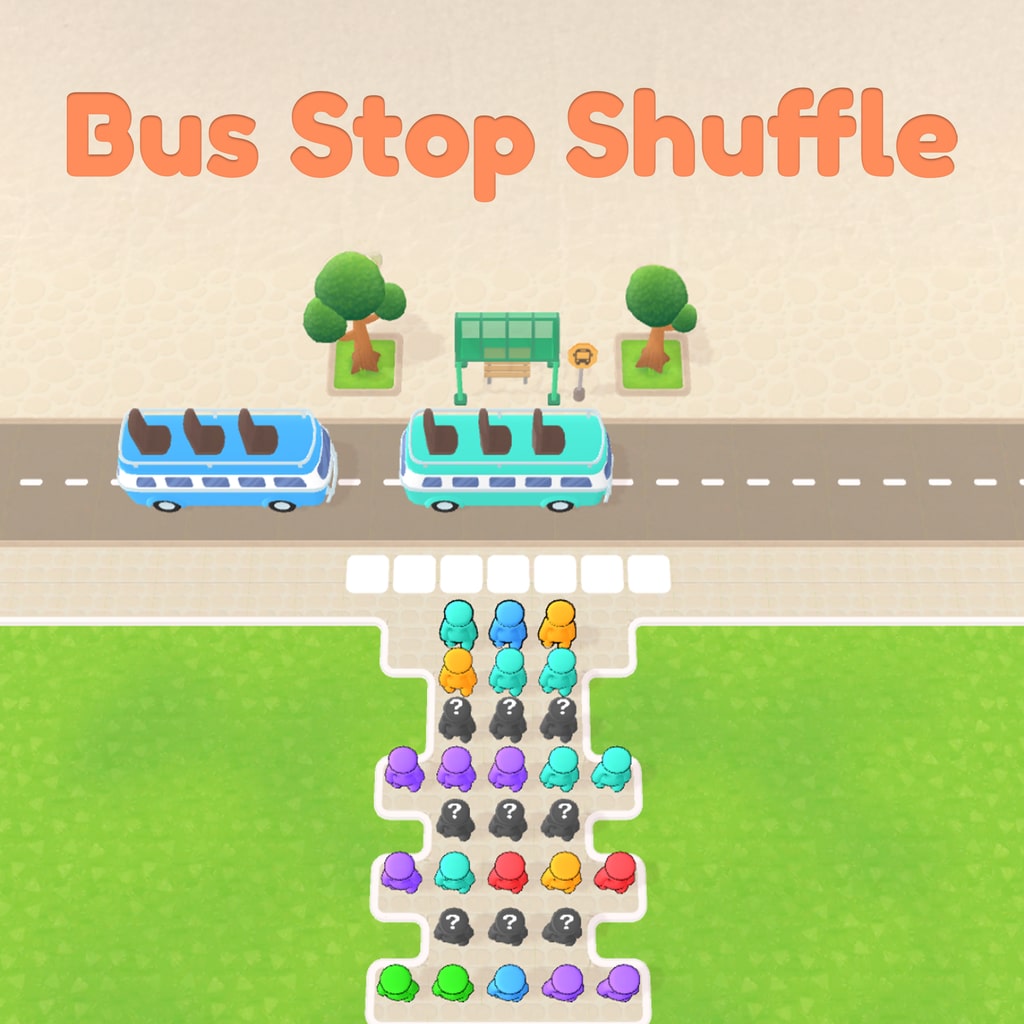
The premise is simple: a crowd of color-coded passengers are waiting at a bus stop. Each bus only accepts passengers of its matching color. Your job is to move people into the correct bus before your limited holding slots fill up.
Mechanically, you:
- Select a passenger.
- Temporarily park them in one of seven holding spaces.
- Clear a path to fill buses in the correct order.
It’s a classic sorting puzzle. If you’ve played liquid-sorting games, parking puzzles, or similar color-matching logic titles, you’ll understand the structure immediately.
But simplicity is deceptive.
Because once buses begin to overlap in color groups and your holding slots fill up, each move starts to matter.
Planning Over Speed
At first glance, Bus Stop Shuffle looks like a casual drag-and-drop time waster. In reality, it leans far more on planning than reflexes.
You don’t lose because you’re too slow.
You lose because you miscalculated your move order.
Each level introduces new complexity:
- More bus colors.
- Narrower sorting margins.
- Tighter holding slot constraints.
The puzzle logic feels reminiscent of the “Exit 8” style loop games—not in theme, but in design philosophy. It’s about pattern recognition and sequence planning.
One wrong move can snowball into a full gridlock. But when you clear a bus with your final slot open, it feels satisfyingly clean.
60+ Levels of Gradual Escalation
The game contains over 60 levels, and while the early stages are almost tutorial-simple, the back half introduces genuine logic tension.
Later puzzles require:
- Backtracking mentally before making a move.
- Prioritizing which bus to clear first.
- Creating temporary blockades to free later paths.
There’s no timer breathing down your neck. No energy system. No intrusive microtransactions. Once you buy it, the full experience is unlocked.
That lack of pressure is part of its appeal. It’s a pure logic toy.
Designed for Short Sessions
The control scheme couldn’t be simpler:
- Left stick to move the cursor.
- One button to select.
That’s it.
On Nintendo Switch, this design shines. The bright, high-contrast colors read perfectly in handheld mode, making it ideal for short bursts on a commute or during downtime.
Each level can be completed in under a minute once you understand the pattern. It’s easy to play one, then another, then another—without noticing 20 minutes have passed.
The Trophy Hunter Effect
It would be dishonest not to address the elephant at the bus stop: Bus Stop Shuffle has become extremely popular in trophy-hunting communities.
On PlayStation and Xbox, you can unlock every trophy or achievement in roughly 10–15 minutes by:
- Completing the first 20 levels.
- Intentionally failing a few times (as some achievements require this).
There are around 70 total trophies/achievements—most of them tied to straightforward milestones.
For completionists, this is low-hanging fruit.
But here’s the thing: the ease of completion doesn’t necessarily diminish the game itself. It just means the progression system is structured generously.
If you ignore trophies entirely, the puzzle design still stands on its own.
Presentation: Clean and Cheerful
Visually, Bus Stop Shuffle adopts a minimalist, high-contrast aesthetic.
- Bright, saturated bus colors.
- Simple character models.
- Clean backgrounds.
- No visual clutter.
It’s easy on the eyes and readable instantly. That’s critical for a sorting puzzle where clarity is everything.
The soundtrack is unobtrusive—light, looping background music that doesn’t distract. Sound effects are simple and functional.
It’s not going to win awards for artistic direction, but it doesn’t need to.
This is a utility puzzle game. It knows its lane.
Where It Stalls
For all its charm, Bus Stop Shuffle isn’t deep enough to sustain long marathons.
After about an hour, you’ve essentially seen all its mechanics. Later levels increase difficulty, but they don’t introduce new systems.
There are no:
- Modifier modes.
- Challenge variants.
- Daily puzzles.
- Leaderboards.
Once you finish the 60+ levels, that’s largely it.
Replay value exists if you enjoy optimizing your movement efficiency—but it’s not structurally incentivized.
At full price (£5.99), it’s fair value. On sale (often under £1), it’s a steal. But it’s undeniably small-scale.
Accessibility and Relaxation
One of the game’s biggest strengths is accessibility.
- No twitch mechanics.
- No complex UI.
- No tutorial overload.
- No difficulty spikes that feel unfair.
It’s approachable for all ages. It works equally well for children learning pattern recognition and adults looking for something low-stress.
In an industry full of live-service demands and bloated menus, there’s something refreshing about a game that just says:
“Here’s a puzzle. Solve it.”
A Budget Puzzle That Knows Its Role
Not every game needs to be a 40-hour epic. Some are designed to be palate cleansers between larger experiences.
Bus Stop Shuffle fills that niche perfectly.
It’s:
- Clean.
- Logical.
- Relaxing.
- Easy to pick up.
- Cheap.
It won’t revolutionize puzzle design. But it doesn’t try to.
It’s a tidy little package of logic satisfaction—and sometimes that’s enough.
Final Verdict
Bus Stop Shuffle is exactly what it advertises: a colorful, straightforward passenger-sorting puzzle with increasing complexity and zero unnecessary friction.
Its reputation as a “Platinum snack” may attract one crowd—but there’s genuine, thoughtful puzzle design underneath the quick completion time.
It’s not deep. It’s not innovative. But it’s polished, readable, and relaxing.
And for under £6 (often much less), it’s hard to complain.