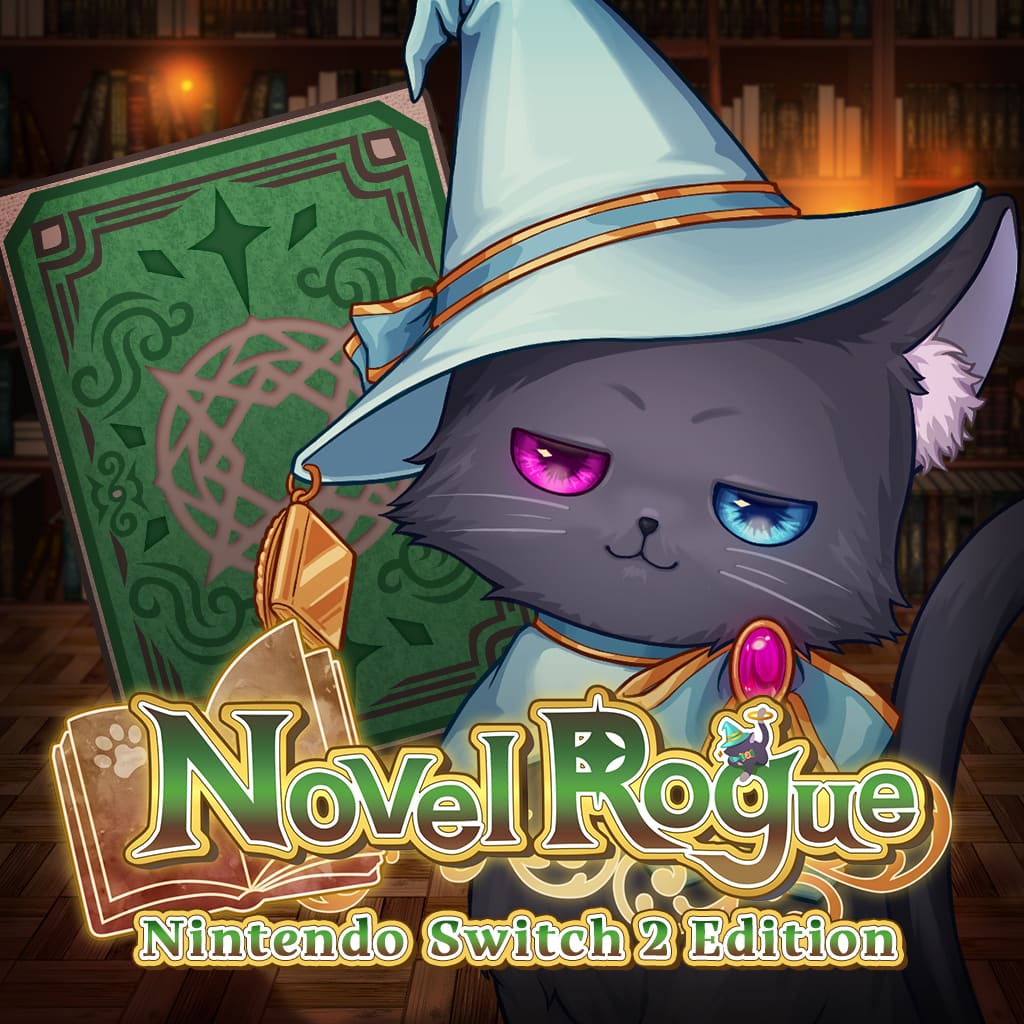
There’s something quietly charming about Novel Rogue. It doesn’t scream for your attention the way many modern roguelites do, nor does it try to overwhelm you with endless mechanics layered atop mechanics. Instead, Exe Create and KEMCO deliver a game that feels thoughtfully constructed, narratively motivated, and mechanically focused—a card-based roguelite that understands restraint as well as it understands replayability. The Nintendo Switch 2 Edition is arguably the best way to experience it, smoothing out prior rough edges while leaning into the game’s biggest strengths: story-driven runs, smart deck systems, and a cozy yet cunning sense of challenge.
A Storybook Framing That Actually Matters
Novel Rogue opens in the Ancient Library, a mystical nexus of stories and worlds where Wright, a young and earnest apprentice, trains under Yuisil, the Witch of Portals. This framing device—stories within stories—could easily have been window dressing. Instead, it becomes the backbone of the entire experience.
Each of the four enchanted books Wright explores represents a distinct world with its own tone, mechanics, and thematic focus. One tale centers on reclaiming a fallen kingdom, another dives into the shadowy logic of the underworld, while others explore equally evocative fantasy concepts. Importantly, these aren’t just reskins. The choices you make within each book ripple outward, affecting characters, endings, and even how later runs unfold.
What’s refreshing is how Novel Rogue respects narrative without bogging the player down. Dialogue is concise but purposeful, and characters are sketched with just enough personality to feel memorable without overstaying their welcome. The branching paths and multiple endings reward curiosity, making story discovery feel like a natural extension of repeated runs rather than a checklist to grind through.
Four Deck Systems, Four Ways to Think
At its mechanical core, Novel Rogue is a turn-based card battler, but it distinguishes itself through its four unique deck systems, each tied to a specific book world. Rather than asking players to relearn the entire game every time, Exe Create smartly introduces variations that alter how you approach combat, resource management, and long-term planning.
Some decks emphasize direct damage and tempo control, while others reward defensive play, status manipulation, or delayed payoffs. This structural diversity does wonders for replayability. Switching books doesn’t just change the scenery—it changes your mindset. Cards that feel essential in one system may be irrelevant or even risky in another.
The Ink system further deepens this customization. Ink allows you to enhance cards, tweak their effects, or improve consistency within your deck. Crucially, Ink forces meaningful trade-offs. Do you invest heavily in upgrading a core strategy, or spread enhancements across multiple cards to hedge against bad draws? These decisions add a layer of strategic tension that elevates the game beyond genre basics.
Roguelite Design That Values Fairness
Randomized dungeons and escalating difficulty are par for the course in roguelites, but Novel Rogue approaches these elements with notable fairness. While luck certainly plays a role—this is a card game, after all—the game rarely feels cheap. Enemy patterns are readable, and failures tend to feel instructional rather than punishing.
Combat encounters are brisk and readable, with pixel-art animations that communicate intent clearly. Bosses, in particular, stand out for demanding adaptation rather than brute force. You’re encouraged to think about synergy, timing, and resource conservation instead of simply stacking the strongest cards you can find.
That said, Novel Rogue isn’t relentlessly brutal. Compared to genre titans like Slay the Spire, it’s more forgiving, especially in its early hours. For some hardcore roguelite fans, this may slightly dampen the adrenaline rush. But for many players—especially those drawn in by the story—this gentler curve makes the game far more approachable without sacrificing depth.
Pixel Art With Personality
Visually, Novel Rogue leans into classic pixel art, and it wears that choice well. Character sprites are expressive despite their simplicity, environments are varied across the different books, and combat effects are flashy without becoming visually noisy.
The Nintendo Switch 2 Edition benefits from improved performance and clarity, with snappier transitions and smoother animations. Load times are short, and the game feels well-suited to both handheld and docked play. This is the kind of title that thrives in short sessions but can easily swallow an entire evening if you’re chasing a specific ending or build.
The soundtrack complements the visuals nicely, favoring atmospheric fantasy themes over bombastic tracks. It won’t dominate your memory the way some indie soundtracks do, but it consistently reinforces the mood of each world without becoming repetitive.
Small Stumbles in an Otherwise Polished Tale
If Novel Rogue has a notable weakness, it’s that its ambition occasionally outpaces its scope. Some narrative threads feel like they could have been pushed further, and certain deck systems are more immediately engaging than others. While all four books are mechanically distinct, not all of them feel equally deep, and veteran players may gravitate toward one or two favorites rather than rotating evenly.
Additionally, while multiple endings are a strong motivator, unlocking them can sometimes feel opaque. The game hints at choice-driven outcomes but doesn’t always clearly communicate how close—or far—you are from a specific narrative resolution.
Final Verdict
Novel Rogue is a thoughtful, story-forward take on the card deck-building roguelite genre. It may not revolutionize the formula, but it refines it with care, offering meaningful narrative integration, mechanically distinct systems, and a welcoming difficulty curve that invites experimentation.
For fans of KEMCO’s RPG sensibilities, deck-building enthusiasts looking for something more narrative-driven, or Switch 2 owners craving a game that feels equally at home in short bursts and long sessions, Novel Rogue is an easy recommendation.