Some games adopt an aesthetic, while others commit to it so fully that the mechanics, tone, and identity become inseparable from the visual language. MOUSE: P.I. For Hire belongs firmly in the latter category.
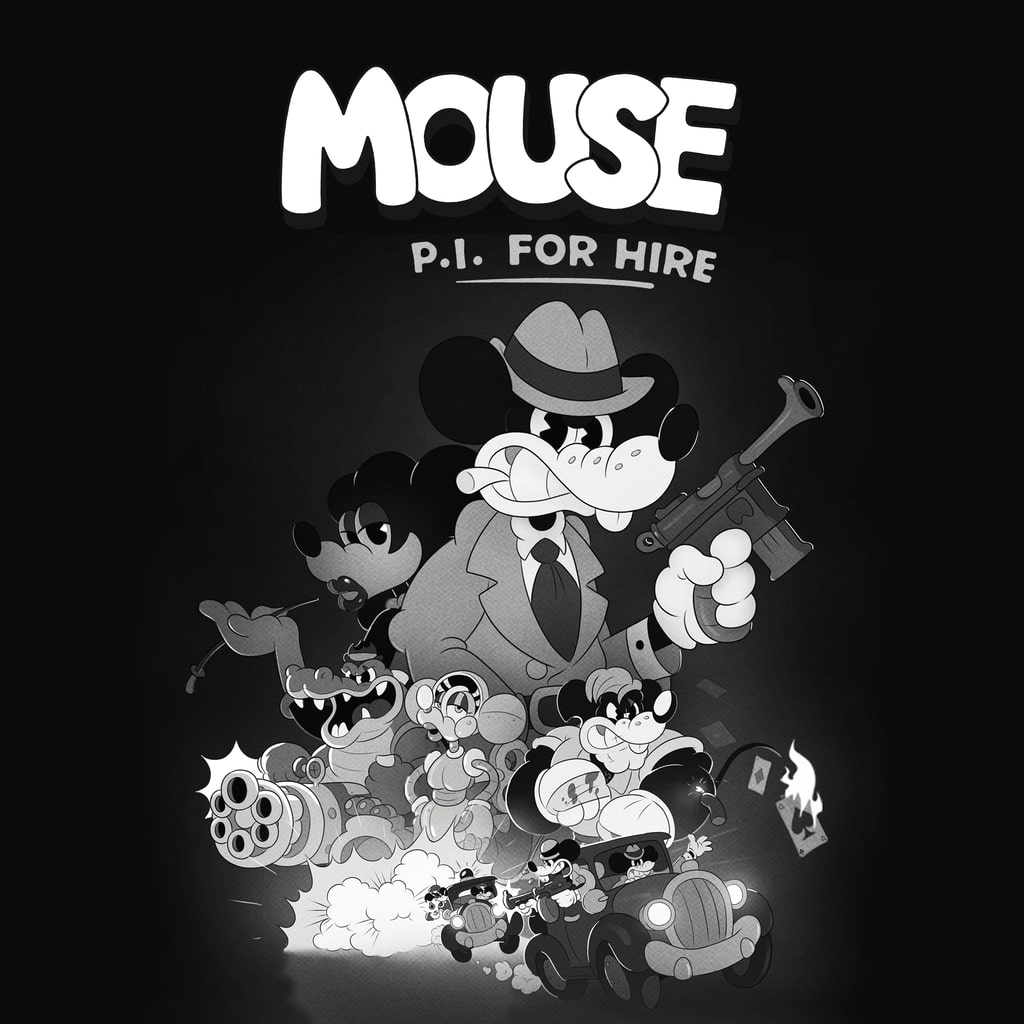
Developed by Polish studio Fumi Games and published by PlaySide Studios, this stylised first-person shooter arrives on modern platforms with an immediate visual hook that is difficult to ignore. Its hand-drawn rubber-hose animation style, inspired by 1930s cartoons, is not merely decorative. It defines how the world moves and reacts, and ultimately how it feels to play.
You step into the worn shoes of Jack Pepper, a private investigator navigating the grim yet absurd world of Mouseburg. It is a city of corruption, gang violence, theatrical excess, and cartoon physics. On paper, it is a noir detective story. In practice, it is something far more unusual.
“MOUSE: P.I. For Hire proves that style is not decoration. It is structure.”
A World Drawn in Motion
The first thing that strikes you is how alive Mouseburg feels within its constraints. The black-and-white presentation is not static. It pulses, bends, and constantly exaggerates. Every animation feels handcrafted, every movement slightly elastic, as if reality itself is held together by ink and timing rather than by physics.
This approach gives the game a distinct identity. The world does not aim for realism. It aims for personality. Characters stretch as they move, recoil dramatically when hit, and interact with their environments in ways that feel both intentional and chaotic.
From dim alleyways to theatrical opera houses and industrial sewers, each location feels like a set piece from a long-lost animation reel. Yet despite the stylisation, readability is never lost. Combat spaces remain clear, and environmental cues are consistently legible.
It is a rare balance between artistic ambition and gameplay clarity.
Noir Narrative with Cartoon Logic
At its core, MOUSE: P.I. For Hire is a detective story. Jack Pepper begins with what appears to be a routine missing-persons case, only to uncover a larger conspiracy involving corruption, crime syndicates, and political manipulation within Mouseburg.
The narrative leans heavily into noir tropes. Moral ambiguity, shadowy figures, and layered deception form the backbone of the story. However, the rubber-hose presentation constantly undercuts the seriousness with absurdity.
This tension between tone and presentation is deliberate. Serious themes are delivered through a world that refuses to take itself seriously. A monologue about corruption might be interrupted by a character literally bending out of shape in surprise. A tense investigation scene might unfold in a room that behaves like a stage set collapsing under pressure.
Rather than weakening the narrative, this contrast enhances it. It reinforces the idea that Mouseburg itself is unstable, both morally and physically.
Combat as Cartoon Chaos
Mechanically, the game operates as a fast-paced first-person shooter with boomer shooter influences. Movement is constant. Standing still is rarely an option. Enemies swarm in patterns that demand awareness and quick reactions.
Weapons range from period-inspired firearms to exaggerated cartoon inventions. Each feels intentionally designed to fit the world rather than simply serve a gameplay function. Machine guns crackle with exaggerated recoil, explosives behave unpredictably, and power-ups introduce temporary bursts of chaotic advantage.
Combat encounters are not just about accuracy. They are about maintaining rhythm. Movement, shooting, dodging, and ability use blend into a continuous flow that rewards aggressive play.
The Fantastic o Matic upgrade system adds another layer to this loop. Upgrades are not just statistical improvements. They often alter how weapons behave in subtle or dramatic ways, reinforcing the game’s commitment to expressive combat.
Movement and Exploration
Beyond combat, Jack Pepper’s mobility is central to the experience. Wall running, grappling, and double-jumping enable vertical and horizontal traversal, keeping encounters dynamic.
Levels are designed with multiple layers of movement in mind. Arenas often encourage repositioning rather than static engagement. Exploration segments, meanwhile, reward curiosity with collectibles, secrets, and optional encounters.
The inclusion of Metroidvania-inspired progression adds light structure to the campaign. New abilities unlock previously inaccessible routes, encouraging backtracking and environmental re-exploration without overwhelming the core linearity of the experience.
Audio and Atmosphere
The soundtrack deserves particular attention. A full big-band jazz score runs throughout the experience, reinforcing the noir aesthetic while adding energy to combat and exploration.
Music shifts dynamically with context. Investigation segments lean into slower, atmospheric arrangements. Combat sequences become energetic and rhythm-driven, matching the intensity of movement and gunplay.
Overall, the sound design is sharp and expressive. Weapons feel weighty without breaking the cartoon illusion, and environmental audio reinforces the density of Mouseburg’s world.
The Baseball Card Interlude
One of the more unexpected additions is the fully playable baseball card minigame. It serves as a break between missions, offering a slower-paced diversion that expands the world’s personality.
While it does not directly impact progression in a major way, it contributes to the sense that Mouseburg is a lived-in space with its own recreational culture. It is a small detail, but one that adds texture to the overall experience.
Where the Ink Smudges
Despite its strengths, MOUSE: P.I. For Hire is not without issues.
The overwhelming visual style, while impressive, can occasionally become visually dense during intense combat sequences. Although clarity is generally maintained, moments with heavy particle effects and overlapping animation can briefly obscure readability.
The tonal contrast between serious noir storytelling and exaggerated cartoon behaviour may also divide players. Some narrative moments rely heavily on stylistic irony, which can undercut emotional weight depending on personal preference.
Additionally, while the movement and combat systems are strong, enemy variety occasionally struggles to keep pace with the game’s mechanical depth in later stages.
A Stylised Identity That Holds Its Ground
What makes MOUSE: P.I. For Hire notable is not just its aesthetic commitment, but how that commitment extends across every layer of design. Movement, combat, narrative, and even downtime activities all reflect the same creative vision.
It is a game that understands its identity and refuses to dilute it. That level of cohesion is rare, particularly in modern first-person shooters that often prioritise mechanical complexity over stylistic unity.
Here, style and substance are not competing forces. They are intertwined.
Final Verdict
MOUSE: P.I. For Hire is a confident, visually striking first-person shooter that uses its rubber-hose aesthetic not as decoration but as a foundation for gameplay and storytelling. Its combat is fast, expressive, and rhythm-driven, while its worldbuilding thrives on the tension between noir seriousness and cartoon absurdity.
It is not flawless, and its visual density and tonal experimentation may not suit everyone, but its ambition and consistency are undeniable.