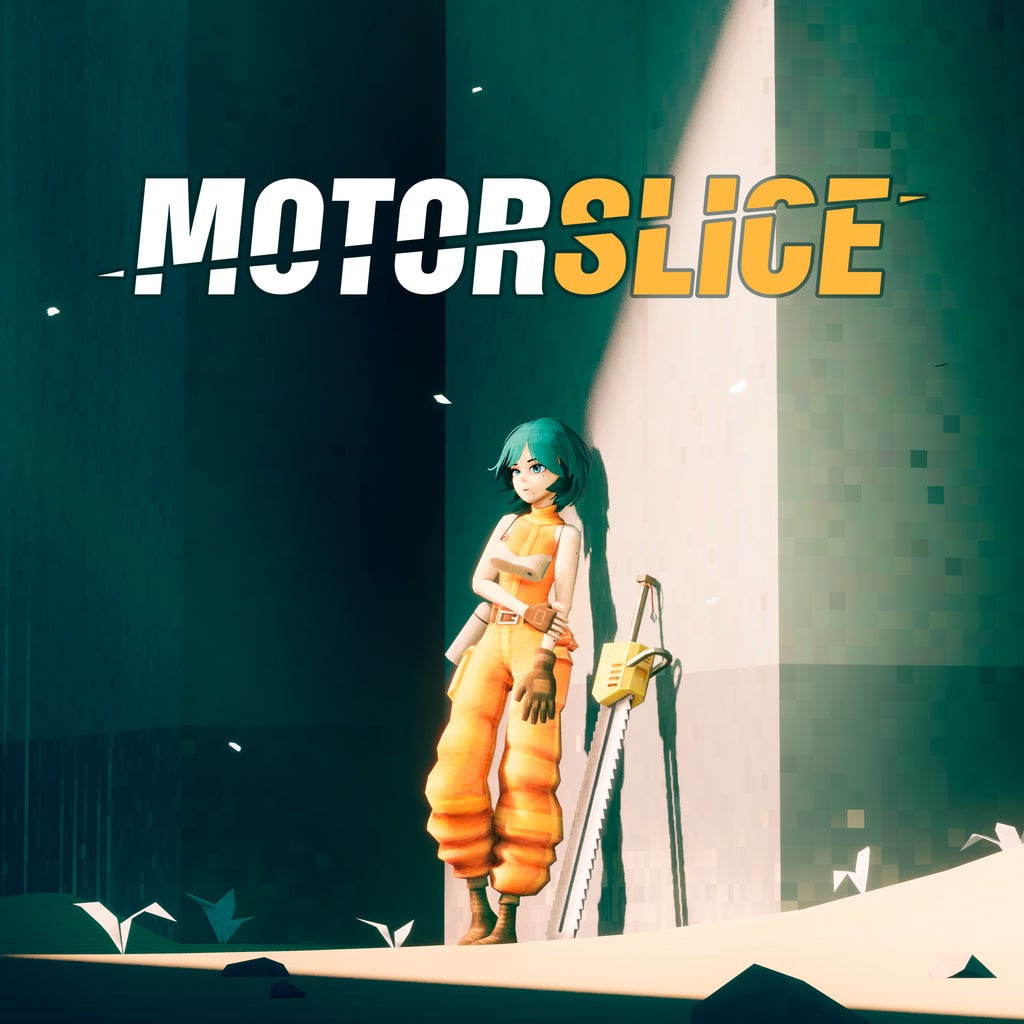
Developed by Regular Studio and published by Top Hat Studios, Inc., MOTORSLICE launched in May 2026 as a kinetic action-platformer blending parkour traversal with brutal, high-speed combat. It puts you in control of P, a “Slicer” sent into a vast, abandoned megastructure to dismantle rogue construction machines that have long since outgrown their purpose.
Accompanied by a malfunctioning drone named Orbie, P navigates a world that feels less like a level and more like a machine that never stopped running. Corridors stretch into darkness, structures tower overhead, and everything seems designed to make you feel small, fragile, and entirely out of place.
The premise is simple. Get in, eliminate the machines, get out. But MOTORSLICE is not interested in simplicity. It is interested in movement, pressure, and the strange quiet that exists between moments of chaos.
Gameplay
MOTORSLICE lives and dies by how it feels to move, and for the most part, it feels exhilarating. You run, slide, wall-run, crouch, and launch yourself across gaps with a kind of reckless precision that becomes second nature. The chainsaw is not just a weapon. It is a traversal tool, a way to extend jumps, redirect momentum, and carve paths through enemies and the environment alike.
Combat is immediate and unforgiving. Most encounters resolve in seconds. You strike first, or you fall. There is very little middle ground. Smaller machines collapse under a few well-placed attacks, while larger enemies demand a more deliberate approach, forcing you to read movement patterns and find openings.
Boss fights are where the game finds its identity. Massive construction machines loom over you, too large to fight directly. Instead, you climb them, navigating shifting surfaces while avoiding attacks and searching for weak points to tear apart piece by piece. It evokes a sense of scale that contrasts sharply with P’s vulnerability.
When everything clicks, MOTORSLICE enters a flow state. Movement chains together naturally. Combat becomes instinctive. The line between traversal and attack disappears, leaving something that feels closer to rhythm than strategy.
But that flow is not always consistent. Controls can occasionally feel loose, particularly during tighter platforming sections where precision matters most. Missed jumps and awkward landings can break momentum in ways that feel frustrating rather than challenging.
The camera, tied to Orbie’s perspective, is an interesting narrative touch but not always functional. In complex sequences, especially those involving vertical movement and rapid direction changes, it can struggle to keep up, leading to moments when visibility becomes a problem.
World and Atmosphere
The megastructure is the game’s defining feature. It is vast, oppressive, and strangely beautiful in its emptiness. Brutalist architecture stretches endlessly, broken only by the movement of machines that feel like remnants of a system that no longer remembers its purpose.
There is a strong sense of scale here. You are constantly aware of how small you are within this space. Corridors feel too long. Rooms feel too large. Even the quiet moments carry weight, as though the structure itself is watching.
Lighting plays a key role in shaping this atmosphere. Darkness is not just visual. It is part of the design. Moving through dimly lit corridors with only a flashlight creates tension that contrasts with the pace of traversal. It forces you to slow down, to listen, to anticipate.
The aesthetic blends low-poly design with pixelated textures in a way that feels deliberate rather than nostalgic. It gives the world a slightly unreal quality, as if it exists somewhere between memory and machinery.
The soundtrack, composed by Pizza Hotline, ties everything together. Drum and bass rhythms drive the pace, pushing you forward even when the environment feels overwhelming. It is not just background music. It is part of the movement, part of the timing, part of the experience.
Narrative and Tone
MOTORSLICE presents itself as a “slice of life” story, though that phrase takes on a different meaning here. P is not a hero in the traditional sense. She is a worker, sent in to do a job no one else can or will. There is a routine to her actions, a sense that this is just another assignment, even as the scale of the task suggests otherwise.
Her interactions with Orbie offer moments of levity and reflection. The drone is not just a companion but a lens through which the world is observed. Dialogue is sparse, yet it carries enough personality to give P a sense of presence without overwhelming the experience.
The story unfolds quietly. It does not demand attention. Instead, it exists in the background, revealed through the environment, small interactions, and the gradual realisation that this job is not as simple as it first appeared.
Themes of isolation, scale, and fear run beneath the surface. The idea of megalophobia, of being overwhelmed by massive structures, is not merely implied. It is felt in the design of the world itself.
Friction and Identity
MOTORSLICE is a game of extremes. At its best, it is fluid, fast, and deeply satisfying. It captures a sense of movement that few games manage, creating moments when everything aligns and the experience feels effortless.
At its worst, it stumbles under its own ambition. Inconsistent controls and camera issues can disrupt the flow it works so hard to build. These moments do not define the experience, but they are hard to ignore when they occur.
What keeps it compelling is its commitment to tone and identity. It knows what it wants to be, even if it does not always achieve it perfectly. There is a confidence in its design that carries it through its rougher edges.
Final Verdict
MOTORSLICE is not a perfect action-platformer, but it is a memorable one. It thrives on movement, on the feeling of momentum building and breaking, and on the tension between speed and control. When it works, it feels incredible. When it falters, it can be frustrating, pulling you out of that rhythm.
Yet even with those flaws, it leaves a strong impression. The world, the music, and the core idea of carving your way through a hostile machine all come together to create something distinct. It is a game that asks you to keep moving, even when the path ahead is not entirely clear. And more often than not, that is enough.