Some games want to impress you with how much they have to offer, while others understand the power of leaving something out. Metal Garden belongs firmly in the latter camp. It is a short first-person shooter set inside a colossal, decaying megastructure where nature has begun reclaiming the remains of a world that has long since forgotten why it was built. There are no sprawling skill trees, endless weapon collections or hundreds of hours of content here. Instead, you get a lonely journey through concrete, machinery and overgrown ruins that asks you to slow down and simply take in the world around you.
That might sound like an odd approach for an FPS, but it is precisely what makes Metal Garden so memorable. This is a game where atmosphere matters as much as gunplay, where a distant structure can be more interesting than a room full of enemies, and where finding a patch of greenery growing in an otherwise lifeless industrial environment can stop you in your tracks. It is compact, strange and occasionally unsettling, but most importantly, it feels like someone had a very particular world in their head and successfully brought it to life.
Lost Beneath the Concrete Sky
The premise is beautifully simple. You are a nomad travelling across the far reaches of an enormous megastructure, a place where countless civilisations have existed and disappeared over unimaginable stretches of time. Your mech is your means of travelling across this immense environment, but when it breaks down, you find yourself stranded in hostile territory with no easy route home.
From there, Metal Garden becomes a journey into the unknown. You are not given a massive exposition dump explaining exactly what happened to this place. Instead, the megastructure’s history is scattered around you in fragments, with machinery, architectural remnants and occasional pieces of written information gradually suggesting what came before.
There is something wonderfully lonely about that approach. The structure feels as though it has existed long before you arrived and will continue to exist long after you leave. You are simply another temporary visitor moving through a place that has witnessed generations rise and fall.
That scale is crucial to the experience. You can look across an enormous industrial space and feel almost insignificant, and the game repeatedly uses its architecture to remind you that you are exploring something far larger than yourself.
An FPS With Room to Breathe
For all its emphasis on atmosphere, Metal Garden is still a shooter. The combat is responsive and satisfying, though it deliberately avoids the weapon overload found in many modern FPS games.
Your arsenal is compact, giving you a handgun, a shotgun and a precision rifle to work with. Each weapon has a clear purpose, and because you are not constantly swapping between dozens of guns, combat becomes more about reading the situation in front of you than searching for the perfect piece of equipment.
There is also a pleasing physicality to the movement. You can strafe around incoming attacks, use double jumps to navigate the environment and move with a slightly floaty quality that gives encounters a distinct rhythm. It can feel almost arena-like at times, particularly when enemies begin throwing projectiles your way and you are forced to keep moving.
The contrast between movement and vulnerability works particularly well. You may have plenty of freedom to leap and dodge around an encounter, but you cannot simply absorb endless punishment. Mistakes matter, which gives even relatively straightforward firefights a little more tension.
Every Injury Tells a Story
One of the more interesting ideas in Metal Garden is its injury system. Your health is not a single bar that gradually depletes when enemies shoot you. Different parts of your body can be injured, and those injuries can directly affect how you play.
Damage to your legs can hinder movement, while injuries elsewhere can reduce your ability to aim effectively. Suddenly, taking a hit is not merely a reduction in a number. It changes your relationship with the controls and can force you to rethink how aggressively you approach the next encounter.
I particularly like systems like this when they reinforce atmosphere rather than simply make a game harder. Being injured in Metal Garden makes you feel vulnerable. You become more cautious, more aware of your surroundings, and perhaps a little less willing to charge into the next room with your weapon raised.
Medical stations therefore become more than convenient places to refill your health. They become small moments of relief in a world that otherwise seems determined to remind you how fragile you are.
The Real Story Is in the Walls
The shooting is only one part of the experience, because Metal Garden is at its best when you are exploring rather than fighting. The megastructure is filled with relics of forgotten eras, strange machinery and environmental details that hint at a much larger history.
There is a deliberate sense of discovery in how information is presented. You might find a text log tucked away somewhere, stumble across an ancient piece of equipment, or notice something unusual while exploring a path you could easily have ignored.
This gives the environment a sense of authenticity. The world does not feel like a collection of levels designed solely to provide combat arenas. It feels like somewhere that existed before the player arrived.
That distinction might sound subtle, but it makes a huge difference. When you start looking at the architecture and wondering who built it, why they built it and what eventually happened to them, the game’s sparse storytelling becomes considerably more effective.
Brutalism Never Looked So Beautiful
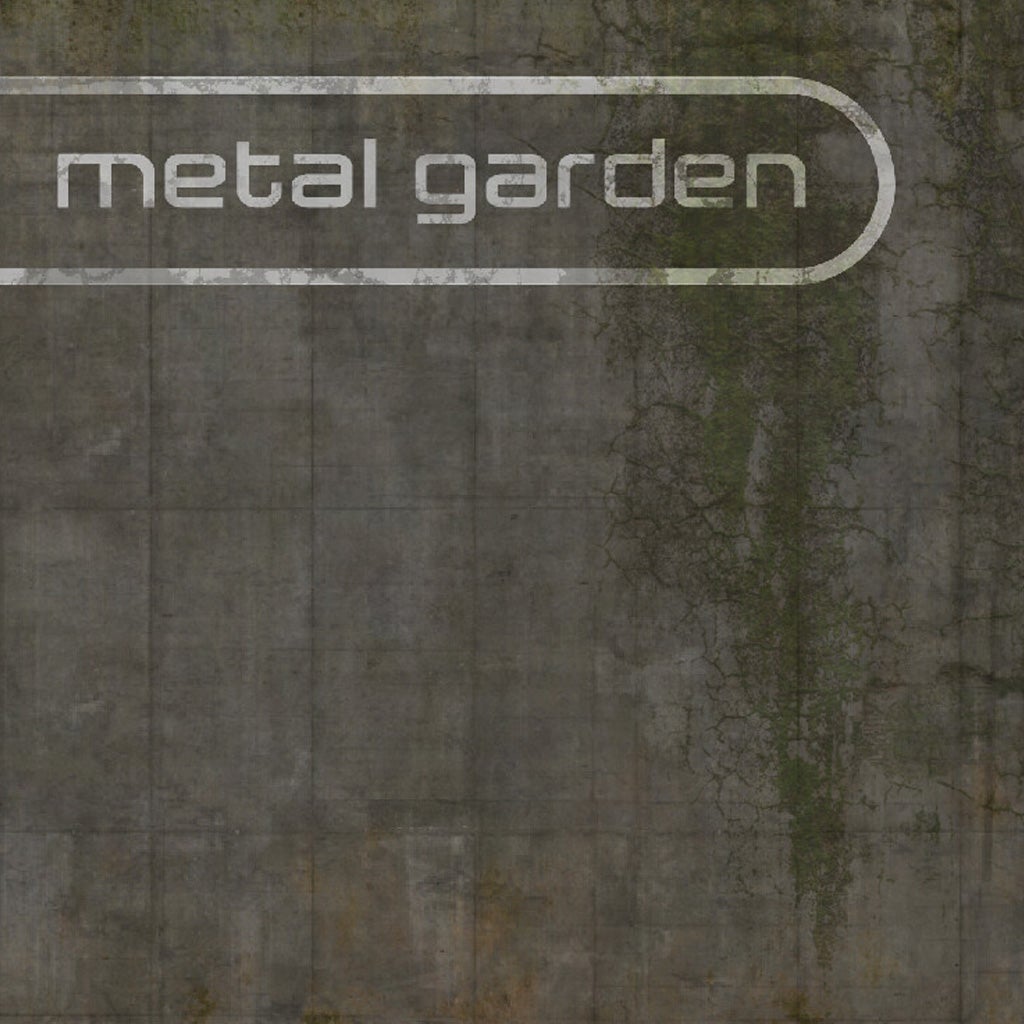
Visually, Metal Garden has an identity that is hard to mistake for anything else. Its enormous concrete structures, muted colours and industrial spaces create a world that feels both oppressive and strangely beautiful.
The brutalist architecture provides much of the game’s character. Towering walls and massive structures make you feel tiny, while the occasional appearance of nature creates a striking contrast. A lone tree, a patch of vegetation or a field of wind turbines can suddenly become more visually significant than anything else in the environment.
That is because the game understands scarcity. When almost everything around you is grey, green and industrial, a little piece of life immediately grabs your attention.
There is also a pleasing mid-2000s quality to the visual design. It does not attempt to mimic modern photorealism, and that works in its favour. The slightly stripped-back presentation allows the architecture and composition to take centre stage.
Silence, Wind and Gunfire
The audio design follows the same minimalist philosophy. Rather than constantly filling the air with music, Metal Garden is comfortable with silence. Wind moves through the enormous spaces, machinery hums in the distance, and your footsteps provide a constant reminder that you are alone. Then an alarm might suddenly sound, or a gunshot breaks the silence, and the effect is considerably stronger because the game has spent so much time making quiet feel normal.
The weapons themselves have a crisp, satisfying sound that gives combat enough weight without overwhelming the atmosphere. There is no need for bombastic music every time an enemy appears. Sometimes hearing your own breathing and footsteps as you move through an enormous abandoned structure is far more effective. It is a soundtrack built around absence, and that suits the game perfectly.
A Short Journey Worth Taking
The biggest challenge for some players will undoubtedly be the game’s length. Metal Garden can be completed in roughly one to three hours, depending on how thoroughly you explore, and there is no pretending it is a sprawling FPS campaign.
Personally, I think the brevity suits the experience. The game has a very specific mood and a particular story to tell, and stretching that experience across ten or twenty hours could easily have diluted what makes it special.
The inclusion of modifiers also adds replayability. You can adjust elements of the experience, including health systems, enemy behaviour and item randomisation, allowing subsequent playthroughs to feel different.
It will not suddenly transform Metal Garden into an endless shooter, but that is not what it needs to do. The modifiers are there for people who want to revisit the world and experiment with its systems after seeing the main journey through.
The Verdict
Metal Garden is a refreshing reminder that an FPS need not be enormous to leave an impression. Its compact campaign, limited arsenal and minimalist storytelling may initially seem modest, but those constraints allow the game to focus on what really matters: atmosphere, exploration and the feeling of being completely alone within something impossibly large.
The gunplay is responsive enough to carry the action, while the injury system adds an unusual layer of vulnerability to encounters. Yet it is the megastructure itself that becomes the true star of the show. Those vast concrete spaces, forgotten machines and unexpected pockets of nature create a world that feels ancient, mysterious and strangely melancholic.
There is a real sense of sadness beneath Metal Garden. You are walking through the remains of countless lives, exploring architecture that has outlasted its creators and trying to understand a place that may no longer have anyone left to explain itself. The game does not spell everything out, and that makes the questions linger long after the credits.
It will not satisfy players looking for a huge arsenal, a lengthy campaign or constant action. What it does offer is something rather different: a short, focused science fiction journey with a strong artistic identity and an atmosphere that gets under your skin.
In an industry where bigger often means supposedly better, Metal Garden makes a convincing argument for restraint. It knows when to let you walk, when to let you wonder and when to put a weapon in your hands and remind you that this beautiful forgotten world is not entirely empty. For a game that can be finished in a single sitting, it leaves behind an unexpectedly large shadow.