There are horror games that rely on what you see, others on what you hear—but Homicipher is built around what you don’t understand. It’s a game that transforms language itself into both a puzzle and a threat, asking players not merely to survive an otherworldly nightmare but to decipher it. The result is one of the most quietly inventive horror experiences in recent years: unnerving not because it overwhelms you but because it forces you to engage on unfamiliar, deeply uncomfortable terms.
At a glance, Homicipher presents itself as a hybrid of visual novel and exploration adventure. But that description barely scratches the surface. This is a game about communication without comprehension—about navigating a world where every word matters, and none of them make sense. At least, not at first.
Learning the Language of Fear
The premise is deceptively simple. You wake in a strange, hostile Otherworld, populated by unsettling figures called “horror men”. They speak in an incomprehensible language, and your only hope of escape is to learn how to understand them.
This is where Homicipher sets itself apart. Instead of relying on traditional dialogue choices or puzzle mechanics, the game asks you to actively decipher a constructed language. Words and symbols appear repeatedly in different contexts, and through observation, deduction, and quite a bit of trial and error, you start to understand their meanings.
It’s a slow, deliberate process—and that’s exactly what makes it so effective. Early interactions are filled with uncertainty. A single misinterpretation can lead to failure, or worse. There’s a constant tension in each exchange, as you weigh your limited understanding against the potential consequences.
This mechanic does more than introduce novelty; it fundamentally changes how you engage with the game. Dialogue becomes a puzzle. Every encounter is a negotiation between knowledge and risk.
Exploration and Structure
While much of the game unfolds through dialogue, exploration plays a key supporting role. The Otherworld is presented as a series of interconnected spaces, each filled with cryptic clues and eerie encounters. Progression depends not only on where you go but also on what you understand.
The pacing is deliberately measured. Homicipher isn’t interested in rushing you forward. Instead, it encourages careful observation and reflection. You’ll revisit areas, recontextualise earlier interactions, and gradually build a mental lexicon that allows you to navigate more confidently.
However, this structure can also be a double-edged sword. The reliance on repetition—seeing the same words and scenarios multiple times—is essential to the learning process, but it can occasionally feel slow, particularly for players who prefer more immediate feedback.
Horror Through Uncertainty
What makes Homicipher truly unsettling is how it uses its core mechanic to heighten its horror. The inability to understand what’s being said creates a constant feeling of vulnerability. You’re not just unsure of what to do—you’re unsure of what’s happening at all.
The “horror men” themselves are central to this effect. Their designs are striking, blending the surreal with the grotesque in a way that feels distinctly personal to the developer’s vision. They’re not traditional monsters; they’re something stranger, more ambiguous. At times, they seem threatening. At others, almost sympathetic.
This ambiguity is crucial. Because you don’t fully understand them, you’re compelled to project your own interpretations onto their actions. Are they helping you? Testing you? Manipulating you? The game rarely offers clear answers, and that uncertainty lingers long after each encounter.
Presentation and Atmosphere
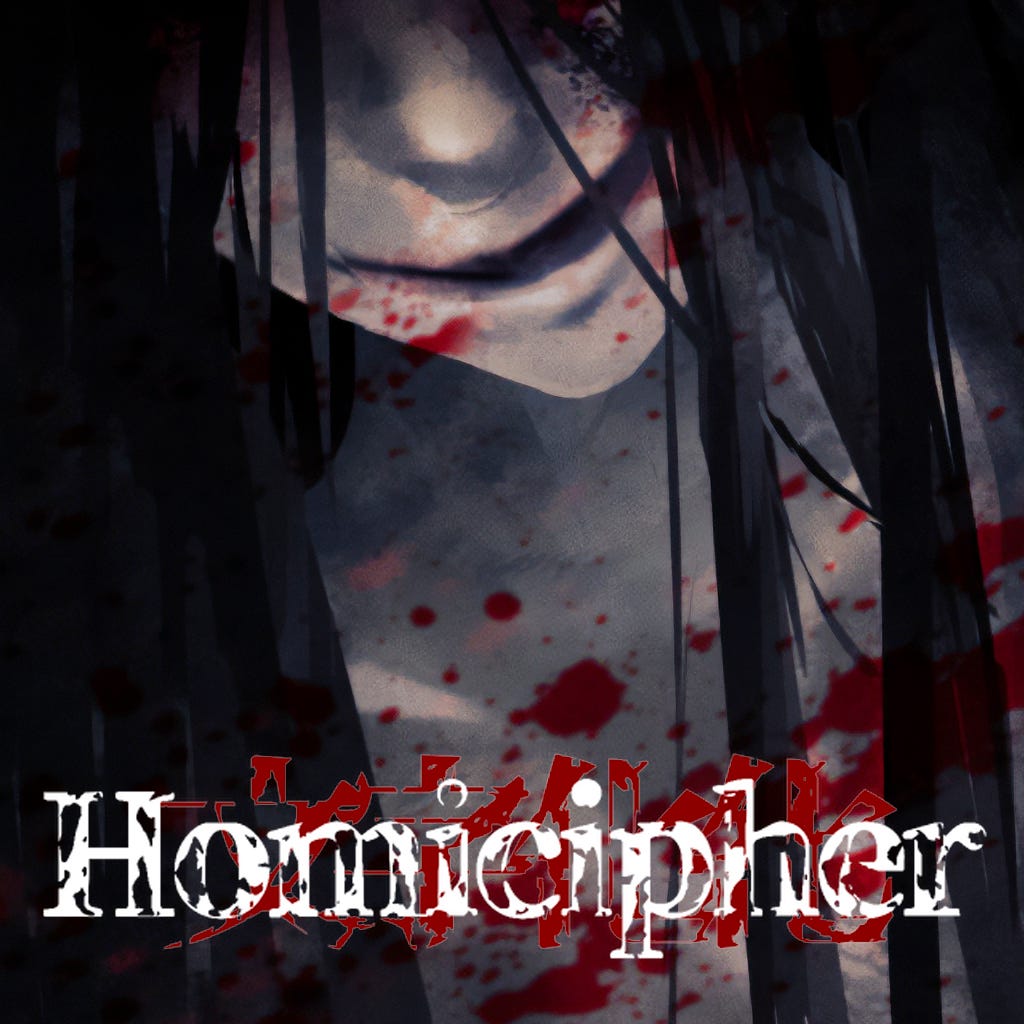
Visually, Homicipher adopts a stylised, hand-drawn aesthetic that complements its surreal tone. The newly added illustrations in the Switch version enhance key moments, giving the experience a stronger emotional and visual impact.
The art direction leans heavily into contrast—soft, almost delicate character designs juxtaposed against disturbing imagery and unsettling environments. It’s a combination that reinforces the game’s central tension between familiarity and alienation.
Sound design is equally effective. Rather than relying on loud scares, the game uses subtle audio cues to build atmosphere. Ambient sounds, distorted voices, and moments of near-silence create a soundscape that feels as disorienting as the visuals.
The Switch Experience
The Nintendo Switch version introduces several welcomed improvements. Controls have been optimised for both text input and point-and-click interactions, making the process of deciphering language more intuitive. This is particularly important given how central that mechanic is to the experience.
The addition of new illustrations also adds value, especially for returning players. Combined with the expanded language support, the Switch release feels like a thoughtful and complete version of the game.
Performance is smooth, with no major technical issues detracting from the experience. The portability of the Switch also suits the game’s structure, allowing for shorter, more reflective play sessions.
Where It Challenges
Homicipher is not an easy game to recommend universally. Its core mechanic, while innovative, demands patience and a willingness to embrace ambiguity. Players seeking clear objectives or quick progression may become frustrated.
The trial-and-error process of deciphering language can sometimes feel punishing, especially when mistakes result in abrupt or unclear outcomes. There’s also a risk of players getting stuck, unsure of how to proceed due to gaps in their understanding.
Furthermore, the game’s deliberate pacing may feel slow at times. This is a necessary trade-off for the depth of its central idea, but it may not appeal to everyone.
Final Verdict
Homicipher is a rare kind of horror game—one that doesn’t rely on reflexes or spectacle, but on cognition and interpretation. By turning language into its primary mechanic, it creates an experience that is as intellectually engaging as it is emotionally unsettling.
It’s not without its flaws. The pacing can drag, and the reliance on trial and error may test some players’ patience. But for those willing to engage with its systems, Homicipher offers something genuinely distinctive: a horror experience that unfolds not just on the screen, but in your mind.
In a genre often defined by repetition, it dares to be different—and succeeds more often than it falters.