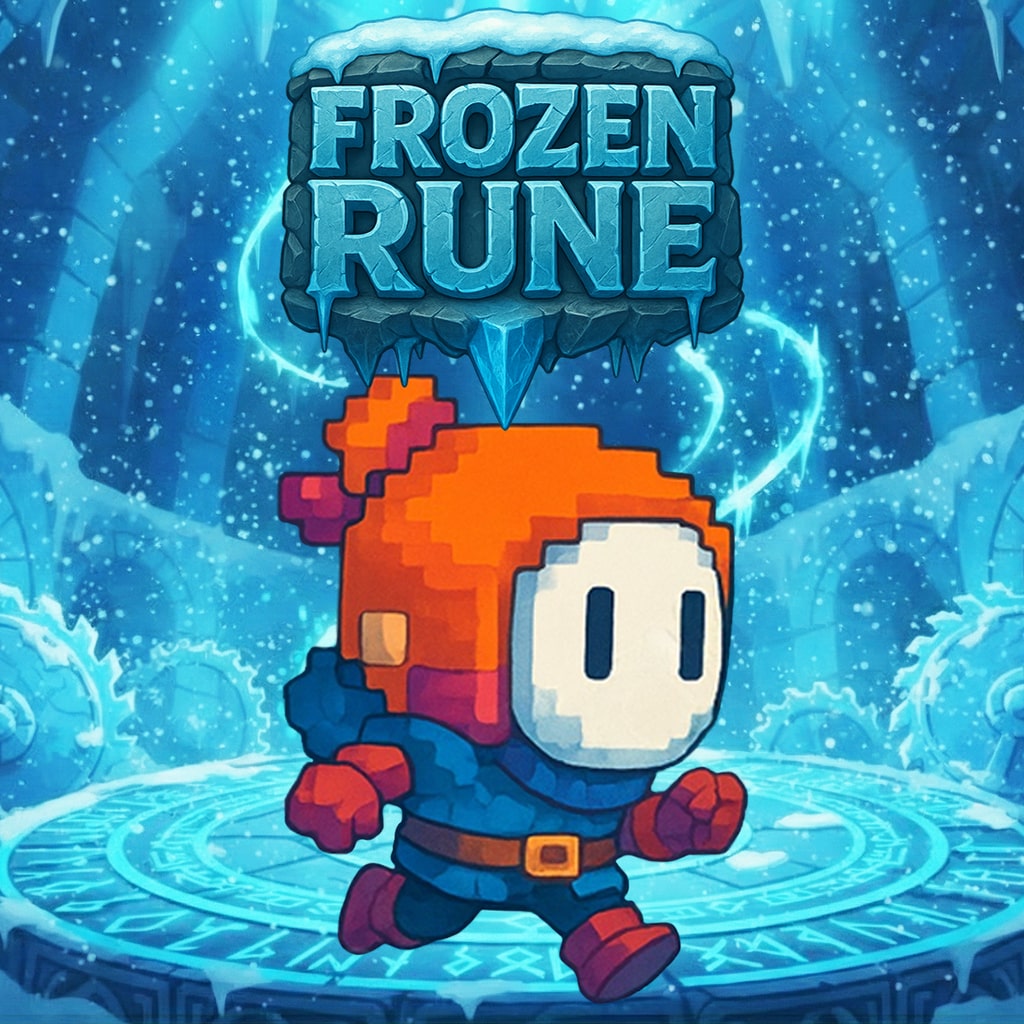
Frozen Rune is a precision platformer that wastes no time establishing its philosophy: perfection or restart. Developed by Fabrizio Q. Abreu and published by FaGames Studio, this PS5 release is the latest stop in a staggered rollout that began on PC and Xbox in late 2025. On PlayStation 5, it retains its uncompromising design identity—an ultra-focused, high-difficulty 2D platformer built entirely around repetition, mastery, and punishment.
At its best, Frozen Rune delivers the razor-edged satisfaction only precision platformers can achieve. At its worst, it occasionally tips into frustration that feels less like a challenge and more like attrition. The result is a tightly designed but emotionally uneven experience.
Core Gameplay – One Mistake, One Restart
Frozen Rune is built around a simple but brutal rule: you have no health bar. Any contact with a trap, hazard, or enemy immediately resets the entire level. There are no mid-checkpoints, no safety nets, and no recovery mechanics. Every stage is a self-contained test of execution.
Across 30 levels, your objective remains the same: navigate environmental hazards, survive moving traps, and reach the Ice Rune that unlocks the exit. That simplicity is deceptive. Each level is less a traditional platforming stage and more a tightly choreographed sequence of inputs that must be executed with near-perfect timing.
Movement is precise and deliberate. The character feels light but not slippery, responsive but not forgiving. Every jump, wall interaction, and directional adjustment matters. Success is never accidental—you either understand the level or you don’t.
What Frozen Rune does particularly well is its commitment to consistency. Once you learn a mechanic, the game expects you to internalise it fully. There is no hand-holding, no easing back into familiar patterns. Instead, it constantly escalates pressure by remixing known ideas in more punishing configurations.
Level Design – Controlled Brutality
The 30 levels in Frozen Rune are carefully structured, even if they rarely feel gentle. Early stages introduce basic hazards such as spike traps, collapsing platforms, and simple timing gates. These serve as training grounds for the game’s strict rhythm of movement.
As the game progresses, however, level design becomes increasingly elaborate. Later stages introduce layered hazards—moving blades combined with shifting platforms, timed environmental triggers that require memorisation, and sequences that demand near-frame-perfect execution.
There is a clear design intent here: teach, then test, then break, then demand mastery.
At its strongest, this structure creates a deeply satisfying learning curve. You fail, you observe, you adjust, and eventually you succeed. The game rewards patience and repetition, and when you finally clear a difficult section, it feels genuinely earned.
However, some levels cross the line from challenging into repetitive frustration. A few later stages rely heavily on trial-and-error memorisation rather than intuitive pattern recognition. This can make progress feel artificially gated, especially when a single mistake forces a full restart of an extended sequence.
Still, the overall structure remains coherent. There is a logic to its cruelty—it is not random, just uncompromising.
Difficulty – Precision Over Forgiveness
Frozen Rune proudly belongs to the tradition of “one-hit reset” platformers, and it makes no apologies for it. This is a game designed for players who learn through failure.
That said, its difficulty curve is uneven. Some stages feel perfectly tuned, offering just enough breathing room for skill development. Others feel noticeably steeper, demanding execution that borders on perfection without much preparatory ramp-up.
The absence of checkpoints is both its defining strength and its most divisive feature. On the one hand, it preserves tension and makes success meaningful. On the other, it can turn longer sequences into endurance tests rather than skill challenges.
This is a game that asks for patience above all else. If you are willing to repeat sections dozens of times, it eventually reveals its internal rhythm. If you are not, it risks becoming exhausting.
Controls – Tight but Demanding
Control responsiveness is one of Frozen Rune’s strongest technical achievements. Inputs are immediate, with minimal latency and predictable physics. When you fail, it is almost always due to timing or positioning—not to inconsistent control.
Jump arcs are consistent, wall interactions are reliable, and directional movement behaves exactly as expected. This precision is essential in a game where milliseconds matter.
However, the flip side of such tight control is a lack of forgiveness. Small mistakes are hard to recover from, and there is little room for improvisation once a sequence begins. This reinforces the game’s identity but also limits expressive play.
Visuals and Audio – Minimalist but Functional
Visually, Frozen Rune adopts a clean, minimalist 2D style. Environments are readable above all else, with hazards clearly distinguished from safe surfaces. This clarity is essential given the game’s difficulty.
The ice-themed aesthetic is consistent throughout, with muted blues, whites, and greys dominating the palette. While not particularly ambitious visually, it effectively conveys danger and cold precision.
Animations are simple but functional. There is no unnecessary flair, only clear movement.
Audio design follows a similar philosophy. Sound effects are crisp and informative, clearly signalling jumps, traps, and collisions. The soundtrack is understated, often fading into ambient minimalism during high-focus sections. It supports concentration rather than attempting to dominate the experience.
PS5 Version – A Clean, Stable Port
The PlayStation 5 version of Frozen Rune is a technically solid port. Load times are fast, performance is stable, and input responsiveness feels excellent on DualSense hardware.
There are no significant PS5-exclusive features beyond general performance enhancements, though the game benefits from smoother frame pacing and reduced loading delays compared with earlier PC and Xbox builds.
DualSense implementation is minimal but present, with subtle haptic feedback tied to movement and environmental interactions. It does not fundamentally change the experience, but it adds a slight tactile layer to precision timing.
Importantly, the PS5 version does not introduce new content or balance changes. It is a straightforward, polished port of the original release.
Replayability – Mastery as Motivation
Replayability in Frozen Rune is entirely skill-driven. There are no branching paths, significant collectibles, or alternate modes. The incentive to replay comes purely from personal mastery.
Speedrunning potential is clearly intended, as levels are structured to reward optimisation. Players who enjoy shaving seconds off runs or perfecting movement routes will find long-term value here.
For others, however, replayability may be limited once the main 30 levels are completed. Without additional systems or modes, the experience is tightly contained.
Final Verdict
Frozen Rune is a disciplined, uncompromising precision platformer that knows exactly what it wants to be. Its strongest qualities—tight controls, consistent level design, and high-stakes design—make it satisfying when everything clicks. But its strictness and occasional reliance on memorisation rather than adaptability may alienate players seeking a more forgiving challenge curve.
It is a game of repetition, patience, and eventual mastery. When it works, it feels excellent. When it doesn’t, it feels exhausting.