There is a particular kind of lawless creativity many of us remember from childhood, whether it was dressing up as a cowboy with a homemade cap gun or staging battles in which a plastic outlaw might just as easily square off against a dragon as another gunslinger. In those moments, ‘magic’ was never defined by rules or systems. It was simply whatever we decided it needed to be to keep the adventure moving.
Far Far West, the latest breakout hit from Evil Raptor and Fireshine Games, is perhaps the first modern shooter to truly bottle that playground mentality. It refuses to be pinned down by the frontier’s gritty realism or the rigid structures of a traditional RPG. Instead, it invites you into a world of robot cowboys and elemental chaos, where the only real law is the ‘Rule of Cool.’ It’s a chaotic, high-fiving reminder that the most memorable games don’t try to make sense of the world—they simply give you the tools to set it on fire.
Far Far West by Evil Raptor captures that exact spirit of joyful, genre-mashing chaos. Released this month on PC, it trades any sense of dusty realism for a neon-soaked frontier where robot cowboys sling elemental spells and supernatural bounties roam the wastes. It is a high-octane cooperative experience that understands something important about play itself: the best adventures are not the ones that follow history, but the ones that hand you a six-shooter, a fireball, and dare you and your friends to make it back to the train in one piece.
Presentation
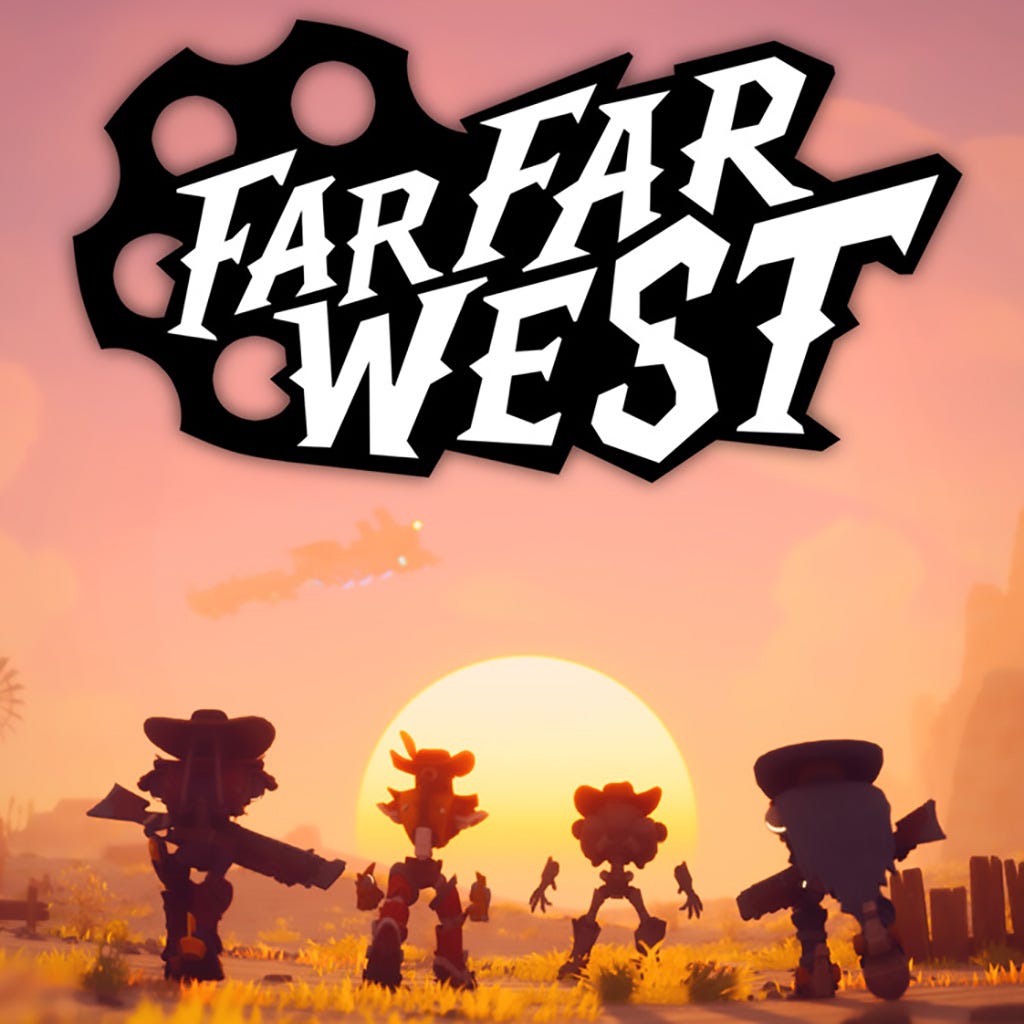
Far Far West commits fully to its identity. This is neither a grounded western nor a subtle fantasy twist on history. It is a cartoon fever dream of the frontier, where skeletons rise from dusty plains and ghost trains scream across the sky like something out of a pulp comic.
The art style leans into bold silhouettes and exaggerated animation. Robot cowboys clank across sun-bleached deserts, while haunted mines glow with an eerie green pulse that feels both inviting and dangerous. Even in Early Access, every biome has a strong sense of personality. The towns feel lived-in, not because they are realistic, but because they are packed with clutter, colour and character.
Sound design deserves particular credit. Guns feel weighty, spells crackle with satisfying force, and the ambient world is filled with distant howls, creaking wood and the occasional spectral train horn that makes you pause mid-loot just to check the horizon.
Gameplay
At its core, Far Far West is built on a simple loop. You and up to three other players accept a bounty, drop onto a map, complete objectives, collect loot, and then attempt to extract before everything goes wrong. Which it often does.
The twist lies in the flexibility you are given during that loop. Every player is a customisable robot cowboy with access to both firearms and elemental magic. You are not locked into a single role. Instead, you are encouraged to mix and match abilities depending on your loadout and team composition.
One moment you are lining up headshots with a revolver; the next you are casting fireballs into a swarm of reanimated skeletons while someone else accidentally triggers an alarm, bringing half the map down on your position.
Combat is fast, responsive and deliberately chaotic. Guns pack a satisfying punch, while spells add a layer of spectacle that keeps encounters visually dynamic. The real strength here is synergy. Lighting an enemy group on fire while a teammate freezes them mid-air never stops feeling good, even after repeated runs.
Extraction itself becomes the tension point. It is rarely clean. More often than not, you are sprinting back towards the escape point, low on health and carrying too much loot, arguing over whether to risk one more optional objective.
Progression and Customisation
Between missions, players return to a central saloon hub that serves as both an upgrade station and a social space. Here, you spend your earned bounty on weapon upgrades, spell enhancements and permanent perks.
The progression system leans into experimentation. You can build a character focused on raw gun damage, lean heavily into spellcasting, or balance both into a hybrid loadout that adapts on the fly. There is also a strong cosmetic layer, allowing you to customise both your robot cowboy and your mount with unlockable skins ranging from rugged to outright absurd.
One of the more interesting systems is the perk structure, which lets you specialise further into roles such as healing support or critical-hit sniper. While Early Access balancing still needs refinement, the foundation is promising and already encourages replayability.
Multiplayer Experience
This is where Far Far West either shines brightest or collapses entirely, depending on your group. With a coordinated team, the game feels like a tightly orchestrated heist. Players call out targets, split objectives, and extract with precision. With a less organised group, it becomes controlled chaos. Someone rushes ahead, someone else lags behind, looting every crate, and suddenly the entire squad is fighting a boss they were not ready for.
And yet, even in failure, the game rarely feels punishing in a frustrating way. Instead, it leans into comedy. Watching your team get wiped by a ghost train because nobody noticed the warning signs is frustrating in the moment, but memorable afterwards.
Solo play is available, but it is clearly not the intended focus. The game’s systems are built around cooperation, and without it, much of the charm is lost.
Performance and Early Access State
As an Early Access release, Far Far West already feels surprisingly stable. Performance is solid across most encounters, with only occasional dips during particularly effects-heavy fights. Matchmaking and lobby systems are functional, though still clearly evolving.
The biggest rough edges stem from progression pacing and some repetitive mission structures. Certain contract types begin to blur together after extended play sessions, and the grind for higher-tier upgrades can feel slightly drawn out in the early hours.
However, it is important to frame this in context. The core experience is already entertaining, and the systems in place suggest strong potential for expansion and refinement.
Final Verdict
Far Far West is not trying to be a serious take on the western genre, nor a perfectly balanced competitive shooter. It is a loud, chaotic co-op playground where teamwork, improvisation and sheer luck matter equally.
When it works, it delivers some of the most enjoyable co-op firefights in recent memory. When it does not, it still produces stories worth retelling.
There is real potential here. With continued refinement, especially in mission variety and progression pacing, this could easily become a staple of the co-op shooter space. Even now, in its Early Access form, it captures something that many games miss entirely: the joy of shared chaos.