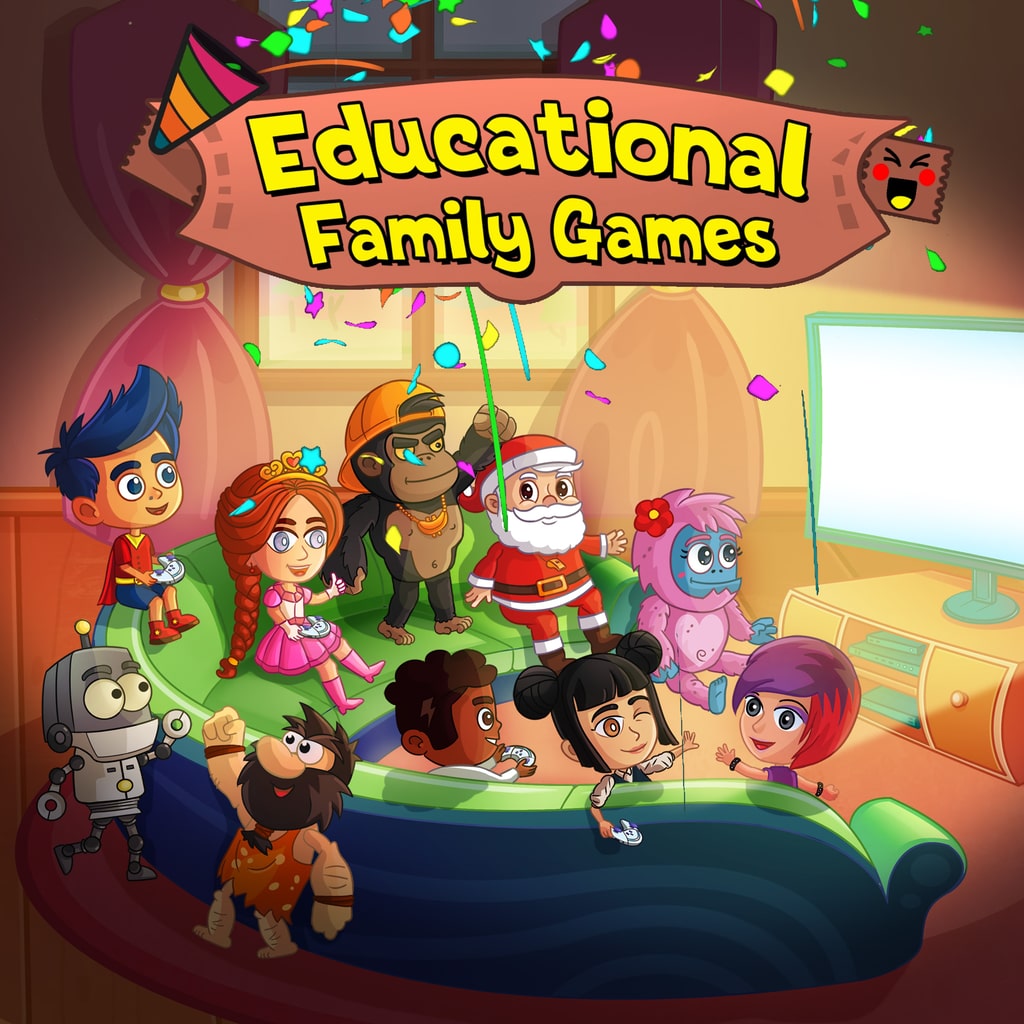
Educational games have always had an uphill battle. Too often, they lean so heavily into teaching that they forget to entertain, leaving children disengaged and adults counting the minutes until they can move on to something else. Party games face the opposite problem, offering plenty of laughs but little substance beyond the next round. Educational Family Games attempts to bridge that gap, blending eighty educational and arcade-inspired mini-games into a colourful local multiplayer package that aims to entertain every generation on the sofa.
Developed by Crazysoft Limited, this latest release is less concerned with creating the next competitive party phenomenon and more focused on bringing families together. It recognises something that many modern multiplayer games have forgotten: some of the best gaming memories are made when everyone shares the same room, laughing at each other’s mistakes and celebrating unexpected victories. Educational Family Games embraces that philosophy wholeheartedly, creating an experience where learning becomes part of the fun rather than the sole purpose.
The result is a charming collection that succeeds far more often than it stumbles. While it may not replace heavyweight party staples for seasoned players, it carves out an impressive niche by making education feel natural rather than forced.
A Modern Take on Family Game Night
At its core, Educational Family Games adopts the familiar structure of a traditional board game. Players choose from a roster of ten cheerful characters before travelling across one of five themed game boards, collecting gems and competing for the crown. Progress is punctuated by a steady stream of mini games that appear after each turn, creating a constant rhythm that keeps sessions lively from beginning to end.
The board game format works because it provides context for everything else. Winning a maths challenge or dominating a reflex-based competition feels meaningful because every success moves you closer to victory. Even younger players quickly grasp the objective, while adults appreciate the light competitive edge beneath the colourful presentation.
The pacing deserves particular praise. Mini games rarely overstay their welcome, ensuring that even activities which are not personal favourites disappear before they become repetitive. There is always another challenge around the corner, making every session feel unpredictable. Whether you have fifteen minutes to spare or want to settle in for a full evening tournament, the structure adapts remarkably well.
Eighty Mini Games Offer Impressive Variety
The headline feature is undoubtedly the collection of eighty mini-games, and thankfully the number is more than a simple marketing ploy. Educational challenges cover an impressively broad range of subjects. Mathematics, geography, science, chemistry, anatomy, memory, logic and the arts all make appearances throughout the experience. Rather than presenting these subjects through static quizzes, the game wraps them in fast-paced challenges that reward quick thinking and observation.
Just when you think the game has settled into an educational rhythm, it shifts direction entirely. Suddenly players are dodging fireballs, racing bicycles, flying rockets, kicking footballs or copying drawings under pressure. These lighter moments prevent the educational content from becoming overwhelming and ensure younger players never feel as though they are sitting through another lesson.
The variety is what keeps the experience engaging. No single activity dominates the overall package, and each round feels distinct enough to sustain excitement throughout longer sessions. Some mini-games are naturally stronger than others, but there are very few that feel genuinely disappointing.
Accessibility Done Exceptionally Well
Perhaps the game’s greatest achievement is how welcoming it feels. Every instruction is fully voiced in nineteen languages, eliminating one of the biggest barriers younger children often face. Players who cannot yet read can still understand objectives simply by listening, allowing them to participate alongside older siblings and adults without feeling left behind.
This feature also benefits grandparents or family members who are less comfortable navigating modern video games. There is no pressure to memorise lengthy menus or complicated controls, as the game continually explains itself in a friendly, approachable manner.
The optional GamePad Link companion app is another thoughtful addition. Allowing Android and iOS smartphones to function as controllers removes the need to own four separate gamepads, making larger family gatherings far easier to organise. It is refreshing to see accessibility treated as a genuine design priority rather than an afterthought.
Bright, Cheerful and Built for Everyone
Educational Family Games embraces a colourful cartoon art style that suits its audience perfectly. Characters are expressive, environments are vibrant, and every board feels inviting without becoming visually cluttered.
Performance is equally polished on PlayStation 5. The game runs smoothly throughout, with fast loading times that keep downtime to a minimum between activities. Mini-games transition seamlessly into one another, helping maintain the energetic flow that defines the overall experience.
The soundtrack supports the cheerful atmosphere with upbeat melodies that remain pleasant without becoming repetitive. Sound effects are playful and exaggerated in all the right ways, giving every success and failure enough impact to keep players smiling.
While the DualSense controller features are fairly modest, relying mostly on standard vibration, the responsive controls make every mini-game feel reliable and accessible regardless of player experience.
Bringing Generations Together
What truly separates Educational Family Games from many educational titles is its understanding of family dynamics. Rather than creating an experience aimed exclusively at children, it actively encourages parents and grandparents to participate rather than supervise. Adults are challenged alongside younger players rather than simply helping from the sidelines.
This shared participation creates genuinely memorable moments. Watching a grandparent unexpectedly dominate a memory challenge or seeing the youngest family member confidently answer a geography question before everyone else creates the sort of stories that linger long after the console has been switched off. The game quietly reminds players that learning is often most effective when done together. That is a surprisingly powerful achievement.
A Few Areas for Improvement
Despite its many strengths, Educational Family Games is not perfect. Its biggest limitation is the complete absence of online multiplayer. The game is intentionally designed around local gatherings, and that philosophy works wonderfully, but families separated by distance will understandably wish they could join the fun remotely.
Some educational categories also begin to repeat questions after extended play sessions. This is unlikely to bother occasional players, but families who return every weekend may eventually notice familiar geography or science prompts reappearing.
Finally, while the mini-game variety is impressive, not every activity reaches the same standard. A handful feel quite simplistic compared with the stronger logic- and memory-based challenges. None are poor enough to damage the overall experience, but there is a noticeable difference in depth between the best and weakest offerings. Fortunately, the sheer volume of content means weaker moments pass quickly.
Final Verdict
Educational Family Games succeeds because it recognises that education and entertainment need not be at opposite ends of the spectrum. By combining a wide range of mini-games with an accessible board-game framework, Crazysoft Limited has created an experience that encourages families to spend meaningful time together while exercising their minds.
Its vibrant presentation, thoughtful accessibility features and extensive selection of activities make it one of the strongest educational party games currently available. Although the lack of online play and occasional content repetition prevent it from reaching absolute greatness, they do little to diminish what is ultimately a genuinely enjoyable family experience.
For households looking to replace passive screen time with shared laughter, friendly competition and a surprising amount of learning, Educational Family Games delivers exactly what it promises. It proves that educational gaming has come a long way from the dull, uninspired software of decades past, offering something that children will happily revisit and that adults will equally enjoy joining.