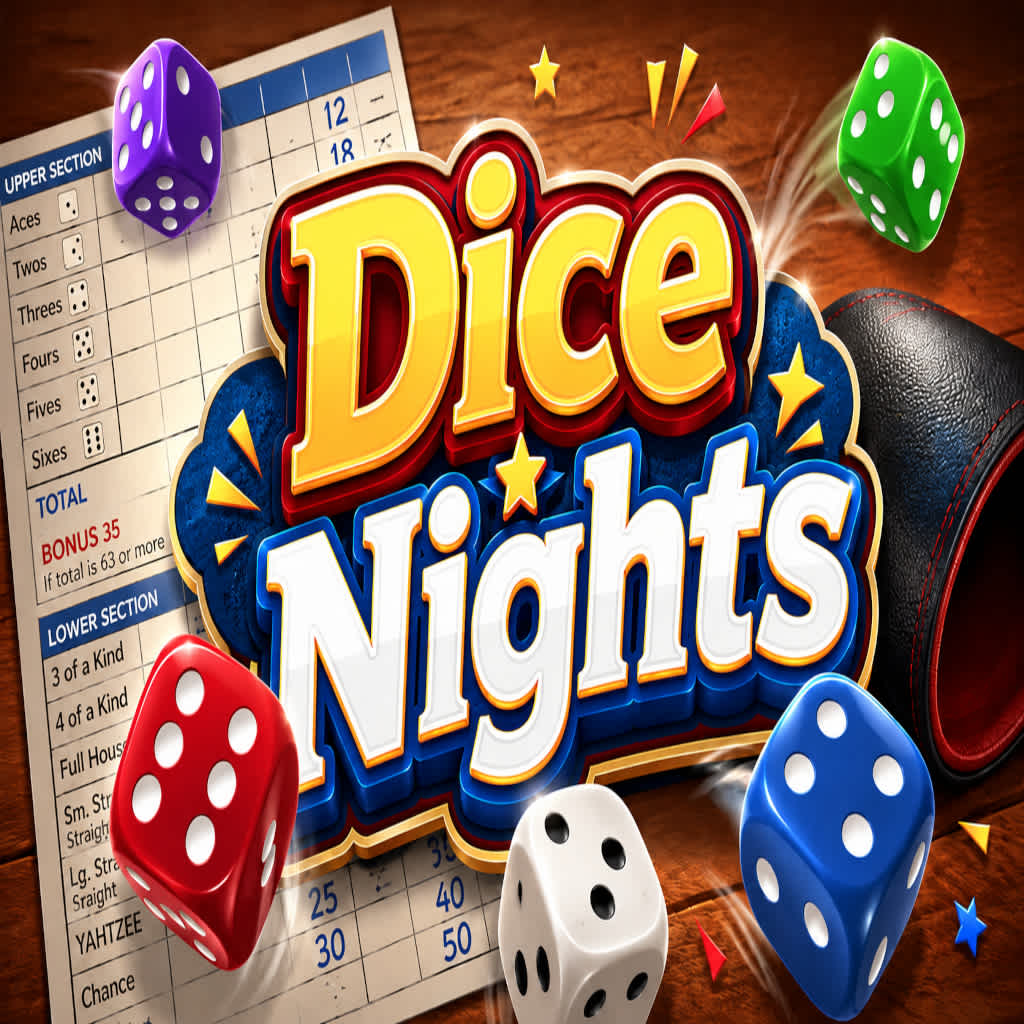
There is something wonderfully uncomplicated about sitting down with a handful of dice. You roll them, hope for the best, make a decision, roll again, and then feel that tiny rush of excitement when the numbers finally fall into place. Dice Nights takes that familiar pleasure and builds an accessible little board game experience around it, focusing on classic combinations, score management and the eternal temptation to take just one more chance. It is not trying to reinvent dice games, but sometimes there is real value in knowing exactly what you want to be.
At its heart, Dice Nights is about making the most of limited opportunities. You can roll up to five dice, decide which results to keep, and then use your remaining rolls to improve the combination in front of you. It sounds simple because it is, but the decisions become increasingly interesting when you have to choose between taking a safe score now and gambling on something considerably better. That little moment of hesitation is where the game finds its personality.
The Simple Pleasure of a Good Roll
The basic gameplay is instantly familiar to anyone who has spent an evening playing dice games. You throw your dice onto the table and inspect the results, deciding which to keep and which to send back into the cup for another roll. A pair might be useful, but perhaps you are one number away from a straight, while a promising set of matching numbers could tempt you to chase four of a kind.
What makes the system work is that every roll presents a small puzzle. You are not simply hoping for lucky numbers because you have some control over how that luck develops. Keeping three matching dice might give you a strong foundation for a bigger combination, while holding onto a couple of sequential numbers could open the door to a straight. The best moments come when you have one final roll left and several possibilities are tantalisingly close.
There is also a lovely rhythm to the rounds. Nothing drags, and you are rarely waiting around for something to happen. You make your choice, roll the dice, assess the result and decide what comes next. It creates the sort of gameplay loop that is perfect for a quick break, but there is enough strategic thinking to keep you coming back when you start chasing a higher score.
Knowing When to Take the Points
The real test in Dice Nights is not necessarily rolling the perfect combination. It is knowing when to stop. A strong score can disappear surprisingly quickly if you become too greedy, and that familiar urge to think “I can improve this” can mark the start of a disastrous turn.
Score management gives the experience just enough depth to prevent it from feeling like a completely passive game of chance. Completing different categories forces you to think about the bigger picture rather than simply chasing whichever combination happens to be in front of you. Sometimes the sensible option is to take a respectable score and move on, while other situations practically beg you to throw caution to the wind.
That balance between luck and decision-making is what gives Dice Nights its replay value. You cannot control the dice, but you can control how you respond to them. When everything goes right, you feel clever. When everything goes horribly wrong, you can usually blame yourself for getting greedy, even if the dice were clearly conspiring against you.
The Familiar Combinations
The scoring system is built around the classics. Pairs, straights, full houses and four of a kind form the backbone of the experience, while the ultimate goal is to land the elusive five-dice combination. These objectives are immediately understandable, making Dice Nights remarkably welcoming to newcomers.
That accessibility is one of the game’s strongest qualities. There is no intimidating rulebook to work through before you can enjoy yourself. You can pick up the controls, start rolling and grasp the fundamentals almost immediately. The game gives you enough information to make sensible decisions without drowning you in unnecessary explanations.
Of course, understanding the rules is not the same as mastering them. Once you begin chasing personal bests, the decisions become more meaningful. You start thinking several moves ahead, weighing probability against potential rewards and considering which scoring categories you still need to complete. That is where a straightforward dice game can become surprisingly compelling.
A Relaxed Board Game Atmosphere
Visually, Dice Nights keeps things colourful and approachable. The presentation is designed to make the board and dice easy to understand at a glance, which is exactly what this kind of experience needs. There is nothing here to distract from the important business of watching those little cubes tumble across the table.
The bright presentation also gives the game a friendly personality. It feels like something you could pick up with a cup of tea beside you and play without needing to dedicate an entire evening to it. The atmosphere is relaxed rather than overwhelming, and that suits the game’s philosophy perfectly.
Sound plays an equally understated role. The rolling of the dice provides the important tactile feedback, while the overall presentation avoids turning every throw into an enormous theatrical event. That restraint works because the excitement should come from the result itself. When you have three matching dice and one roll remaining, you do not need a bombastic soundtrack to tell you that the moment matters.
Easy to Learn, Harder to Master
One of the most appealing things about Dice Nights is how little friction there is between starting the game and actually enjoying it. Modern games sometimes seem determined to bury simple ideas beneath progression systems, currencies, tutorials and endless menus. Dice Nights largely avoids that temptation and instead focuses on what matters.
That simplicity does mean the game is unlikely to satisfy players seeking a huge amount of content or complex systems. There is only so much variety you can squeeze from a traditional dice game without fundamentally changing its identity. However, that is not necessarily a weakness. Dice Nights is more interested in delivering a polished, repeatable experience than pretending to be something it is not.
The high score element provides motivation to return. Once you have established a respectable personal best, beating it becomes the next challenge. Then comes the desire to improve your decision-making, followed by the inevitable thought that perhaps you can squeeze just a few more points from your next run. It is a modest progression loop, but an honest one.
The Joy of One More Roll
Perhaps the greatest compliment I can pay Dice Nights is that it understands the psychology of dice. There is always another roll waiting. Even when the sensible choice is obvious, there is something irresistible about taking a chance and seeing what happens.
That makes the game surprisingly good at crafting small stories. You might begin a round with an awful set of numbers and somehow turn it into a full house. You might find yourself one number away from a straight, only to watch your final roll completely destroy your plans. Or you might stumble into an incredible combination almost by accident and immediately start wondering whether you can do it again.
These are tiny victories and defeats, but they are precisely what makes dice games so enduring. Dice Nights does not need grand narratives or elaborate mechanics because its drama comes from the table. Every roll creates another little moment of possibility.
The Verdict
Dice Nights is a cheerful, accessible and pleasantly addictive dice game that captures the timeless appeal of rolling the bones and hoping fortune smiles on you. Its mechanics are simple enough for anyone to grasp, yet the interplay of dice selection and score management gives experienced players plenty to think about. The presentation is colourful, the rounds are comfortably paced, and the high-score structure provides a good reason to keep coming back.
It is not a revolutionary board game, and it does not need to be. Its greatest strength is that it takes a familiar formula and presents it without unnecessary complications. There is something genuinely satisfying about making a good decision, watching the dice roll, and seeing your carefully planned combination finally come together.
For players looking for a relaxed game that can be enjoyed in short sessions, Dice Nights is an easy recommendation. It will not keep you occupied for hundreds of hours, nor is it attempting to, but it can provide that wonderfully familiar feeling of saying, “Just one more roll,” only to realise you have been playing for considerably longer than intended.