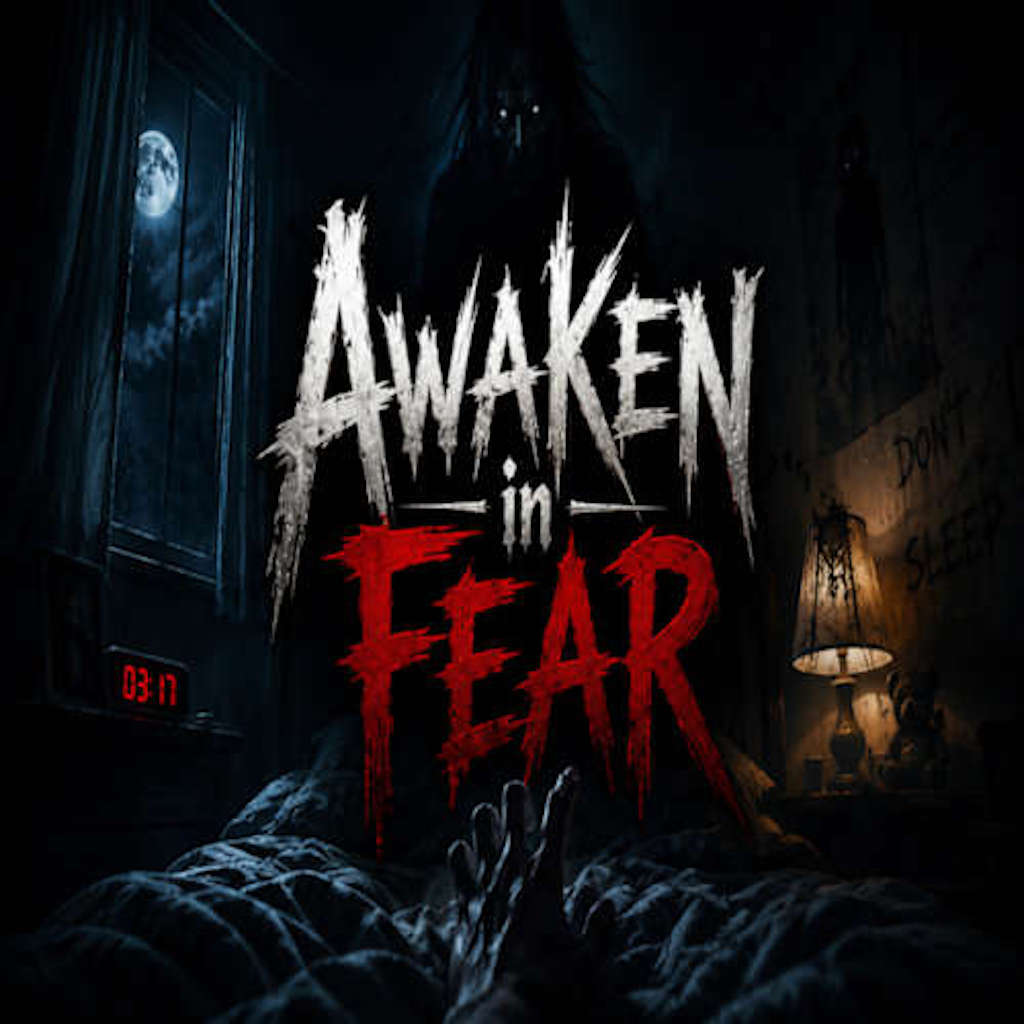
There is something uniquely unpleasant about waking from a nightmare and not being entirely sure you have actually woken up. That brief moment of confusion, when the darkness around you feels strangely familiar and your mind is still trying to separate reality from whatever horror you have just experienced, is the feeling Awaken in Fear attempts to capture. Rather than giving players a comfortable introduction before the terror begins, it throws them into a world where something is immediately wrong and leaves them to work out exactly what that means.
Awaken in Fear is a first-person psychological horror experience built around exploration, puzzles, resource management and the constant threat of supernatural creatures. You explore unsettling environments, search for clues and gradually piece together the mystery behind the nightmare that has swallowed you. It is a familiar formula for anyone who has spent time with survival horror, but there is still something effective about being placed in an environment where every corridor feels like it might contain something you really do not want to meet.
Waking Into the Nightmare
The opening premise does exactly what it needs to. You awaken with questions rather than answers, surrounded by darkness and an oppressive atmosphere that gives you very little reason to feel safe. There is no comforting voice explaining exactly what happened or conveniently marking your route through the nightmare. Instead, you are encouraged to explore and gradually work out what kind of place you have found yourself trapped in.
That uncertainty becomes an important part of the experience. The environments are filled with clues, objects and strange details that suggest there is more going on than simply escaping from a collection of monsters. Notes, environmental details and discoveries gradually form a bigger picture, and the more you uncover, the more unsettling the situation becomes.
There is a real advantage to horror games that allow their environments to do some of the storytelling. Rather than stopping the action every few minutes for lengthy exposition, Awaken in Fear lets you discover its secrets naturally. A bloodstained room, a strange piece of equipment or something that looks slightly out of place can be enough to make you stop and wonder what happened before you arrived.
Never Quite Feeling Safe
The greatest weapon Awaken in Fear has is uncertainty. You are rarely completely comfortable, even when nothing appears to be happening. A quiet corridor can feel more threatening than an obvious monster encounter because your imagination starts filling in the gaps.
Sound plays a particularly important role here. Distant noises, metallic groans, and footsteps travelling through the darkness can make you stop dead in your tracks. When you hear something approaching but cannot immediately see where it is coming from, your brain does a remarkable amount of work for the game.
That is where the psychological horror elements are at their best. Not every frightening moment needs a creature jumping directly into your face. Sometimes the knowledge that something could be nearby is enough. Awaken in Fear understands that anticipation can be considerably more effective than constant action.
Survival Means Thinking Carefully
The survival mechanics lend the exploration a little more weight. Resources are limited, so you cannot simply wander through the nightmare, using every useful item the moment you find it. Batteries, medical supplies and other tools must be used carefully, particularly when you are never entirely certain when the next opportunity to replenish them will arise.
Inventory limitations add another layer of tension. Finding something useful does not necessarily mean you can take it with you immediately, which creates surprisingly meaningful decisions. Do you carry a healing item because you are already injured, or keep space available for something that could help you solve a puzzle later? These are small choices, but horror is often at its best when ordinary decisions suddenly feel important.
The resource system also encourages you to pay attention. Running blindly through unfamiliar areas is rarely the smartest approach, because wasted supplies can come back to haunt you. There is something satisfying about learning to move through an area more efficiently, remembering where useful items are located and becoming just a little more confident with every return trip.
When Running Is the Only Option
Combat is not presented as the answer to every problem, which is exactly what the game needs. The supernatural threats you encounter are intimidating precisely because you cannot simply stroll into a room and eliminate everything standing between you and the exit. Instead, survival often depends on staying quiet, paying attention and knowing when it is time to run.
The sound-based nature of encounters makes movement especially important. Broken debris, careless footsteps and unnecessary noise can turn a quiet exploration sequence into a desperate escape. The creatures feel more dangerous because you are forced to consider how your actions might attract their attention.
This also creates some excellent moments of vulnerability. Hearing something nearby while knowing you need to keep moving, yet desperately trying not to make too much noise, is a classic horror situation, but it remains effective when handled well. There is a primal fear in knowing something is hunting you while you try to work out where the nearest safe route might be.
Puzzles That Keep You Moving
The puzzle design offers a welcome change of pace from stealth and exploration. Broken electrical systems, locked areas, security mechanisms and environmental clues stand between you and the next section of the nightmare. These puzzles give you a reason to investigate the surroundings properly rather than simply following a linear corridor from one scare to the next.
The best puzzles encourage observation rather than demanding obscure leaps of logic. Finding a clue in one room and later realising it provides the solution to something you encountered earlier gives the world a satisfying sense of connection. It also rewards players who take their time rather than rushing through every environment.
There is an appealing rhythm to the overall experience. You explore, discover something strange, search for a solution, encounter a threat and then retreat before returning to investigate further. The repetition of that cycle creates a gradual sense of progress, even when the story itself deliberately keeps you in the dark.
A World Built to Make You Uncomfortable
Visually, Awaken in Fear leans heavily into decay. Dark corridors, deteriorating environments, flickering lights and abandoned spaces create the impression of somewhere that should have been left behind long ago. The darkness is not simply there for visual effect either. It becomes part of the gameplay because you are constantly trying to work out what is hiding beyond the reach of your immediate vision.
The lighting deserves particular credit for maintaining that uncertainty. A corridor illuminated by a flickering light can be considerably more frightening than one that is completely dark, because you are given just enough information to start imagining what might be standing between the flashes.
The sound design completes the atmosphere. Footsteps echo, machinery groans and distant noises seem to come from places you cannot quite locate. With headphones on, the experience becomes considerably more intimate, particularly when you begin relying on sound to determine whether something dangerous is approaching.
The Nightmare Begins to Wear You Down
What makes Awaken in Fear effective is how its different systems work together. Exploration would be less interesting without puzzles, puzzles would feel less tense without the possibility of interruption, and the monsters would be less frightening if resources were plentiful. Each element feeds into the others.
There are moments when the formula can feel familiar. Survival horror has spent decades teaching us to distrust dark corridors, flickering lights and suspiciously convenient doors. However, familiarity does not automatically make those techniques ineffective. What matters is how well they are combined, and Awaken in Fear manages to create a consistently uncomfortable atmosphere.
It also benefits from understanding that horror does not need to be relentless. Giving players quieter moments allows tension to build naturally. When nothing happens for several minutes, you start wondering why, and that question can be far more effective than another predictable jump scare.
The Verdict
Awaken in Fear is a solid psychological survival horror experience that succeeds because it understands the importance of atmosphere. Its dark environments, unsettling sound design and unpredictable supernatural threats create a world where exploration rarely feels entirely comfortable. The combination of scarce resources, environmental puzzles and stealth gives players plenty to think about beyond simply walking from one frightening room to another.
It is not reinventing survival horror, but originality is not everything. Sometimes what matters is execution, and Awaken in Fear delivers the fundamentals with enough confidence to keep you invested. The feeling of hearing something moving nearby, checking your resources and wondering whether to risk continuing is exactly the kind of tension horror fans come looking for.
Most importantly, the game understands that fear is often about what you cannot see. The darkness becomes an active part of the experience, the soundscape constantly raises questions and every unexplored doorway feels like an invitation to discover something you might regret finding. For players who enjoy atmospheric horror where survival depends as much on nerves and observation as on reflexes, there is plenty here to appreciate.