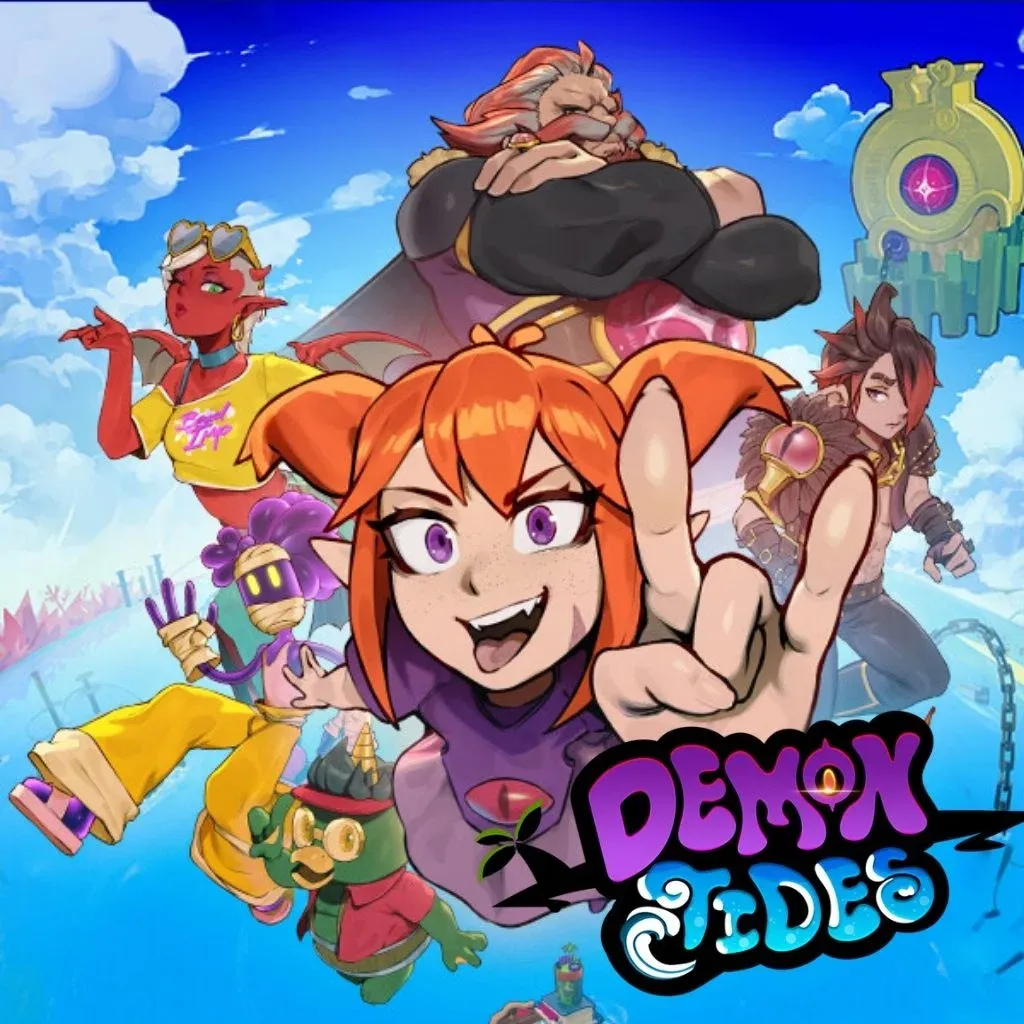
When Demon Turf launched in 2021, developer Fabraz delivered one of the most mechanically expressive 3D platformers in years — a cult favorite defined by personality and movement freedom rather than nostalgia alone. With Demon Tides, released February 19, 2026 on PC (with a Nintendo Switch version arriving later this year), the studio attempts something far more ambitious: transforming that tightly designed platformer into a fully open-world adventure built around speed, exploration, and what the developers proudly call “schmoovement.”
The result is not just a sequel but a reinvention. Where Demon Turf emphasized curated stages, Demon Tides embraces a sprawling oceanic playground filled with islands, secrets, and traversal challenges that reward mastery of movement above all else.
It’s messy in places, occasionally punishing, and unapologetically player-driven — but when it clicks, Demon Tides becomes one of the most exhilarating platformers of the modern indie era.
Story & Setting
You once again step into the shoes of Beebz, the chaotic demon queen-in-training whose punk-rock energy defines the series’ tone. This time, the adventure unfolds across Ragnar’s Rock, an expansive ocean dotted with mysterious islands hiding ancient secrets and increasingly dangerous challenges.
Narratively, Demon Tides leans into character interaction more than its predecessor. Beebz travels with a crew aboard a mobile hub ship, creating downtime moments between exploration bursts. Dialogue remains playful, sarcastic, and occasionally introspective, giving Beebz more emotional dimension without sacrificing the irreverent humor fans expect.
The story itself takes a back seat to exploration — and intentionally so. Like classic collectathons, narrative motivation exists primarily to push players toward discovery rather than dominate pacing.
The real storytelling emerges through environmental design: crumbling structures, surreal landmarks, and hidden areas hinting at a world shaped by forgotten conflicts.
Gameplay — The Art of “Schmoovement”
Movement is everything in Demon Tides.
Beebz’s toolkit includes jumps, dashes, wall-runs, spins, air tricks, and momentum-based chaining that allow skilled players to traverse environments in wildly creative ways. The system rewards experimentation rather than strict execution, encouraging players to invent routes rather than follow prescribed paths.
Early on, movement feels slightly chaotic. Inputs stack quickly, and momentum can betray inexperienced players. But once muscle memory develops, traversal becomes intoxicating — a flowing rhythm where platforms blur into continuous motion.
Few modern platformers capture this sense of freedom. You’re not just reaching destinations; you’re performing your way there.
The game’s open ocean structure amplifies this philosophy. Sailing between islands feels fast and liberating, evoking comparisons to The Wind Waker while maintaining a distinctly punk aesthetic.
Each island acts as a self-contained playground featuring:
- Precision platforming gauntlets
- Hidden collectibles (“Golden Gears”)
- Puzzle challenges
- Combat encounters
- Speedrun routes
Importantly, exploration is nonlinear. Players can tackle objectives in almost any order, creating a strong sense of personal adventure.
Talisman Customization
One of Demon Tides’ smartest additions is its Talisman system.
Over 50 Talismans modify gameplay in meaningful ways:
- Utility upgrades like hookshots and paragliders expand traversal options.
- Movement modifiers alter jump physics or momentum behavior.
- Cosmetic Talismans change Beebz’s appearance, including a nostalgic 2D visual style.
This system turns progression into experimentation. Instead of simply becoming stronger, players reshape how the game feels to control.
Certain combinations dramatically alter traversal strategies, encouraging replayability and speedrunning experimentation.
Player Interaction & Online Features
Fabraz introduces asynchronous multiplayer elements that enhance community engagement without disrupting solo play.
Players can leave graffiti messages and artwork on walls that appear in others’ worlds — sometimes helpful, sometimes ridiculous. The mechanic echoes Souls-style messaging but fits perfectly within the game’s rebellious aesthetic.
Ghost challenges allow players to race against others’ completion times, reinforcing the game’s speedrun-friendly design philosophy.
These features subtly transform exploration into a shared experience without requiring constant online interaction.
Platforming Challenge & Checkpoint System
One controversial mechanic is manual checkpoint placement.
Players must plant flags to create respawn points before attempting difficult platforming sections. Forgetting to do so can result in long returns after failure — a design choice that intentionally raises stakes.
This system creates tension but also occasional frustration, especially during lengthy vertical challenges. Some players will appreciate the added responsibility; others may view it as unnecessarily punishing.
Either way, it reinforces intentional play rather than careless experimentation.
Graphics & Art Direction
Visually, Demon Tides maintains Fabraz’s signature hybrid style — blending 2D character animation with vibrant 3D environments.
The punk-rock aesthetic shines through bold colors, exaggerated silhouettes, and playful environmental design. Islands feel distinct and memorable, ranging from neon-lit ruins to surreal floating structures.
Animation work is particularly strong, giving Beebz expressive personality even during high-speed traversal.
The art direction favors clarity over realism, ensuring platforming readability remains strong even at extreme speeds.
Sound & Music
The soundtrack by Fat Bard and 2Mello is outstanding.
Music dynamically evolves during boss fights, layering additional instruments and eventually vocals based on player performance. This adaptive scoring creates a powerful feedback loop — the better you play, the more energetic the music becomes.
Few platformers integrate audio so directly into gameplay momentum.
Sound effects reinforce movement satisfaction, with every dash, spin, and landing delivering tactile audio feedback that enhances flow-state gameplay.
Performance & Technical State
On PC, performance is largely excellent. The game runs smoothly across a wide range of hardware and is Steam Deck Verified, making portable play surprisingly viable despite the open-world design.
Minor camera quirks occasionally appear during high-speed traversal, and physics interactions can behave unpredictably in tight spaces, but technical issues rarely undermine the experience.
Load times are minimal, maintaining immersion during exploration.
Replay Value & Longevity
Replayability is one of Demon Tides’ greatest strengths.
Between collectible hunting, Talismans experimentation, ghost races, graffiti sharing, and speedrunning routes, players are encouraged to revisit areas repeatedly.
Completionists will find dozens of hours of content, while speedrunners may spend far longer mastering optimal movement paths.
The open structure ensures no two players experience the world in quite the same way.
Pros & Cons
Pros
- ✔ Exceptional movement system with deep mastery potential
- ✔ Seamless open-world design encourages exploration
- ✔ Creative Talisman customization reshapes gameplay
- ✔ Outstanding dynamic soundtrack
- ✔ Strong personality and visual identity
Cons
- ✘ Manual checkpoint system can frustrate newcomers
- ✘ Camera occasionally struggles at high speeds
- ✘ Story remains secondary to gameplay
- ✘ Early learning curve for movement mechanics
Final Verdict
Demon Tides is a rare sequel that understands evolution doesn’t mean abandoning identity — it means expanding it. Fabraz takes the expressive platforming foundation of Demon Turf and scales it outward into an open-world adventure that prioritizes player creativity above all else.
Its greatest achievement is how movement becomes language. Every jump chain, dash cancel, and improvised shortcut tells a story about player skill and experimentation. The game trusts players to learn systems organically, rewarding curiosity with freedom rather than rigid progression.
Not every design choice lands perfectly. The checkpoint system and steep mechanical learning curve may alienate some players, and those seeking narrative-driven experiences may find the story light. But for fans of precision platformers and movement-driven gameplay, Demon Tides offers something increasingly rare: a game built entirely around mastery and self-expression.
In an era where many platformers chase nostalgia, Demon Tides pushes forward — fast, loud, and confidently weird.