There is something rather lovely about a game that does not ask you to defeat an army, save the universe or master a complicated combat system. Sometimes, it is enough to sit down, pick up a virtual crayon and make a story your own. Crayon Story: Thumbelina takes one of the most familiar fairy tales and turns it into a gentle, creative experience in which children can colour scenes, write their own words and gradually build a personalised version of Thumbelina’s adventure. Developed and published by GaniTani, it is a simple idea, yet there is a surprising amount of charm in the way it encourages children to become part of the storytelling process.
At a time when many games aimed at younger players are packed with bright distractions and constant rewards, Crayon Story: Thumbelina takes a quieter approach. There are no complicated systems to master and no pressure to achieve a perfect score. Instead, the emphasis is on creativity, imagination and the wonderful feeling of seeing something you have made appear on the screen. It feels less like a conventional video game and more like a digital activity book with a familiar fairy tale at its heart.
A Familiar Fairy Tale
For many children, Thumbelina is a story they may already know from books, bedtime stories or animated adaptations. The tale of the tiny girl living in a world that is enormous compared with her has always offered plenty of opportunities for colourful illustrations, imaginative characters and fantastical settings. Crayon Story: Thumbelina takes those ingredients and gives young players the chance to interact with them rather than simply watching the story unfold.
That distinction is important. Children are not merely presented with finished artwork and asked to admire it. They are given the chance to add their own personality to each scene, deciding how it should look and, through the writing feature, how the story should be expressed in their own words.
There is something genuinely satisfying about that approach. Even if two children experience exactly the same scenes, their finished stories can look completely different. One might fill a flower with bright colours while another chooses something much more unusual, and their written descriptions can take the story in their own imaginative directions.
Colour Outside The Lines
The colouring mechanic is the most immediately accessible part of the game. Touch the screen to apply colour to the various elements of the scene, gradually transforming an unfinished illustration into something that feels like your own creation.
That simplicity is a strength. There are no complicated controls to memorise and no lengthy tutorial explaining how crayons work. Children can simply experiment, try different colours and see what happens. If they want to make a flower purple, a dress green, or a background completely unlike the one they might expect from the traditional story, there is nothing stopping them.
That freedom is central to the game’s creative appeal. It is not really interested in telling children there is a correct way to colour Thumbelina. Instead, it gives them the tools and lets them decide what their version of the fairy tale should look like.
For younger players in particular, that can be an important distinction. A game that rewards creativity rather than correctness can make the experience feel personal, and the finished image becomes something they can genuinely feel proud of.
Your Story, Your Words
The writing feature takes the idea a step further. Once a scene has been coloured, children can write their own sentences to accompany it, effectively creating their own version of the story.
This is perhaps the most interesting element of Crayon Story: Thumbelina, as it moves the experience beyond simple colouring. A child is not just deciding what a picture looks like. They are encouraged to think about what is happening, describe it, and potentially invent details that were never part of the original fairy tale.
That can turn the game into a surprisingly useful creative exercise. A scene might prompt one child to write a straightforward description of what Thumbelina is doing, while another might invent an entirely new conversation or explain what a character is thinking. There is plenty of room for imagination.
It also gives the classic story a fresh lease of life. Rather than simply repeating Andersen’s tale word for word, the game encourages children to become storytellers themselves. That is a lovely idea, particularly because the familiar characters and setting provide a comfortable starting point for children who may not yet feel confident inventing stories entirely from scratch.
A Little Gallery Of Big Ideas
The personal gallery is another welcome feature. Completed pages are saved so they can be revisited later, meaning the experience does not simply disappear once a child finishes a scene.
This is particularly valuable because creative work deserves to be seen again. A completed page can be a snapshot of what the child imagined at that moment, and returning to it later can be just as enjoyable as creating it in the first place.
There is also a natural sense of progression that comes from building the gallery. Instead of chasing conventional rewards, the player gradually builds a collection of personalised pages. The reward is the finished story itself.
For parents, this aspect is also rather nice. The finished gallery can provide a glimpse into how a child interpreted the story, which colours they preferred and what ideas came into their head while playing. It is a much more tangible result than simply completing another level.
More Activity Book Than Traditional Game
It is important to understand what Crayon Story: Thumbelina is trying to achieve. This is not a traditional adventure game, and anyone expecting puzzles, platforming or conventional objectives may come away wondering where the gameplay is.
The answer is that creativity is the gameplay. The act of colouring, writing and revisiting completed pages is the experience. That means its appeal will naturally depend on whether the player enjoys creative activities. For children who love drawing and making up stories, it could be a wonderfully relaxing little experience. For those who want constant action, it may feel considerably too quiet.
Personally, I think that restraint works in its favour. There is something refreshing about a children’s game that is happy to slow down and let the player decide what to do with the material in front of them. It does not need to throw rewards at the screen every few seconds because the satisfaction comes from creating something.
A Gentle Introduction To Creativity
The strongest quality of Crayon Story: Thumbelina is that it does not make creativity feel like homework. Colours and writing are presented as enjoyable parts of the story rather than educational tasks the player has to complete.
That makes the experience feel natural. A child can begin by colouring because it looks fun, then discover they can write about the scene and eventually start thinking more carefully about the characters and what happens next.
There is also plenty of room for experimentation. The absence of rigid expectations about how the story should look allows children to make mistakes without them feeling like failures. If a colour does not work, another can be chosen. If a sentence is silly, it can simply become part of the story. That sense of ownership is what gives the game its heart.
Presentation That Understands Its Audience
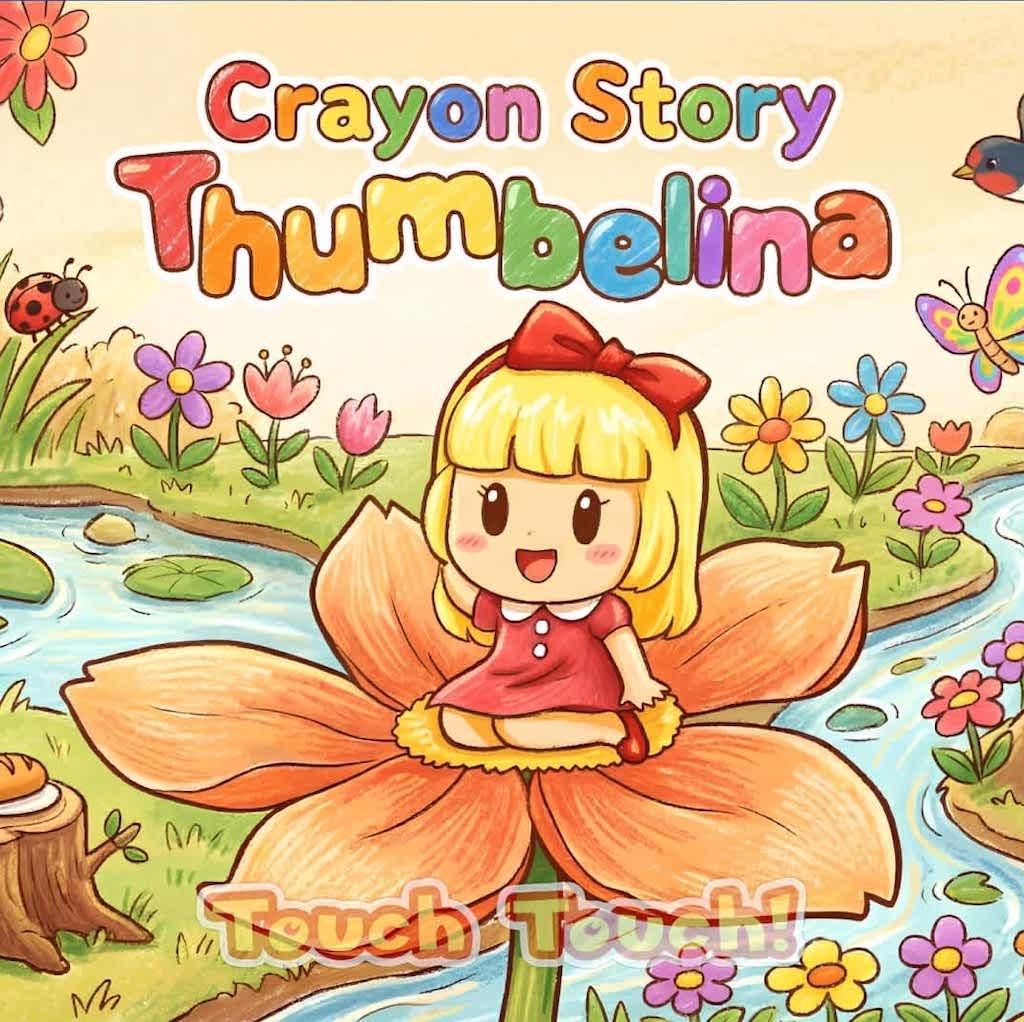
The visual presentation is central to the experience. Crayon Story: Thumbelina needs to make its illustrations inviting because the artwork is effectively the canvas on which the player works.
The fairy-tale setting offers plenty of opportunities for flowers, woodland scenery and tiny characters, all of which lend themselves beautifully to a colouring-book format. The overall presentation has a gentle, storybook quality that suits younger players without becoming overly complicated.
The key is that the artwork gives children something attractive to work with while still leaving enough space for their own creativity. A colouring game can easily become frustrating if the illustrations are too intricate or restrictive, but Crayon Story: Thumbelina is at its best when it simply lets the player enjoy the process.
The presentation also complements the storytelling element nicely. Each finished page feels like another part of a personal picture book, which is exactly the impression the game should create.
The Joy Of Making Something
There is a tendency to judge games solely by how much content they contain, how long they last, or how many mechanics they offer. Crayon Story: Thumbelina is a useful reminder that those measures do not tell the whole story.
What matters here is what the player gains from the experience. A child who finishes a page, looks at it and thinks, “I made that,” has achieved something meaningful within the context of this game. The fact that it may take only a few minutes to colour a scene does not make the result any less valuable.
The writing feature strengthens that feeling, as the child becomes both illustrator and storyteller. The familiar fairy tale provides the foundation, but their imagination determines how the finished version looks and sounds. That is a wonderfully simple concept, and sometimes simple ideas are the ones that work best.
Final Verdict
Crayon Story: Thumbelina is not going to satisfy someone looking for a traditional adventure, but that is beside the point. This is a gentle, creative experience designed to encourage children to colour, write, experiment and take ownership of a familiar fairy tale.
The colouring mechanics are straightforward enough for young players to grasp immediately, while the writing feature gives the experience considerably more depth than a conventional digital colouring book. Being able to create your own sentences transforms each page into something personal, and the gallery provides a lovely place to preserve those creations.
There are inevitably limitations. The simplicity that makes the game accessible also means there is not a huge amount of conventional gameplay, and older children may find the experience somewhat limited once they have completed the available material. It is also an experience that works best when approached as a creative activity rather than a conventional game.
For its intended audience, however, Crayon Story: Thumbelina has a lot going for it. It encourages imagination without making creativity feel like a lesson, gives children control over a familiar story and provides a tangible record of what they have created.
Most importantly, it understands something that many games forget. Not every experience needs to be about winning. Sometimes the best reward is simply making something that belongs to you.
And when that something happens to be your own colourful version of Thumbelina, complete with your own words and ideas, there is a certain magic in that.