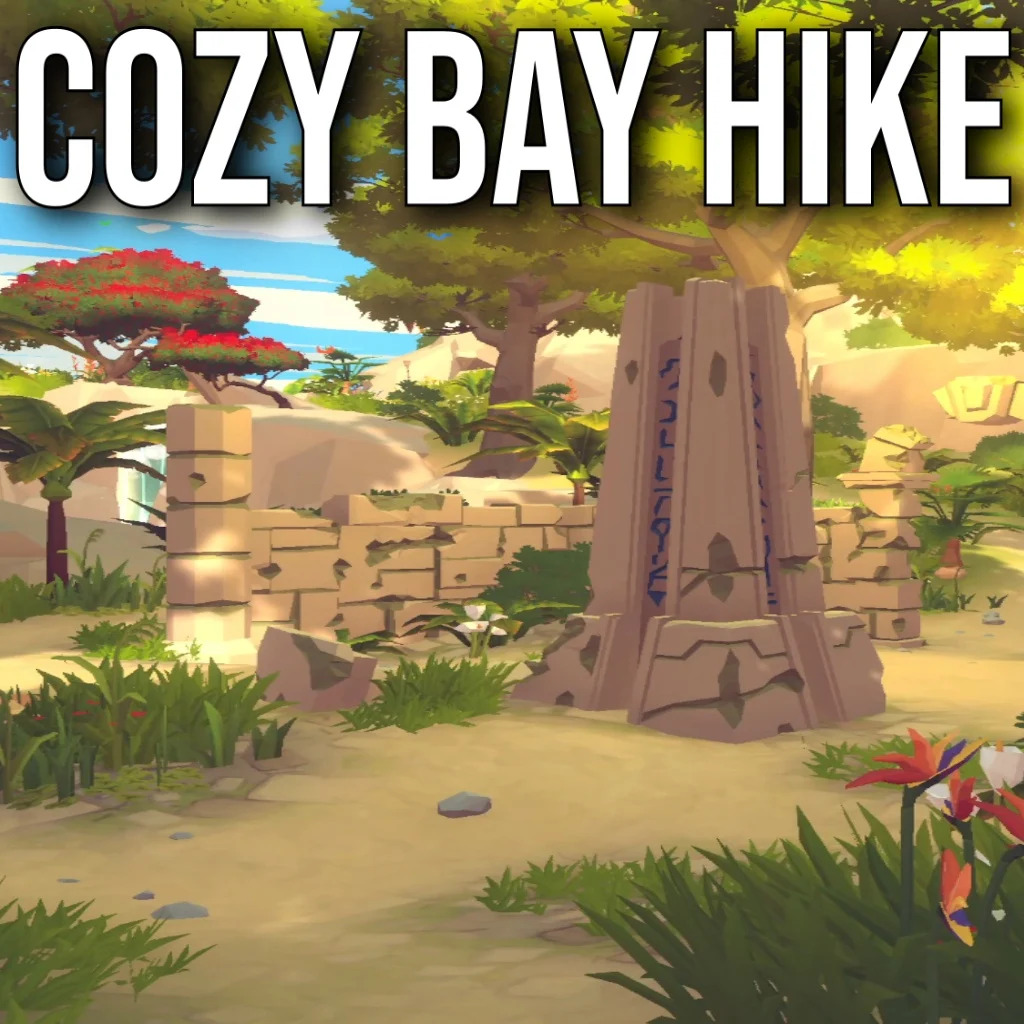
In an industry increasingly characterised by escalation—larger maps, louder systems, denser mechanics—it is easy to forget that games can simply invite the player to exist. No optimisation. No combat loops. No urgent objectives ticking down in the background. Cozy Bay Hike, developed and published by Downmeadowstreet, serves as a deliberate counterpoint to that trend. Released on April 4, 2026, for Nintendo Switch, it is a first-person exploration experience built entirely around stillness, observation, and slow discovery.
It is also, crucially, one of the most dedicated examples yet of what has come to be known as “slow gaming”—a philosophy that emphasises atmosphere and presence over challenge or reward structures.
A World Designed to Be Wandered
Set on a secluded coastal island, Cozy Bay Hike offers no explicit goals beyond exploration itself. There are no enemies, no fail states, no timers, and no traditional progression systems. Instead, the game gently encourages you to walk, look, listen, and gradually piece together a personal map of its world.
From the moment you step onto the shoreline, the design intent is clear: this is not a place to conquer, but a place to inhabit.
The island itself is divided into loosely connected biomes—rocky cliffs, sandy coves, wind-swept hills, and quiet woodland paths. Each area feels intentionally unhurried, with winding routes that invite detours rather than direct traversal. Hidden viewpoints reward curiosity, but never pressure it. If you miss something, the game does not punish you. It simply allows you to continue walking.
In essence, it shares DNA with contemplative exploration experiences like Firewatch, but eliminates even the narrative urgency that usually drives those titles. Here, there is no mystery seeking resolution—only space to think.
The Absence of Pressure as Design
What defines Cozy Bay Hike most strongly is not what it includes, but what it chooses to exclude. There is no HUD cluttering the screen. No stamina bar limiting your movement. No minimap guiding your decisions. Even the concept of failure has been entirely removed.
This absence is not due to a lack of design but reflects a deliberate philosophical stance. The game trusts the player to self-direct and find satisfaction in simple observation rather than in structured reward cycles.
Progress is tracked through a light touch discovery journal, which quietly fills as you encounter new locations, landmarks, and environmental details. It is not presented as a checklist of obligations but as a personal record of your time spent in the world.
This approach will strongly resonate with players familiar with meditative experiences like Journey, where movement itself is the primary verb and meaning is derived from presence rather than outcome.
Sound, Space, and Stillness
If Cozy Bay Hike excels anywhere, it is in its sound design. The audio landscape forms the true backbone of the experience and is arguably its most expressive feature.
The constant presence of wind, distant waves, shifting foliage, and subtle wildlife creates a sense of continuous life that exists independently of the player. Even when you are standing still, the world does not pause with you. It breathes.
The soundtrack, when it appears, is minimal and carefully spaced. Soft acoustic tones drift in and out without demanding attention, reinforcing the idea that silence is not empty — it is part of the composition.
Visually, the game adopts a soft, stylised aesthetic that leans towards warmth rather than realism. Colours are gently saturated, edges slightly softened, and lighting designed to evoke late afternoon calm rather than dramatic contrast. It does not seek to impress through technical fidelity but through unity of mood.
Discovery Without Direction
Exploration in Cozy Bay Hike is deliberately unguided. You are not directed towards objectives or landmarks. Instead, curiosity becomes your sole navigational guide.
Hidden paths branch off subtly—behind rock formations, through narrow gaps in foliage, or along cliffside trails that are easy to miss. These discoveries rarely offer tangible rewards. There are no upgrades, no unlockable abilities, and no gameplay systems tied to exploration that alter the experience.
What you gain instead is perspective. A new view of the coastline. A quiet clearing overlooking the sea. A small, tucked-away structure that hints at a story without explicitly telling it.
This restraint is central to the game’s identity. It refuses to turn discovery into currency. Instead, discovery itself is the reward.
The Philosophy of “Nothing to Do”
For some players, Cozy Bay Hike will feel liberating. For others, it may seem aimless. This tension is key to understanding what the game aims to achieve.
Modern game design often revolves around continuous engagement loops—tasks, challenges, unlocks, and rising difficulty curves. Cozy Bay Hike dismisses all these structures. It is at ease with inactivity. It welcomes silence. It even accepts boredom, at least in the sense that it does not try to eradicate it.
Instead, it reinterprets boredom as attention. When nothing is pushing you forward, you start to notice smaller details: the rhythm of waves against rocks, the way light shifts across grass, the distant calls of birds you may have initially overlooked.
This is where the game finds its emotional resonance—not in spectacle, but in awareness.
Limitations of Intentional Simplicity
Certainly, this design philosophy is not without its drawbacks. The very lack of systems that define traditional games also restricts long-term engagement. Once the island has been fully explored and the journal completed, there is little mechanical incentive to return.
Replayability, therefore, relies almost entirely on experience. You return not to achieve something new but to re-enter a specific mood. For some players, that will suffice. For others, it may not justify extended playtime.
There is also a risk that the absence of narrative framing may feel underdeveloped. While environmental storytelling exists subtly, those seeking a clear story arc might find the experience too diffuse to emotionally connect with.
Final Verdict
Cozy Bay Hike is a confident and deeply intentional exploration of minimalism in game design. It eliminates nearly every conventional system associated with interactive entertainment and replaces them with atmosphere, space, and quiet observation.
It does not try to compete with larger, more structured titles. Instead, it provides an alternative: a space where nothing is demanded of the player except attention.
Its success will rely entirely on what the player is seeking. For those in need of stimulation, progression, or challenge, it may feel sparse. But for those willing to embrace its pace, it offers something increasingly rare in modern gaming—a genuine sense of calm.