There’s a long tradition in games of using utopia as a mask for something more unsettling. From the glossy artifice of BioShock to the controlled social engineering of titles like Papers, Please, developers have repeatedly asked a simple question: what does “perfect” actually cost? Perfect City, developed and published by Aldora Games, ventures into this thematic space with confidence, but instead of relying on systems-driven simulation or action-heavy metaphor, it opts for something quieter, more intimate, and arguably more vulnerable—a narrative-driven visual novel experience on Nintendo Switch.
Released on 6 April 2026 as a Switch exclusive, Perfect City presents itself less as a traditional game and more as an interactive storybook. It is a linear adventure about observation, choice, and the slow realisation that comfort and control often come at the expense of something deeply human.
A Utopia That Smiles Too Much
You arrive in Perfect City alongside protagonists Tino and Mila, two newcomers who are immediately struck by how effortless everything seems. People are polite. Needs are met. Conflict barely exists. Every conversation feels pre-written to avoid discomfort. At first glance, it resembles paradise.
But Perfect City is not interested in sustaining that illusion for long. Instead, it gradually peels back the superficial layer of its setting, revealing a society where ease has replaced autonomy, and harmony has been achieved through the quiet removal of meaningful choices.
The narrative unfolds through dialogue choices and light exploration, with players slowly uncovering the mechanisms that keep the city so unnervingly calm. What begins as curiosity becomes unease, and eventually something closer to moral urgency. The game doesn’t rely on sudden twists or shocking reveals; instead, it builds discomfort through repetition, omission, and the growing sense that everyone is rehearsing their lines.
Choice Without Consequence… At First
Mechanically, Perfect City is intentionally restrained. It is not a sprawling epic like Detroit: Become Human, nor does it aim to imitate intricate narrative systems. Instead, it employs choice as a thematic device rather than a mechanical one.
Early decisions seem trivial. Dialogue options often result in similar outcomes, emphasising that the city resists deviation. This can initially feel restrictive, especially for players expecting more traditional branching narratives. However, this is exactly the point: the game uses the illusion of choice to mirror the experiences of its characters.
As the story unfolds, however, cracks begin to appear. Subtle differences emerge in how characters react. Previously uniform conversations start to diverge. Small narrative threads begin to fragment, indicating that the city’s control is not as absolute as it first seems — or perhaps it is simply more adaptable than anticipated.
The addition of new character-specific side quests in the Day One patch introduces welcome depth, giving supporting figures more emotional significance and reinforcing the idea that every resident of Perfect City harbours their own suppressed complexities.
The Horror of Soft Control
Where Perfect City succeeds most is in its depiction of control that never feels overtly oppressive. There are no guards in the streets, no overt authoritarian decrees, no obvious villains pulling levers behind the curtain. Instead, control manifests as politeness, efficiency, and emotional moderation.
Everyone in the city is pleasant. Everyone is agreeable. But no one is truly alive.
This is where the game’s writing excels. Conversations are carefully crafted to feel slightly off-kilter—responses that avoid confrontation, answers that circle around meaning without ever quite reaching it. Over time, this cultivates a creeping sense of alienation, as if the player is the only person willing to acknowledge that something is wrong.
It’s a tonal approach that feels closer to psychological fiction than traditional game storytelling, and it benefits enormously from its slower pace. Perfect City asks you to sit with discomfort rather than escape from it.
Presentation: Clean, Clinical, and Intentional
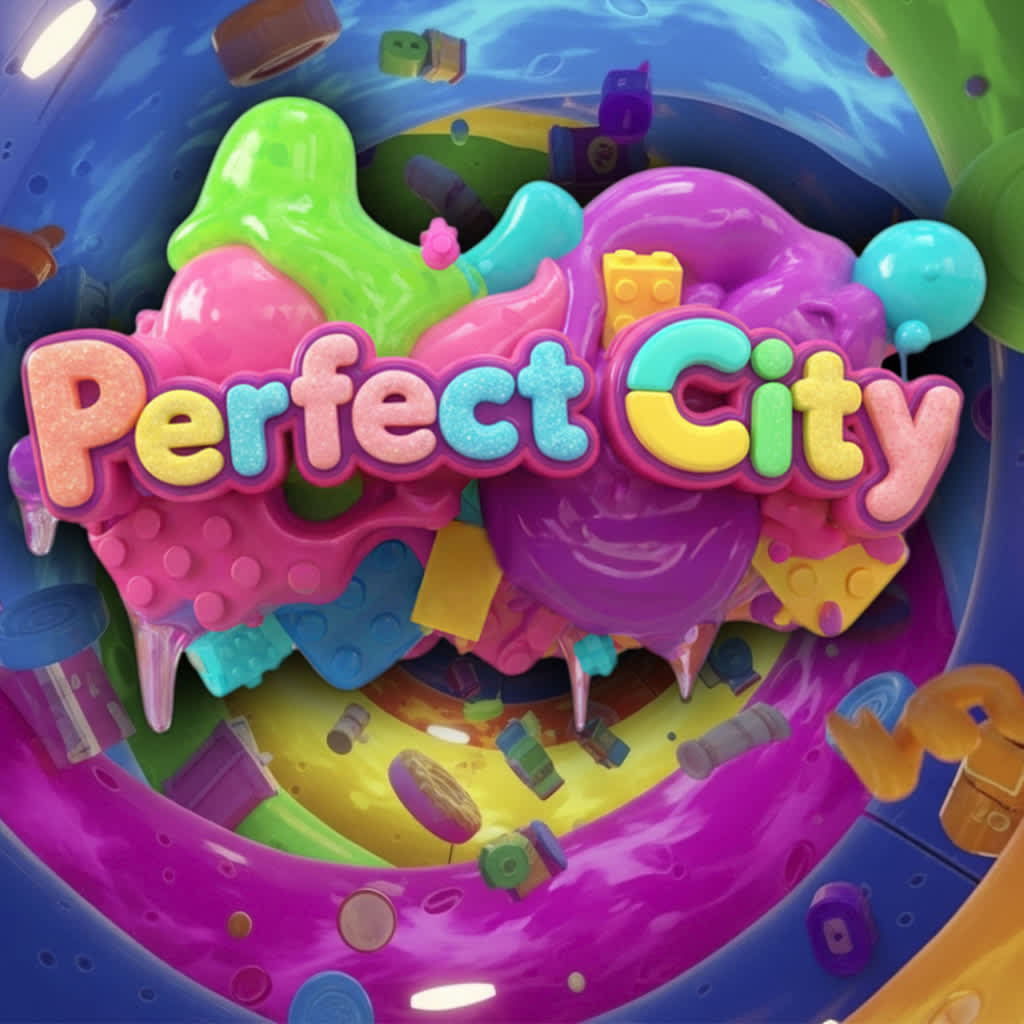
Visually, Perfect City embodies its concept with striking consistency. The city is depicted in soft, clean lines and bright, almost sterile colours. Everything is pleasing to the eye, but in a way that feels intentionally uniform. There are few rough edges, both literally and figuratively.
Character designs follow a similar philosophy. Residents are expressive but subtly restrained, as if their emotions are filtered through an invisible constraint. This visual language complements the narrative beautifully, reinforcing the idea that perfection is, in itself, a kind of limitation.
The soundtrack is understated, relying heavily on ambient tones and gentle melodic fragments. It rarely draws attention to itself, which again feels deliberate. This is not a world that seeks to overwhelm you — it aims to smooth you out.
A Story That Trusts Its Audience
One of Perfect City’s greatest strengths is its trust in the player. It avoids over-explaining its themes or forcing explicit moral conclusions. Instead, it presents a situation and allows interpretation to develop naturally.
Is Perfect City a critique of social conformity? A meditation on free will? A metaphor for modern digital life and algorithmic comfort? The game never commits to a single answer, and that ambiguity adds to its charm.
However, this subtlety might also act as a barrier for some players. Those expecting more traditional narrative progression or dramatic branching paths could find the experience too restrained. The pacing is slow, and the payoff is more emotional than mechanical.
Limitations in Interactivity
If there is a consistent criticism to be made, it is that Perfect City sometimes feels more like a visual novel than an interactive experience in the broader sense. While this is clearly intentional, it does limit replayability and mechanical engagement.
The dialogue system, while thematically strong, offers limited variation in actual outcomes. Even with the additional side content from the Day One patch, the core structure remains largely linear. For some players, this might reduce the incentive to revisit the game after completion.
There is also a sense that certain narrative threads could have been explored further. The game introduces interesting ideas about memory, identity, and civic design, but does not always develop them as deeply as it could.
Final Verdict
Perfect City is a quiet, contemplative narrative experience that succeeds not through complex systems, but through a consistent vision. It depicts a world that is beautiful, unsettling, and emotionally contained, prompting players to gradually recognise the cost of that restraint.
It is not a game for those seeking intricate mechanics or branching narrative fireworks. Instead, it is suitable for players willing to engage with slower, more reflective storytelling—where meaning arises not from an abundance of choices, but from limited options.
Its restraint is both its greatest strength and its most noticeable limitation. Yet, in a landscape filled with louder, more reactive narrative games, Perfect City stands out precisely because it refuses to shout.