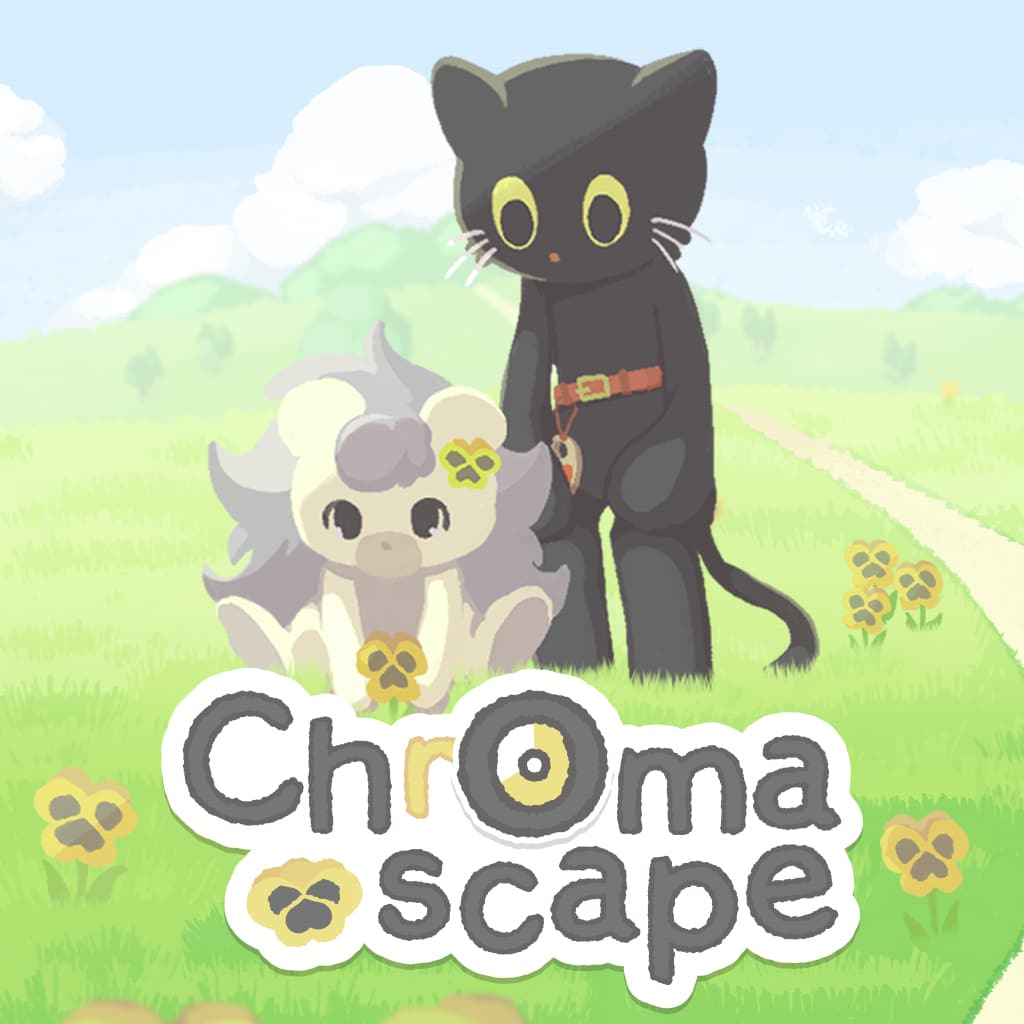
There is something rather beautiful about a game built around the idea of bringing colour back to a world that has forgotten what it looks like. Chromascape begins with Palette Planet slowly fading, its flowers, trees and inhabitants losing their colour as a mysterious phenomenon known as the “Colour Loss” takes hold. It is an immediately striking premise, particularly because the solution is not to fight the darkness with weapons, but simply to give the world its colour back. The result is a gentle little adventure that feels less concerned with testing your reflexes and more interested in making you stop, look around and appreciate the world you are gradually restoring.
Developed and published by Zoo Corporation, Chromascape is a top-down 2D adventure that combines exploration, environmental puzzles and a wholesome storybook atmosphere. You play as Luna, an adorable hedgehog who discovers she can absorb, hold and bestow colour. What initially sounds like a simple magical trick quickly becomes the foundation for the entire adventure, as different colours can alter the properties of objects and environments around you. There are no hordes of enemies to defeat or punishing challenges waiting around every corner. Instead, Chromascape invites you to explore a world in need of a little help and work out how to bring it back to life.
A World Losing Its Colour
The opening concept is simple, yet Chromascape draws a surprising amount of atmosphere from it. A world that should be filled with bright flowers, colourful trees and cheerful inhabitants is instead gradually losing its identity. The disappearance of the residents adds a slightly melancholic edge to what otherwise looks like a wonderfully cosy adventure, giving Luna’s journey a genuine purpose beyond simply solving puzzles.
There is something inherently satisfying about restoring colour to the environment. Rather than collecting points or completing arbitrary objectives, your progress is visible in the world itself. A faded object can become vibrant again, a dormant mechanism can spring back into action, and a previously lifeless section of the environment can begin to feel alive.
That gives the adventure a lovely sense of cause and effect. You are not simply solving puzzles because the game has placed them in your path. You are solving them because the world needs you, and each successful interaction feels like another small victory against the Color Loss.
Luna and the Power of Colour
Luna’s ability is the game’s central mechanic, and thankfully it is considerably more interesting than simply choosing a colour from a menu. The important question is not just which colour you have available, but where to place it and what effect it will have.
Warm colours, for example, can take on fiery properties, allowing you to illuminate darkness or interact with heat-related objects. Cooler colours can freeze flowing water, creating new routes and changing the environment in useful ways. This creates a pleasing relationship between colour and function, turning something normally associated with visual presentation into a practical gameplay tool.
The idea is particularly well suited to a cosy puzzle adventure because it encourages experimentation without making every mistake feel like a disaster. You can look at a problem, consider the colours available to you, and think about what might happen if you apply one in the right place. When you find the answer, the satisfaction comes from understanding the world rather than simply remembering a solution.
Puzzles That Ask You to Think, Not Panic
The environmental puzzles are deliberately gentle, and that is worth emphasising. Chromascape is not trying to be the next brutally difficult puzzle adventure that leaves you staring at the screen for half an hour wondering what on earth you missed. Its puzzles are designed to be accessible, allowing players to understand the underlying rules and then apply them to the environment.
For some players, that will be exactly what they are looking for. There is a lovely rhythm to wandering into an area, noticing something that looks slightly out of place, and then working out how colour can change it. The game rewards observation more than speed, which fits beautifully with the overall tone.
Players looking for a serious intellectual challenge may find the difficulty curve a little too forgiving. The puzzles are generally straightforward, and once you understand how the colour system works, many of the solutions can become fairly obvious. Personally, I think there is value in that approach, because not every puzzle game needs to make you feel like you have just completed an examination paper.
Friends Make the Journey Better
Luna does not have to restore Palette Planet alone. Along the way, she meets companions with unique abilities, and working together becomes another important part of exploration.
This adds a welcome social element to the adventure. Instead of simply unlocking another ability for Luna and moving on, you gradually build a small team of characters whose talents help you reach areas previously inaccessible. It also reinforces one of the game’s central themes, that restoring this world is something that can be achieved through cooperation.
There is something particularly fitting about that idea. A world suffering from the loss of its colour is not restored by one heroic act, but through many small contributions. Luna’s friends each have something useful to offer, and together they make the journey feel more like a community effort than a solitary quest.
A Gentle Adventure With Plenty of Heart
The presentation is one of Chromascape’s strongest elements. The hand-drawn visual style gives the game a storybook quality that immediately makes Palette Planet feel like somewhere you want to spend time.
The contrast between colour and its absence is also central to the visual identity. Seeing a faded section of the world gradually regain its vibrancy gives the game a visual progression that is far more meaningful than simply moving from one level to another. Colour becomes a reward in itself.
There is a warmth to the overall presentation that suits the subject matter perfectly. Luna’s design, the environmental artwork and the various inhabitants all contribute to the feeling that this is a little illustrated world waiting to be explored. It is the kind of aesthetic that makes even a simple puzzle feel inviting.
The Joy of Making Things Beautiful Again
One of the things I particularly like about Chromascape is how closely its mechanics and themes are connected. In many games, the story might tell you that you are saving a world while the gameplay consists of defeating enemies and collecting objects. Here, the act of restoring the world is the gameplay.
You see something grey and lifeless, work out how to interact with it, and then bring the colour back. It is a wonderfully simple idea, but there is something emotionally satisfying about seeing the consequences of your actions.
That also makes the game feel remarkably peaceful. There is no pressure to hurry through an area because the objective is not simply to reach the next checkpoint. The journey itself is the reward, and the act of restoring the world gives you a reason to take your time.
When Cosy Means Casual
There is, however, a limit to how far this approach can carry the experience. The lack of substantial difficulty means that Chromascape will probably not satisfy players seeking complex puzzle design or demanding adventure mechanics. Once you become familiar with the colour system, some challenges can feel more like gentle exercises than genuine tests.
That is not necessarily a criticism of the game itself. It is simply important to understand what Chromascape is trying to be. This is a game for someone who wants to relax after a long day, not for someone who wants to throw a controller across the room because they cannot solve an elaborate environmental puzzle.
In fact, there is something quite refreshing about that confidence. The game does not feel embarrassed about being gentle. It does not suddenly introduce unnecessary difficulty simply to prove it can. Instead, it stays committed to its calming atmosphere from beginning to end.
A Little World Worth Saving
There is also a surprisingly thoughtful idea beneath all the cuteness. Colour represents life, connection and possibility, while the Colour Loss signifies something gradually disappearing from the world. Luna’s journey is therefore about more than restoring pretty scenery. She is bringing back what makes Palette Planet feel like home.
That gives the adventure a gentle emotional thread without resorting to melodrama. The disappearing residents and fading environments create enough mystery to keep you curious, while the act of restoring colour provides a constant sense of progress.
It is a simple story, but sometimes simple is exactly what works. Chromascape does not need to bombard you with complicated lore or endless dialogue when its central idea can be understood through the world itself.
Verdict
Chromascape is a charming, gently paced adventure that understands the appeal of simply making a world a little brighter. Its colour-based mechanics are clever without becoming intimidating, while the combination of exploration, environmental puzzles and companion abilities gives the adventure enough variety to keep things moving.
It is also a game that knows its audience. If you are searching for punishing puzzles, intense combat or a sprawling adventure packed with mechanical complexity, this probably is not going to scratch that particular itch. But if you want something peaceful, attractive and genuinely wholesome, there is plenty here to enjoy.
The best thing about Chromascape is how naturally its mechanics fit its message. You are not simply restoring colour because the game tells you to. You are restoring colour because that is how you interact with the world, and every puzzle solved makes Palette Planet feel a little more alive.
Luna is an instantly likeable protagonist, the hand-drawn presentation gives the game plenty of personality, and the colour mechanics provide a solid foundation for its puzzles. It may not push the genre particularly hard, and experienced puzzle players may occasionally find themselves wishing for a little more resistance, but there is something to be said for an adventure that is comfortable with being kind.
In a gaming landscape filled with worlds constantly needing saving from destruction, Chromascape offers something considerably more peaceful. Here, saving the world means giving it colour, helping its inhabitants and bringing life back to places that have lost it. Sometimes, that is exactly the sort of adventure we need.