Children’s games often fall into one of two traps. They either overwhelm young players with mechanics too complex to grasp, or they become so simplified that even their intended audience quickly loses interest. Striking the right balance is far more difficult than it appears. A good children’s game should entertain, spark imagination, encourage curiosity and create memories that families can share.
Alice and the Looking-Glass understands this responsibility. Rather than trying to become an action game or a puzzle adventure, it embraces its identity as an interactive storybook. Built around feature-quality 3D animation, full voice acting and a gentle fairy-tale structure, it is an experience designed to be enjoyed one chapter at a time. It may not offer much for older players seeking traditional gameplay, but for young children discovering interactive storytelling, it provides a charming and heartfelt journey.
A Familiar Fairy Tale With Its Own Identity
Although the title naturally evokes Lewis Carroll’s classic, Alice and the Looking-Glass tells an entirely original story with a gentler tone. The adventure follows young Alicia, who discovers a mysterious Looking-Glass on a rainy afternoon. Passing through it transports her into a magical kingdom that has lost its colour, warmth and happiness.
Alongside two delightful companions, Snugglet and Mira, Alicia sets out to discover why the once joyful land has become so bleak. Her search eventually leads to King Cozy, a lonely bear king whose decision to hoard the world’s sparkles has slowly drained life from everything around him.
The narrative focuses on empathy rather than conflict. Instead of presenting villains to be simply defeated, it explores loneliness, friendship, kindness and understanding in ways that younger audiences can easily appreciate. Every chapter reinforces positive values without ever feeling overly preachy, allowing its lessons to emerge naturally through the characters and their choices. It is a comforting story from beginning to end, one that parents can share with children before bedtime.
An Interactive Story Rather Than a Traditional Game
Anyone expecting platforming, puzzles or combat should adjust their expectations before stepping through the Looking-Glass. Alice and the Looking-Glass is fundamentally an interactive video book. The focus is firmly on reading, listening and watching the story unfold rather than on testing player skill.
Spread across ten chapters containing more than 10,000 words, the adventure encourages players to experience the narrative at a relaxed pace. Each chapter is perfectly sized for younger attention spans, making it easy to complete one section each evening and move on the following day.
This structure works particularly well for families. Parents can read together with younger children, while slightly older readers can gradually gain confidence by following the dialogue themselves. Because every line is fully voiced, even children who cannot yet read fluently can enjoy the complete story without feeling left behind. The interactive elements remain intentionally light, ensuring the narrative always remains the centre of attention.
Presentation That Feels Like An Animated Film
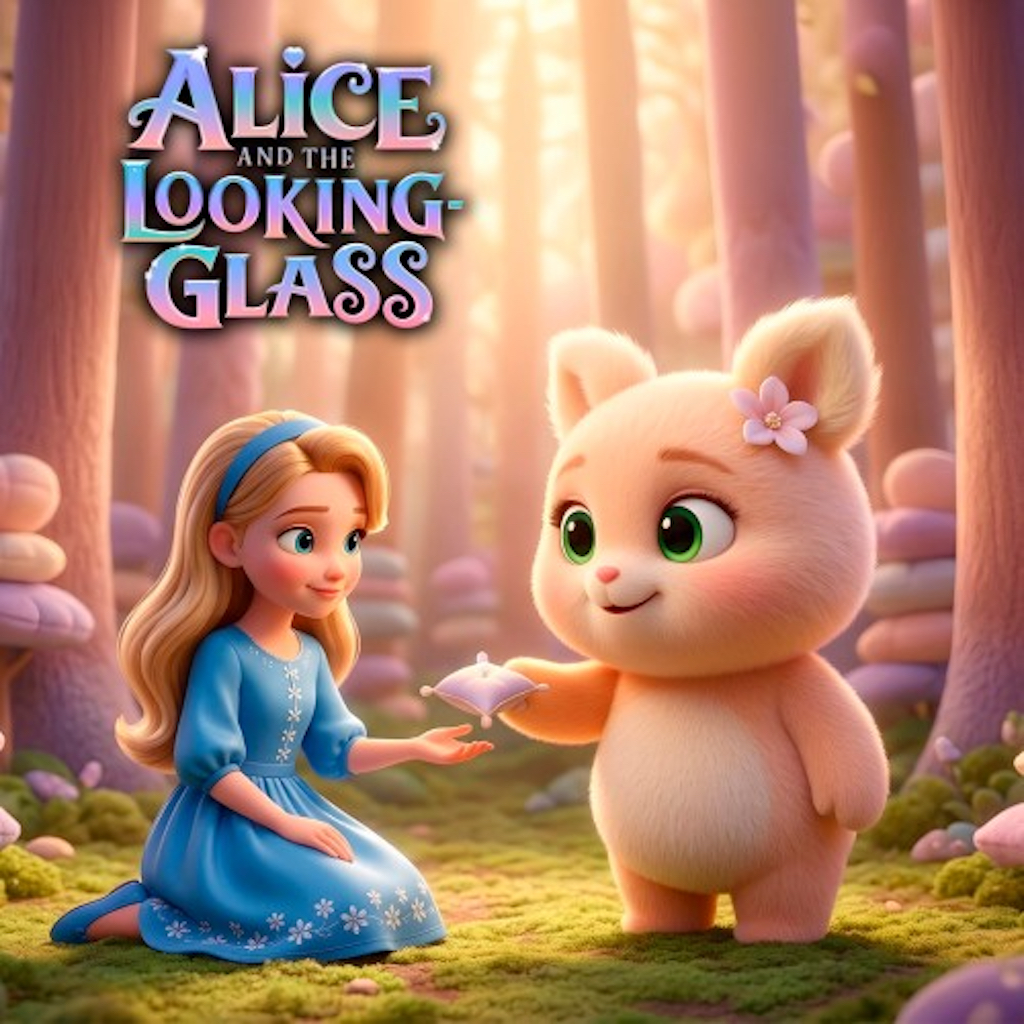
The visual presentation is easily one of the game’s greatest strengths. Rather than relying on static illustrations, Alice and the Looking-Glass presents its world through beautifully animated 3D scenes that often resemble a feature-length children’s film.
The magical mirror world feels wonderfully inviting. Colourful forests, cosy villages and whimsical fantasy landscapes constantly spark the imagination, while expressive character animation ensures every emotional moment lands naturally. Younger players will quickly become attached to Alicia, Snugglet and Mira thanks to their warm personalities and charming visual design.
The transition from the ordinary rainy afternoon to the vibrant fantasy realm captures the sense of wonder that every great children’s story strives to achieve. Even without complex gameplay systems, the presentation consistently encourages players to keep turning the page. Nothing ever feels frightening or overwhelming, making the entire adventure suitable for its intended audience.
Excellent Voice Acting Brings Every Character To Life
The decision to fully voice every character proves invaluable. With seventeen distinct voices alongside a narrator, the performances inject warmth and personality into every chapter.
The narration flows naturally, helping younger listeners follow the story with ease and giving each scene the feel of an audiobook brought vividly to life. Individual character performances avoid exaggerated caricatures, instead delivering friendly, expressive dialogue that feels sincere throughout.
The soundtrack complements the presentation beautifully. Twenty-nine cheerful instrumental pieces accompany the journey, creating a consistently uplifting atmosphere that perfectly matches the story’s themes. The music never competes with the narration, instead gently supporting the emotional beats of each chapter.
The inclusion of five karaoke songs is also a thoughtful addition. Younger players who become attached to the characters have another way to engage with the world after completing the story, extending the experience beyond simply reaching the final chapter.
Designed With Families In Mind
One of the most admirable aspects of Alice and the Looking-Glass is its understanding of its audience. Every design decision seems built around making the experience welcoming for both children and parents.
There are no advertisements interrupting the story, no in-app purchases encouraging extra spending, and no unnecessary distractions pulling attention away from the adventure itself. Everything is contained within one complete package.
The gentle pacing also deserves praise. Modern children’s media often feels obliged to move at breakneck speed, constantly chasing excitement. Here, the developers allow scenes room to breathe. Conversations unfold naturally, emotional moments are given proper attention, and children are encouraged to absorb the story rather than simply rush towards the ending. That slower rhythm makes the experience surprisingly refreshing.
Limited Gameplay Means Limited Longevity
The game’s biggest limitation is entirely intentional. Players hoping for traditional gameplay will likely finish the story wishing there had been more opportunities to interact with the world.
Beyond progressing through the narrative, exploring the image gallery, and enjoying the karaoke songs, there is relatively little to encourage repeated play beyond revisiting favourite chapters. Older children who regularly play platformers or adventure games may also outgrow the experience fairly quickly.
Parents should therefore approach Alice and the Looking-Glass as an interactive storybook rather than a conventional video game. Judged by those expectations, it succeeds admirably. Judged as a gameplay-heavy adventure, however, it understandably feels rather slight. Fortunately, the developers never pretend otherwise. They know exactly what they have created.
Final Verdict
Alice and the Looking-Glass is a heartfelt reminder that games do not always need complex mechanics to leave a lasting impression. Sometimes a thoughtful story, memorable characters and beautiful presentation are more than enough. By embracing its role as an interactive video book, it delivers an experience that feels welcoming, sincere and genuinely crafted with young audiences in mind.
Its production values are consistently impressive. The fully voiced performances, polished 3D animation and cheerful musical score combine to create something that feels closer to an animated family film than to a traditional children’s game. More importantly, the themes of friendship, courage and kindness remain at the heart of every chapter, giving the story emotional warmth without tipping into sentimentality.
Older players seeking challenging gameplay may find little reason to stay once the credits roll, but that is not the audience this adventure is trying to reach. Instead, Alice and the Looking-Glass succeeds by offering families a safe, beautifully presented story that can be enjoyed together over several evenings. In a marketplace often crowded with noisy distractions, there is something refreshing about a game that simply wants to tell a comforting tale. For parents searching for a wholesome interactive experience to share with younger children, Alice and the Looking-Glass is an easy recommendation. It may be gentle, but sometimes gentle is exactly what a story needs to be.