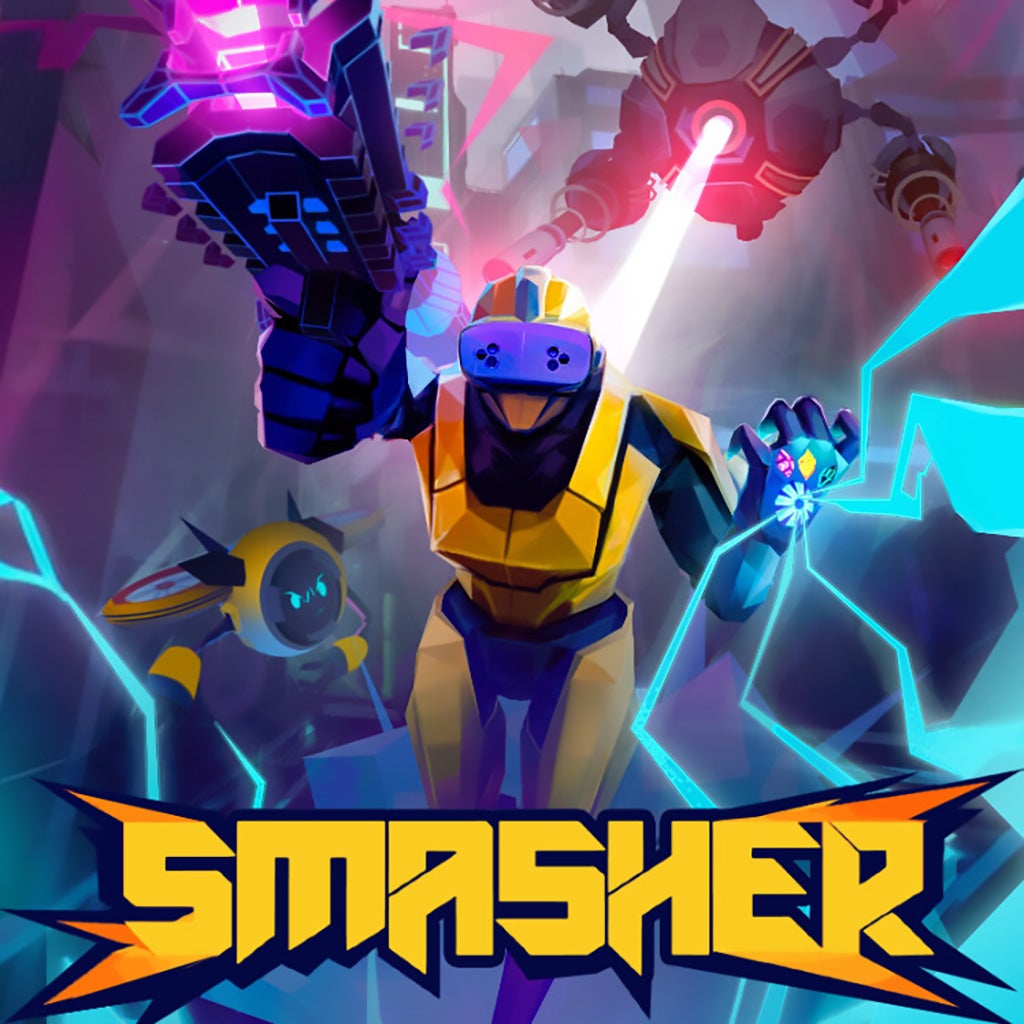
In a market saturated with increasingly complex and expansive titles, Smasher positions itself as an unapologetically straightforward and visceral hybrid of action and physics-driven combat. Developed with a focus on kinetic feedback and brutal fun, Smasher is less about narrative depth or strategic nuance and more about the immediate pleasure of destruction, momentum, and impact. It is a game that wears its intentions plainly: you hit hard, you take damage, you collide with environments and foes, and you laugh at what happens next.
However, behind its seemingly simple premise lies a surprising depth of systems, emergent interactions, and mechanical precision. Smasher is not just about chaos for its own sake — it is about controlled chaos and the satisfaction that arises when the game’s physics and combat systems align in near-perfect harmony. In this review, we explore where Smasher succeeds, where it strains under its own momentum, and what kind of player will find lasting enjoyment in its aesthetic of impact.
Concept and Core Loop
At its core, Smasher is built around moment-to-moment impact. Players control heavily animated characters or vehicles (depending on mode and customization) that are designed to collide with enemies, obstacles, and the environment itself with dramatic force. The game frames destruction as both sport and spectacle: smashing opponents against walls, launching them into hazards, and chaining impacts into satisfying combos that feel as good as they look.
Unlike traditional action titles that might prioritise precision strikes or strategic depth, Smasher celebrates improvisation, risk-taking, and the unpredictable consequences of physics interactions. The core loop is simple: enter an arena or match, confront opponents or objectives, unleash dynamic attacks, and revel in the resulting spectacle. This simplicity is both a strength and a limitation — it invites immediate engagement, but sustaining long-term depth demands supplementary systems that must match the intensity of the moment.
Mechanics and Combat
Mechanically, Smasher blends real-time action with physics-based collision dynamics. Hits are not abstracted by health bars and simplified animations; rather, every strike, bump, and collision involves momentum calculations, trajectory arcs, and sometimes absurd ragdoll outcomes. The combat system rewards players who understand how to use velocity, angle, and chaos to their advantage. A cached swing at the correct time can send an opponent spinning across the arena, setting up a follow-up hit that finishes them off in dramatic fashion.
Despite the apparent emphasis on brute force, Smasher demands control. Excessive aggression without spatial awareness often leads to self-inflicted setbacks; hugging a corner might describe your character’s fate as often as your opponent’s. This push-and-pull between reckless abandonment and tactical positioning gives each round an unpredictable rhythm that feels both chaotic and purposeful.
The controls are tight considering the game’s physics focus. Movement, dodging, and attack inputs possess a responsiveness that belies the raw force they are designed to simulate. Hits can feel weighty without feeling sluggish, and defensive options — such as evasive rolls or temporary blocks — provide windows of strategic agency. This balance between control and chaos is one of Smasher’s greatest achievements: it never feels like pure luck is dictating the outcome, even when emergent interactions create seemingly accidental outcomes.
Modes and Variety
Smasher supports a variety of modes designed to keep the chaos fresh and engaging. Standard arena brawls — free-for-all and team-based — are the most straightforward and serve as the backbone of competitive play. Objective-based modes augment this core by introducing environmental hazards, capture points, and interactive elements that encourage players to adapt their smashing approach on the fly.
Perhaps most intriguing are the physics-challenge modes, where players engage with custom-designed scenarios that emphasise environmental interaction over enemy combat. These segments vary from demolishing auto-generated obstacle courses to high-score challenges where optimal trajectories and chain reactions yield bonus rewards. These alternative modes provide welcome variety and take full advantage of the game’s underlying collision engine.
However, this variety is not entirely uniform in its payoff. While some modes feel novel and richly engaging, others cycle back to the core combat loop without adding meaningful twist mechanics or strategic depth. The effect is a sense that Smasher’s creative ambition occasionally outpaces its capacity to fully realise distinct experiences in every mode.
Visuals and Aesthetic
Visually, Smasher adopts a stylised aesthetic that emphasises readability and flamboyance over hyper-realism. Characters and arenas are rendered with clear silhouettes and bold colour palettes, ensuring that even the most chaotic exchanges remain visually intelligible. Particle effects, impact sparks, and exaggerated ragdoll animations all contribute to the spectacle, conveying both force and consequence in an immediately recognisable way.
This aesthetic supports the game’s design philosophy: action should be visible, consequences should be dramatic, and chaos should be enjoyable rather than overwhelming. While the graphics do not push the boundaries of what current hardware is capable of, their clarity and consistency serve the gameplay exceptionally well. Performance on both base and next-generation platforms remains stable, with minimal frame-rate dips even in the most explosive sequences.
The sound design further complements the visual identity. Impacts thud with satisfying weight; collision sounds have distinct feedback cues that differentiate a light bump from a devastating Slam; and the soundtrack — a dynamic blend of driving beats and percussive thumps — successfully underscores the kinetic tempo of each encounter.
Progression and Customisation
To sustain replayability, Smasher incorporates a progression system that rewards play with unlockable characters, skins, and gear modifiers. These unlocks add incremental variety to combat without fundamentally altering the core mechanics. Some gear modifies impact force, others tweak movement speed or resilience — but none break the fundamental physics expectations that the game has established.
For players who enjoy levelling up and optimising playstyle, this system provides an accessible sense of growth. However, it stops short of deep customisation ecosystems found in more RPG-oriented action titles. Gear modifiers are effective enhancements rather than transformative tools, and the lack of persistent stat trees or branching specialisation paths can leave longer-term players craving more structured progression.
Nevertheless, the simplicity of the system aligns with the game’s design ethos: play aggressively, discover synergies, and judge your loadouts on how they feel in the heat of chaos, rather than on abstract numbers on a character sheet.
Strengths and Weaknesses
Strengths:
- Impactful Physics-Driven Combat: The core combat loop is defined by satisfying, weighty interactions that feel both chaotic and purposeful.
- Responsive Controls: Despite the emphasis on physics chaos, player inputs remain tight and intuitive.
- Visual and Audio Identity: The game’s stylised aesthetic and sound design successfully reinforce its kinetic, visceral character.
- Mode Variety: A broad set of modes adds engagement beyond standard brawls.
Weaknesses:
- Limited Long-Term Progression: Customisation systems are serviceable but lack the depth to sustain extended engagement for some players.
- Mode Depth Variance: While variety exists, not all modes offer equally compelling experiences.
- Narrative Absence: The game’s focus on mechanics over story means there is little meta context beyond match outcomes.
Final Verdict
Smasher is a gratifying demonstration that, when executed well, physics-driven action can transcend spectacle and deliver genuinely engaging combat. Its visceral feedback, kinetic design, and expressive interactions make it a standout for players who enjoy immediate, impact-centric gameplay. The title’s accessibility and responsiveness ensure that players are rarely frustrated by control imprecision — even in the midst of unpredictable chaos.
However, those seeking deep progression systems, narrative context, or rigid competitive structure may find Smasher’s offerings comparatively light. It excels as a visceral, moment-to-moment experience but stops short of evolving into a long-term staple without habitual replay incentives.