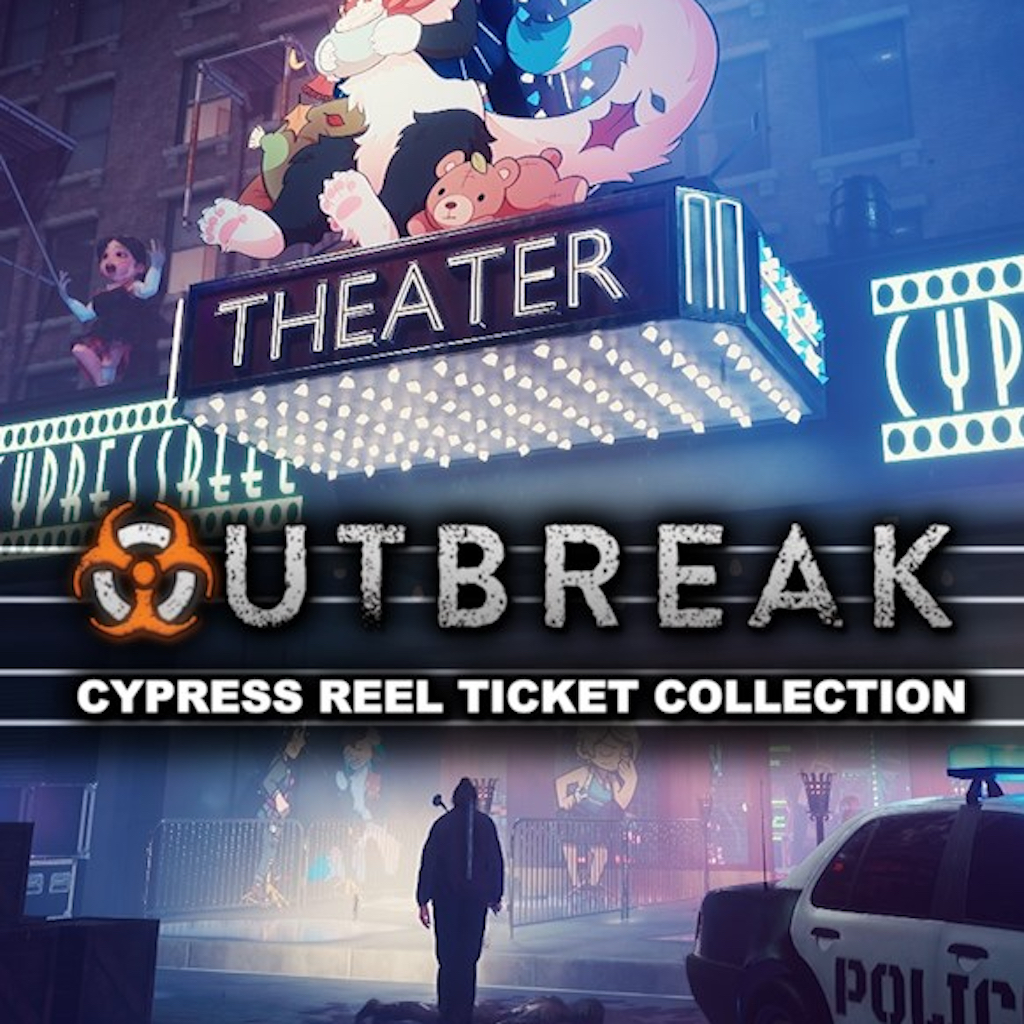
Outbreak: Cypress Reel Ticket Collection is an expansive anthology bundle that brings together multiple entries from the Outbreak universe into a single package. Rather than focusing on one tightly honed survival horror experience, the collection aims to showcase the franchise’s full range — from tense cooperative survival and narrative-driven prequels to arcade-style shooters and retro throwbacks.
This ambition is both the collection’s greatest strength and its most persistent weakness. When the games align in tone and intent, the experience is engaging and memorable. When they diverge, the collection can feel fragmented and inconsistent. Still, for fans of classic survival horror sensibilities and cooperative play, there is a lot to appreciate here.
What’s Included: Quantity and Variety
The Cypress Reel Ticket Collection bundles together several titles and expansions, including:
- Outbreak: Shades of Horror – the main survival horror experience
- Outbreak: Shades of Horror – Chromatic Split – an expanded prologue edition
- Outbreak: Shades of Horror – Dinobreak Crossover – crossover content featuring additional characters
- Outbreak: The Fedora Files: What Lydia Knows – a narrative-focused prequel
- Dinobreak – a retro-styled survival horror title
- Railbreak – an arcade-inspired on-rails shooter
Together, these components form a varied package that experiments with different gameplay styles while sharing a common universe. Not all of these pieces are equally polished, but their inclusion does provide a sense of scope and value.
The Core Experience: Outbreak: Shades of Horror
At the heart of the collection lies Outbreak: Shades of Horror, a cooperative survival horror game that draws heavily from late-1990s genre conventions. The setting revolves around the town of Cypress Ridge and its central hub location, the Cypress Reel cinema, which acts as both a narrative anchor and a multiplayer lobby.
The gameplay loop emphasises exploration, resource management, and survival against waves of infected enemies. Ammunition is limited, healing items are scarce, and players are encouraged to plan encounters carefully rather than charging headfirst into danger. The game supports solo play as well as cooperative multiplayer, and it is in co-op where the experience shines brightest.
Playing with others introduces genuine tension and coordination: splitting up to search rooms, covering choke points, and deciding when to retreat. Character selection adds light RPG elements, with different stats and loadouts offering modest variation in playstyle.
However, enemy variety and AI behaviour can feel repetitive over time. While early encounters generate tension, prolonged sessions reveal predictable patterns that reduce the sense of danger. The mechanics do their job, but they rarely evolve enough to maintain consistent intensity.
Narrative Threads and Prequel Content
Narrative cohesion across the collection is mixed, but The Fedora Files: What Lydia Knows helps contextualise the broader outbreak. Presented in a visual-novel-style format, this prequel focuses on character perspective and emotional grounding rather than action.
While brief, it adds depth to the universe and offers a welcome change of pace from combat-driven gameplay. The Chromatic Split expansion builds upon this foundation, adding extra mechanics and combat-oriented scenarios that bridge narrative and action.
These story elements are valuable, but they are fragmented. Players must actively piece together context across modes, which can be rewarding for lore-focused fans but confusing for those seeking a single, cohesive narrative arc.
Retro and Arcade Diversions
The inclusion of Dinobreak and Railbreak significantly broadens the collection’s scope.
Dinobreak is a deliberate throwback to classic fixed-camera survival horror, complete with stiff movement, limited visibility, and methodical pacing. For fans of old-school design, this mode delivers nostalgic appeal, though modern players may find its controls and structure dated.
Railbreak, by contrast, is loud, fast, and unapologetically arcade-focused. As an on-rails shooter, it trades tension for spectacle, leaning into exaggerated characters and relentless action. While enjoyable in short bursts, it feels tonally disconnected from the survival horror core and functions more as a novelty than a central pillar of the bundle.
These modes add variety, but they also underscore the collection’s lack of focus. The experience shifts dramatically depending on which component you engage with, and not all transitions feel natural.
Atmosphere, Audio, and Presentation
Atmosphere remains one of the collection’s strongest elements. In the survival horror segments, dim lighting, claustrophobic interiors, and ambient audio design work together to create sustained unease. Environmental sound cues — distant groans, metallic creaks, sudden silence — reinforce the sense of vulnerability.
Visually, the games are functional rather than striking. Textures and models are serviceable, and while environments do their job, they lack the detail and polish of higher-budget horror titles. Performance is stable across modes, and frame rates remain consistent even during co-op sessions.
Audio design varies depending on the mode. Horror sections favour subtle ambience, while Railbreak embraces bombastic sound effects and energetic music. The contrast reinforces each mode’s intent but also highlights tonal disparity within the bundle.
Strengths and Weaknesses
Strengths
- Strong cooperative survival horror foundations
- Substantial amount of content across multiple genres
- Effective atmosphere in core horror modes
- Narrative expansion adds depth to the universe
Weaknesses
- Uneven quality across included titles
- Repetitive combat and limited enemy variety
- Fragmented narrative structure
- Tonal inconsistency between modes
Final Verdict
Outbreak: Cypress Reel Ticket Collection is an ambitious horror anthology that offers breadth rather than refinement. Its cooperative survival horror components deliver genuine tension and enjoyable teamwork, while its narrative prequels and genre experiments expand the universe in interesting — if uneven — ways.
The collection is best approached as a grab-bag of experiences rather than a single, unified game. Players willing to sample different styles and tolerate inconsistencies will find value here, especially in co-op. Those seeking a tightly focused, narratively driven horror experience may find the package unfocused despite its strengths.