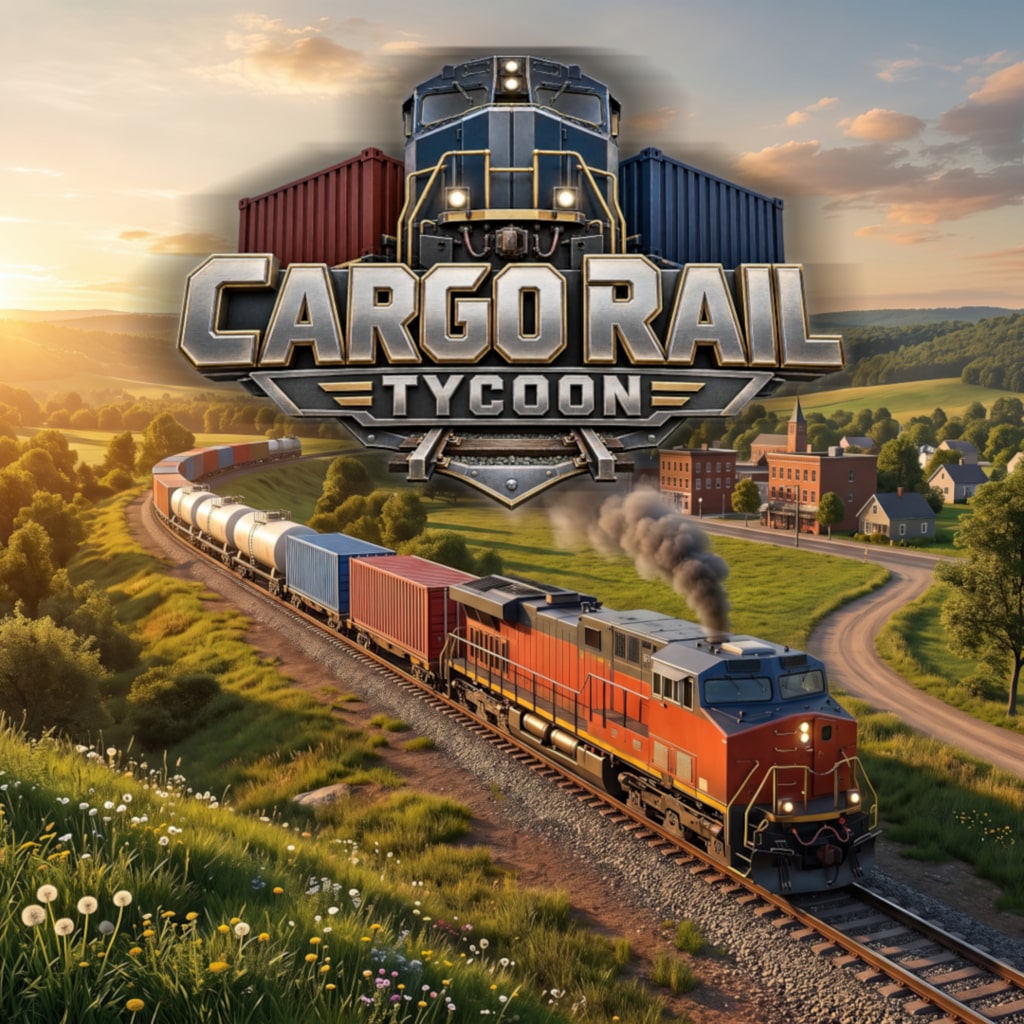
There is something inherently romantic about railways. Perhaps it is the sound of a locomotive grinding into motion, the sight of endless track disappearing towards the horizon, or simply the idea that somewhere beyond the next bend there is another destination waiting to be discovered. Cargo Rail Tycoon takes that familiar railway fantasy and gives it a distinctly entrepreneurial twist. Here, you aren’t simply driving trains because you love them. You are driving them because someone, somewhere, desperately needs a wagon full of goods, and there is money to be made if you can get those goods there in one piece.
Published by Pix Arts, Cargo Rail Tycoon combines freight trading, train driving and negotiation into a budget simulation with a surprisingly appealing central idea. Your objective is straightforward: start with a small convoy and a modest bankroll, buy goods where they are cheap, transport them across Michigan and sell them where demand is higher. The further you progress, the more money you can make, allowing you to expand your convoy and take on increasingly ambitious journeys. It sounds simple, and in many respects it is, but there is an enjoyable little rhythm to the whole process that makes those early profits surprisingly satisfying.
All Aboard the Money Train
At the heart of Cargo Rail Tycoon is its trading system. Rather than being given a fixed price for your cargo, you have to look at the market, decide where the best opportunity lies, and then work out whether the journey is worth the risk. There are 26 towns scattered across the map, each with its own supply and demand, meaning the most profitable destination can change as you progress. This gives the game a basic but effective economic layer, because making money isn’t simply about buying something cheaply. It is about understanding where that cargo needs to go.
That creates a pleasant sense of purpose before every journey. You aren’t just selecting the next mission from a menu and following an arrow. You are effectively planning a little freight operation, weighing potential profit against distance, route, and the size of your convoy. The farther north you travel, the greater the potential rewards, but pushing deeper into the map also means committing to longer journeys. When your bankroll is still small, every decision matters, and that makes the early game more interesting than you might expect from such a modest production.
There is also a nice personal touch to the trading system thanks to the station masters. Rather than simply clicking a button to purchase or sell your cargo, you negotiate directly with them. The multi-round haggling system gives these encounters a little personality, allowing you to push for a better deal while knowing that being too aggressive can cause the other party to dig their heels in. It isn’t a hugely sophisticated negotiation system, but it gives the trading side of the game a human element that a conventional spreadsheet-driven economy would lack.
Take the Throttle
The biggest difference between Cargo Rail Tycoon and a conventional trading simulator is that you don’t simply send your trains off and wait for the profits to roll in. You have to drive them yourself. Every journey puts you in the cab, with control over the throttle and brakes as you navigate the railway network.
This is where the game can become surprisingly tense. Speed matters because arriving quickly can earn you a bonus, but the temptation to charge through every bend is dangerous. Take a curve too quickly and you can derail, potentially turning what looked like a lucrative trip into a costly disaster. It creates a simple risk-and-reward relationship that works well. You want to be fast, but you also need to respect the train.
The track-switching mechanic adds another layer to the driving. Destinations aren’t always directly ahead, and signs indicate which route you need to follow. A moment of inattention can send you towards the wrong town, wasting time and potentially ruining your carefully planned delivery. It is a wonderfully simple idea, but it gives the driving sections something that many basic train games lack: consequences.
There is also something strangely satisfying about simply sitting in the cab and watching the landscape roll past. The experience isn’t aiming for the realism of a dedicated train simulator, and its physics are fairly lightweight, but there is still a certain charm to watching your freight consist snake around a bend while you try to judge the braking distance. The train itself becomes more than a vehicle. It is your livelihood.
Watch Out for Bandits
Just when you think freight transportation is becoming a little too respectable, Cargo Rail Tycoon throws bandits into the mix. These roadblocks can bring your journey to a halt and force you into another negotiation. You can pay the ransom, or you can try to haggle the price down.
It is a slightly ridiculous addition to a railway trading game, but it gives otherwise straightforward journeys an unexpected interruption. You might be cruising along quite happily, thinking about your potential profit, only to discover that somebody has decided to make your railway journey considerably more expensive. The bandit encounters aren’t deep enough to become a major gameplay system, but they do provide moments of tension and stop every journey from feeling exactly the same.
They also reinforce the game’s underlying philosophy. Nothing is entirely guaranteed. You can plan your route, calculate your profit and choose the right cargo, but there are still things that can get in your way. That unpredictability works particularly well in a game built around relatively short individual journeys.
Building Your Convoy
As money starts coming in, you can invest in additional wagons and expand your convoy. This is where the game’s progression loop becomes particularly satisfying. Starting with a modest train and gradually increasing its capacity gives you a tangible sense of growth, while different wagons can be matched to the cargo you want to transport.
There is no denying that the progression is relatively simple, though. Cargo Rail Tycoon doesn’t offer the kind of enormous management systems or intricate railway networks you might find in more ambitious tycoon games. You won’t be spending hours designing complex timetables or micromanaging hundreds of employees. Instead, the game concentrates on a smaller loop of buying, negotiating, driving, selling and expanding.
Personally, I think that simplicity is both its greatest strength and one of its biggest weaknesses. It makes the game incredibly approachable, particularly if you aren’t already familiar with simulation games, but it also means experienced tycoon players may eventually find themselves wanting more. There is a good foundation here, but the mechanics rarely go particularly deep.
A Different Journey Every Time
One of the more interesting features is the procedurally generated railway system. Routes can include curves, bridges, rivers and varied stretches of scenery, while the destination itself can require you to take a route straight ahead, left or right. This means you cannot simply memorise one perfect route and repeat it indefinitely.
The procedural approach cleverly adds variety without requiring an enormous handcrafted world. It also complements the driving mechanics, as you have to pay attention to the signs rather than simply switching off your brain and following the same track every time. There is a small sense of discovery on each journey, even if the underlying environments are fairly basic.
Unfortunately, the budget’s limitations are evident here. The scenery isn’t going to compete with the more visually impressive train simulators, and the simple asset design can make parts of the world feel sparse. There is also a lack of visual sophistication in the overall presentation, which occasionally makes the procedurally generated environments feel more like functional scenery than a convincing slice of Michigan.
That said, I would rather have a game with modest visuals and a decent gameplay idea than a beautiful railway experience with nothing interesting to do. Cargo Rail Tycoon gets the fundamentals of its concept right, even if the presentation doesn’t always match the ambition.
A Small Simulator With Big Ambitions
The real question is whether Cargo Rail Tycoon can sustain its appeal over the long term. The answer depends heavily on what you want from it. If you’re looking for a deep, complex tycoon simulator with a vast number of interconnected systems, this probably won’t satisfy you. Its economy is straightforward, its visuals are basic, and the train physics don’t attempt to replicate every detail of operating a real locomotive.
However, there is something quite relaxing about its simplicity. You find a good deal, negotiate with a station master, load your wagons, climb into the cab and head for your destination. Along the way, you have to manage your speed, watch the signs, deal with bandits and try not to turn your expensive cargo into scattered wreckage. Then you arrive, sell your goods, count your profits and start thinking about where to go next.
That loop works because every element feeds into the next. Trading gives you a reason to drive, driving gives trading a sense of risk, and profits give you a reason to keep expanding. It isn’t revolutionary, but it is coherent, and sometimes that is enough.
Final Verdict
Cargo Rail Tycoon is a modest railway management game with a surprisingly likeable personality. Its combination of freight trading, first-person train driving and face-to-face haggling makes it feel different from the average budget simulator, while the procedural routes and bandit encounters provide enough variety to keep individual journeys interesting. The satisfaction comes from turning a small convoy into a more capable freight operation, watching your profits grow and gradually reaching the more lucrative northern towns.
It does, however, wear its budget origins on its sleeve. The visuals are basic, the physics lack sophistication, and the overall management systems don’t have the depth needed to keep serious tycoon enthusiasts occupied indefinitely. Some players will also find the repetition sets in once the novelty of the central loop begins to fade. With more detailed economic systems, richer environments and deeper train mechanics, there is certainly room for the concept to grow.
For what it is, though, Cargo Rail Tycoon is an enjoyable little diversion. It doesn’t try to bury you beneath endless statistics or complicated menus. Instead, it puts you in the driver’s seat and asks you to make money the old-fashioned way: buy low, sell high, drive carefully and hope nobody has blocked the tracks.