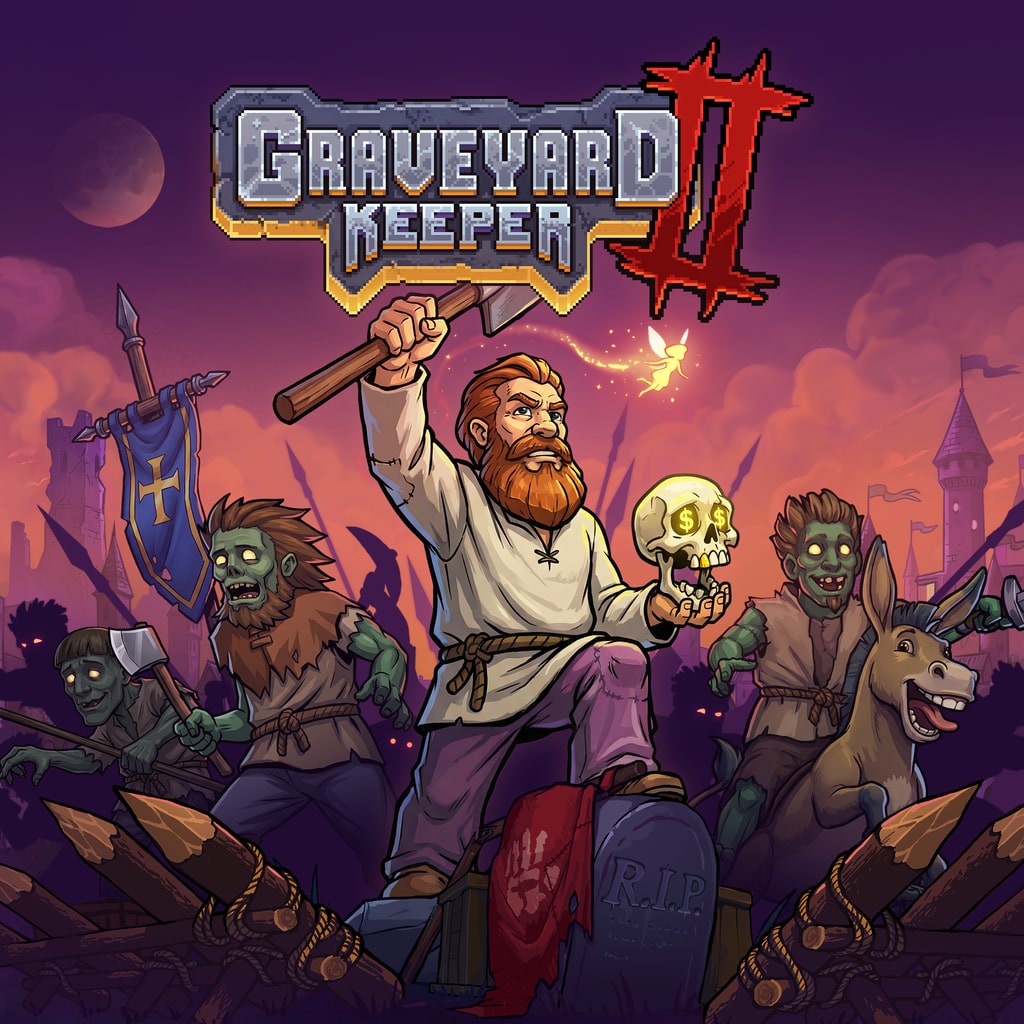
There are plenty of games about building a better life. You know the sort of thing: plant a few crops, make friends with the neighbours, decorate your house and generally become a more wholesome member of the community. Graveyard Keeper 2 looks at all of that and apparently decides that what the genre really needs is a neglected cemetery, a mountain of human remains, an army of zombies and an industrial production line powered by the undead. It is wonderfully, gloriously wrong, and that is precisely why it is so much fun.
Returning to the strange medieval world of the original, you once again find yourself in the shoes of the long-suffering Keeper, though things have escalated considerably this time around. You are now the Grand Inquisitor, which sounds like a position that should come with considerable authority, but mostly seems to involve managing a cemetery, extracting useful materials from corpses, rebuilding a town and somehow preparing an army of zombies to save the kingdom. It is an absurd premise, but the sheer number of interconnected systems makes the whole thing surprisingly addictive.
Welcome Back To The Graveyard
The first thing Graveyard Keeper 2 gets right is its sense of humour. This is not a game that wants you to become emotionally attached to every character or spend your evenings enjoying wholesome community activities. Instead, it looks at medieval life through a distinctly macabre lens, where a fresh corpse is less a tragic event and more an opportunity to acquire a few useful resources.
That dark comedy runs through almost everything you do. You can be carefully managing the quality of your cemetery one moment and then happily dissecting a body because you desperately need something that happens to be inside it. The game knows how ridiculous that sounds and leans into it, creating a wonderfully dry tone that makes even the grindiest activities feel strangely entertaining.
It also helps that the world itself is full of eccentric characters. The townsfolk have their own problems, ambitions and requests, while the wider setting is packed with little jokes and bizarre situations. There is a genuine sense that the developers are having as much fun with this world as the player is.
A Graveyard Is Just The Beginning
At first, managing a cemetery might sound like a fairly limited premise, but Graveyard Keeper 2 quickly shows that your graveyard is only the beginning. You will harvest plants, collect materials, work with corpses, craft equipment, and gradually unlock increasingly complex production chains.
The cemetery itself remains an important part of your operation, with the quality of individual graves contributing to your overall prestige. This means that even something as simple as preparing a body becomes part of a much larger optimisation process. You are constantly assessing what you have, what you need, and how you can turn one resource into something considerably more valuable.
That is where the game’s management systems start to become addictive. One task leads naturally into another, and before long you are thinking several steps ahead. You need one material to create a component; that component is required for another machine, and the machine will eventually allow you to automate something that was previously eating up half your day.
Let The Zombies Do The Work
Automation is arguably the star of Graveyard Keeper 2. Rather than spending your entire existence running backwards and forwards, collecting resources and processing materials yourself, you can build increasingly sophisticated production systems and put zombies to work.
There is something wonderfully funny about watching a group of undead workers quietly getting on with their jobs while you wander around managing the bigger picture. Conveyor belts, machinery and specialised zombies gradually transform your operation from a scrappy little medieval enterprise into something resembling a completely unhinged industrial complex.
The automation is also more than a novelty. It genuinely changes the way you approach the game. Early on, you do a lot of the work manually, which helps you understand the different systems and resources. Eventually, you start looking for ways to remove yourself from the process entirely, allowing your undead workforce to handle the repetitive jobs while you concentrate on exploration, quests and expansion.
Death Has Never Been So Useful
The handling of corpses remains one of the game’s most distinctive features. Corpses are not simply something you bury and forget. They are sources of useful materials, so preparing them becomes an important part of your broader production network.
It is a wonderfully twisted mechanic because the game treats something deeply grim as just another resource-management problem. You might need a particular material for crafting, which means you need the right kind of corpse, which means you need to process it correctly. Suddenly, your graveyard has become another part of your supply chain.
The cemetery rating system adds another layer to this. You cannot simply dump bodies into holes and call it a day if you want to maximise your reputation. Improving graves, managing the quality of remains, and making the entire place look respectable become another long-term project.
It is probably the only game where you can genuinely find yourself thinking, “I really need to improve the quality of my corpses,” and somehow that feels completely normal.
Build An Army Of The Undead
Then there is the rather significant matter of the zombie apocalypse. As Grand Inquisitor, you are not merely managing a cemetery and making questionable use of the dead. You are also expected to defend the kingdom, which means building an undead army and sending it into battle. This introduces a more combat-focused side to the game and gives all that zombie production a rather useful purpose.
You can build towers and fortifications, craft armour and weapons, and prepare your undead troops for battle. The idea of taking a bunch of zombies that previously spent their days moving materials around a factory and turning them into an organised military force is exactly the kind of ridiculous escalation that makes this game work.
Combat itself adds welcome variety to the otherwise heavily management-focused gameplay. Rather than simply watching your empire grow from the safety of your workshop, you occasionally have to think about territory, defence and how to deal with the threats surrounding the kingdom.
The Town Needs You
Rebuilding the town gives you another reason to explore beyond your own little corner of the world. The townsfolk have problems that need solving, and helping them can open up new opportunities while also providing another source of income.
The clever part is that your undead workforce can take care of some of the heavy lifting. This means your involvement gradually shifts from doing every little job yourself to managing an increasingly sophisticated network of systems. You become less of a medieval labourer and more of a slightly unhinged executive overseeing an army of dead employees.
The quest system also benefits from the game’s flowchart approach. With so many characters, objectives and interconnected tasks, it would be easy to lose track of what you were supposed to be doing. A visual representation of your various questlines makes the whole thing considerably easier to follow without removing the sense of discovery.
The Grind Is Real
If there is one thing that might put some players off, it is the sheer amount of grinding involved. Graveyard Keeper 2 is not a game that hands you everything you need. You will spend a lot of time gathering resources, unlocking technologies, building machines, and slowly improving your operation.
For some players, that will be part of the appeal. There is something tremendously satisfying about starting with very little and gradually creating a complex system that can produce increasingly sophisticated goods with far less effort. Watching a process that once took ten minutes become automated is its own reward.
There are moments, however, when the number of interconnected systems can feel overwhelming. You may find yourself needing several different resources to create one item, only to discover that another part of the process requires something else entirely. It can be a lot to absorb, particularly in the early hours.
Fortunately, the game generally rewards patience. Once you understand how the systems connect, the complexity becomes considerably more enjoyable. What initially looks like an enormous wall of crafting requirements gradually starts to resemble a puzzle you can solve piece by piece.
A World Full Of Character
Visually, Graveyard Keeper 2 sticks with the detailed top-down pixel art that gave the original its personality. It is colourful without ever losing its darker atmosphere, and the various locations have enough detail to make exploring them worthwhile.
Dynamic lighting, changing weather and shifting shadows help bring the world to life. It may be a pixel art game, but there is a surprising amount of atmosphere packed into its environments. The contrast between cheerful colours and grim subject matter also reinforces the game’s particular brand of comedy.
Full voice acting is an especially welcome improvement. The eccentric cast benefits enormously from having their personalities brought to life, and the distinctive regional UK accents give many of the characters an extra layer of charm. Some of the dialogue was already funny on the page, but hearing it delivered properly makes the jokes land considerably better.
Sauna, Style And Other Important Matters
For a game involving zombies, corpses and industrial levels of human remains, Graveyard Keeper 2 has an oddly strong appreciation for relaxation. The sauna is a particularly amusing addition, letting you take a break from the constant grind and enjoy some downtime outside your house.
Then there is the exclusive outfit, because apparently becoming the Grand Inquisitor and commanding an undead army is not enough. You also need to look the part. It is a small touch, but it fits perfectly with the game’s sense of humour.
These little moments are important because they stop the experience from becoming nothing more than an endless checklist of crafting requirements. The world has personality, and those moments of absurdity remind you that this is supposed to be fun.
Final Verdict
Graveyard Keeper 2 is a wonderfully twisted management adventure that takes everything strange about its predecessor and expands it into something considerably bigger. The combination of cemetery management, corpse processing, crafting, automation, town rebuilding and undead warfare sounds completely ridiculous on paper, yet somehow all of these systems fit together remarkably well.
The zombie automation is a particular highlight. Watching your undead workforce slowly transform a chaotic collection of resources into a functioning industrial operation is incredibly satisfying, and it gives the long-term progression a genuine sense of purpose. The addition of zombie armies also gives you something else to work towards, ensuring that your carefully constructed empire is not simply about making money from the dead.
There is a lot to learn and an awful lot to grind, so this is certainly not a game for anyone looking for a quick, uncomplicated management experience. However, if you enjoy games where you can disappear down a rabbit hole of crafting, optimisation and automation for hours at a time, Graveyard Keeper 2 has an enormous amount to offer.
Most importantly, it has personality. It is dark, silly, occasionally disgusting, and completely comfortable with all three. Few games can make harvesting human remains, employing zombies and improving the local cemetery feel like a perfectly respectable afternoon’s work, but Graveyard Keeper 2 somehow manages it.