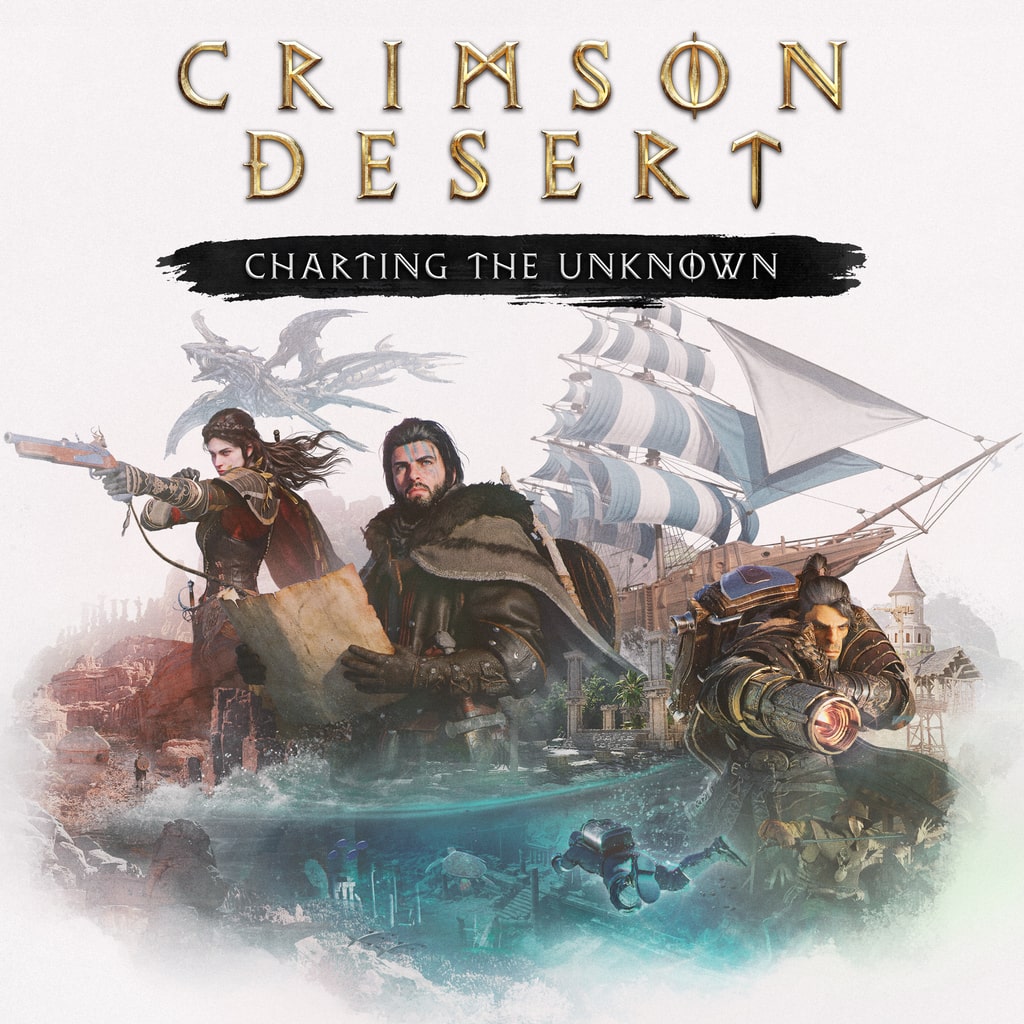
There is something wonderfully appropriate about taking an enormous open world and simply asking, “What’s over there?” Crimson Desert has always been a game built around exploration, spectacle and the sense that another adventure is waiting just beyond the horizon. With Crimson Desert Enhanced: Charting the Unknown, Pearl Abyss takes that philosophy and points it towards the sea. Suddenly, Pywel feels considerably bigger, and the horizon is no longer something you simply admire from afar. It is somewhere you can actually go.
Charting the Unknown expands the adventure with new islands, naval combat, underwater exploration, forgotten ruins and a collection of new threats designed to make both land and sea feel dangerous. Kliff returns alongside Damiane and Oongka, but this time the journey takes the group away from familiar territory and into waters where there are plenty of reasons to keep one hand close to your weapon. It is an ambitious expansion, and thankfully it understands that simply adding a large body of water is not enough. The ocean needs its own identity, its own dangers and its own reasons to explore.
Setting Sail Into The Unknown
The first thing that makes Charting the Unknown work is the simple thrill of setting sail. Taking command of your own ship gives the expansion a completely different rhythm from the land-based adventure, and there is something genuinely exciting about watching the coastline disappear behind you. The islands scattered across the ocean provide new destinations to discover, while the open water itself becomes part of the adventure rather than empty space separating one location from another.
There is a nice sense of uncertainty to these voyages. You might be heading towards an island because you know something interesting is waiting there, or you might simply spot something in the distance and decide to investigate. That freedom suits Crimson Desert perfectly. Exploration feels much more rewarding when the game allows curiosity to drive you rather than constantly pointing you towards the next objective.
Of course, the ocean is not a peaceful holiday destination. Pirate fleets and enormous aquatic creatures make sure that travelling from one place to another can become an event in itself. The result is an expansion where simply getting somewhere can be as memorable as what you find when you arrive.
Cannon Fire On The High Seas
Naval combat is one of the biggest additions here, and it gives Crimson Desert a surprisingly different flavour. Ships can be upgraded and customised, with faster vessels suited to mobility and heavier warships offering more protection and firepower. Once combat begins, the calm of sailing quickly gives way to cannon fire, splintering timber, and the frantic business of positioning your ship for the next attack.
There is something satisfying about the scale of these encounters. Fighting another vessel already feels considerably more dramatic than an ordinary skirmish on land, but the presence of colossal ocean beasts raises the stakes again. A pirate ship is one thing. A creature large enough to make your carefully upgraded vessel look like a toy is something else entirely.
The ship controls can occasionally feel a little heavy, particularly when navigating tighter areas or manoeuvring around awkward coastlines. It is not enough to ruin the experience, but there are moments when you wish your vessel would respond just a little faster. Once you get accustomed to its weight, however, the naval systems become an enjoyable extension of the wider combat experience.
Beneath The Waves
The underwater exploration is arguably the most intriguing part of the expansion. Diving beneath the surface completely transforms the atmosphere, replacing the open skies and sweeping landscapes of Pywel with darker, quieter environments where ancient ruins and forgotten treasures lie beneath the waves. These sections have a genuine sense of discovery, as the underwater world feels like somewhere that has been waiting to be found.
Specialised diving equipment allows Kliff and his companions to explore submerged areas and investigate aquatic ruins. These locations are not simply underwater versions of the environments you have already seen. They introduce their own puzzles, resources and mysteries, giving exploration a distinct texture.
There is also something pleasing about the contrast. Above the water, the world can be loud and chaotic, filled with battles and travelling companions. Below it, everything becomes quieter and more mysterious. The change of pace works particularly well, giving the expansion moments when you can simply explore without immediately worrying about what is going to attack you next.
The Lost Islands
The new islands scattered throughout the archipelago provide another reason to keep sailing. These locations are packed with unfamiliar wildlife, ancient structures, pirate strongholds and strange remnants of a much older history. They help prevent the ocean from feeling like a glorified loading screen between major story locations.
Exploring an island can be a little adventure of its own. You might arrive expecting a simple search for resources and instead discover an enemy encampment or something tied to one of the expansion’s deeper mysteries. That unpredictability is important because it gives exploration purpose.
The Abyss Gates and subterranean areas also help create a sense that there is much more beneath Pywel than anyone fully understands. Charting the Unknown is at its best when it encourages you to wonder what happened here rather than simply handing you an explanation.
Kliff, Damiane And Oongka
The returning characters also benefit from the expansion’s broader scope. Kliff remains at the centre of the adventure, but Damiane and Oongka have more opportunities to make their mark, particularly during naval boarding encounters. Watching companions become part of the action rather than simply following behind adds a welcome sense of teamwork.
Ship-to-ship combat becomes more interesting when you can bring those characters into the fighting. Ranged attacks and heavier close combat complement one another, giving boarding actions their own character. It reinforces the idea that this is not simply Kliff’s adventure with a different backdrop. The wider group has a role to play.
The expansion also promises new stories involving political conflict, an ominous presence in the desert, journeys beyond time and ancient secrets beneath the ocean. That mixture of ideas is unmistakably Crimson Desert. It is willing to throw several strange concepts into the same pot and somehow make them feel like part of the same enormous fantasy world.
A Richer Life In Pywel
Perhaps surprisingly, Charting the Unknown is not entirely about fighting and exploration. The expansion also offers more ways to establish yourself in Pywel, including renting and managing facilities, an improved housing system, and deeper interactions with the world’s inhabitants.
These additions may sound less exciting than fighting a sea monster, but they are important because they make Pywel feel more like a place to live rather than simply a giant playground. Having somewhere to call home and businesses to manage gives a reason to return between adventures. It adds another layer to the fantasy of being an influential figure in this world.
The deeper conversations with NPCs are particularly welcome. When an open world is this large, its inhabitants can easily become background decoration. Giving players more opportunities to build relationships helps make the world feel more personal.
A World That Looks Fantastic
Visually, Charting the Unknown is predictably impressive. The ocean itself is a major part of the spectacle, with waves responding dynamically to the weather and ships moving through increasingly rough conditions. Storms can transform the atmosphere from beautiful to threatening in moments, while underwater lighting lends the submerged environments an eerie beauty.
The underwater areas are especially effective. Light filtering through the surface, distant coral formations and the vast drop-offs beneath the player all contribute to the feeling that you have entered an entirely different world. It is the sort of environment that makes you want to stop moving for a moment simply to look around.
Ship combat also benefits from the visual detail. Cannon blasts, turbulent water and damaged vessels create wonderfully cinematic moments, particularly when a huge aquatic creature emerges from the waves. Crimson Desert has never been shy about spectacle, and this expansion gives it plenty of new toys to play with.
The Sound Of The Sea
The audio design plays an equally important role. The creaking of wooden ships, the crashing waves and booming cannons create a convincing sense of being at sea, while the orchestral soundtrack knows when to step forward and make an encounter feel suitably epic.
Leviathan battles benefit enormously from this. There is a particular thrill in hearing the music build as something enormous moves beneath the water, because the audio gives you a warning that something unpleasant is about to happen. It is an old trick, but a good one.
The quieter underwater sections benefit too. With the noise of the surface largely removed, the atmosphere becomes more mysterious and contemplative. Those quieter moments give the expansion some breathing room between its larger action sequences.
An Expansion With Real Ambition
The greatest compliment that can be paid to Charting the Unknown is that it does not feel like a collection of extra missions bolted onto an existing game. Pearl Abyss has taken one of the most obvious unexplored parts of Pywel and built a substantial new adventure around it.
There is a lot going on here. Naval combat, diving, islands, underwater ruins, aquatic creatures, new gear, expanded housing, facility management and additional character stories could easily have resulted in a bloated mess. Instead, the different elements largely complement one another because they all feed into the central idea of exploration.
It is not perfect. Ship handling can be cumbersome in confined spaces, and the sheer amount of content may occasionally make the expansion feel overwhelming. There is also a danger that players who prefer the immediacy of land combat may find some of the slower exploration sections a little too deliberate.
For me, though, those are minor complaints against an expansion that understands what makes open-world adventures special. Sometimes the best moments are not the enormous boss fights or dramatic story revelations. Sometimes it is sailing towards an island you have never visited before and wondering what you are going to find when you finally step ashore.
The Verdict
Crimson Desert Enhanced: Charting the Unknown is a confident expansion that adds another dimension to Crimson Desert without losing the original’s adventurous spirit. The addition of naval exploration and underwater diving could easily have felt like a gimmick, but Pearl Abyss has built enough systems around them to make the ocean feel like a genuine extension of Pywel.
The naval combat is exciting, the underwater environments provide a welcome change of pace, and the lost islands give exploration plenty of purpose. Add in new threats, expanded character stories, housing improvements, and deeper ways to interact with the world, and there is plenty here for returning players to sink their teeth into.
It is the kind of expansion that makes you look at the map differently. The sea is no longer just the blue stuff around the edge of the world. It is another frontier, full of secrets, monsters, ruins and trouble, which is exactly what an adventure game should make you want to explore.