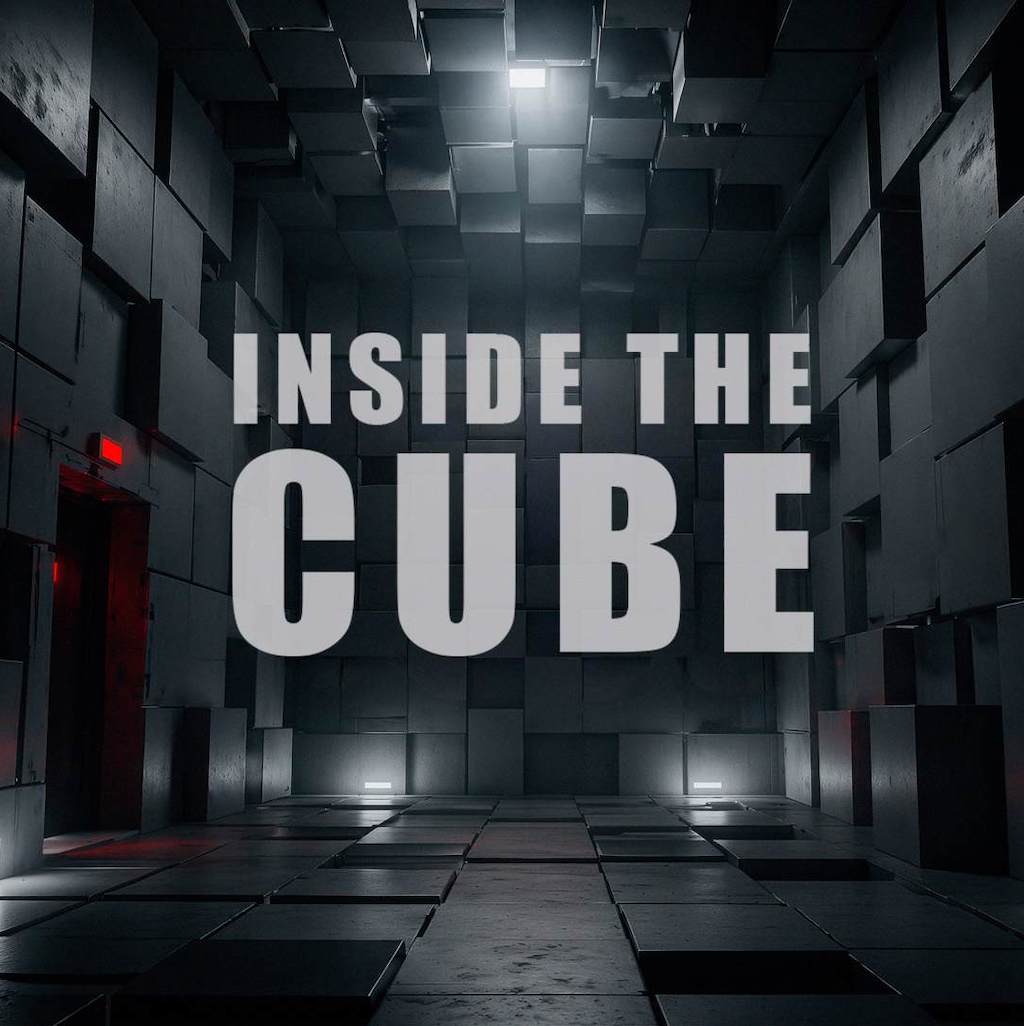
There is something wonderfully unsettling about waking up somewhere you do not recognise. No explanation, no helpful voice in your ear, and certainly no convenient arrow pointing towards the exit. Inside the Cube takes that simple idea and builds an entire puzzle experience around it, dropping you into a strange geometric labyrinth where every room feels deliberately designed to make you question what you are seeing. It is a game that understands the appeal of being left alone with a problem and, in the gentlest possible way, being told to figure it out yourself.
Developed and published by Play Lab, Inside the Cube is a minimalist first-person puzzle adventure that prioritises observation and logical thinking over combat, character development or elaborate storytelling. Its world is built from interconnected chambers that initially appear almost identical, but subtle differences soon become enormously important. What starts as a straightforward search for an escape gradually becomes a test of your ability to understand the strange rules governing the environment.
The premise is deliberately sparse. You awaken inside an unfamiliar labyrinth with no memory of how you arrived and seemingly no idea where you are supposed to go. Corridors lead into more rooms, doors conceal further challenges, and the clock is always ticking somewhere in the background. There is no need for a sprawling narrative because the mystery is the environment itself, and that is where Inside the Cube is at its strongest.
A Maze Built Around Your Curiosity
The greatest strength of Inside the Cube is how it encourages you to see its rooms differently. At first, you simply walk around, searching for switches and examining anything that looks remotely interactive. Before long, however, you begin to notice patterns and realise that the room itself might be the puzzle. A wall is not necessarily a wall; a floor may become something else entirely, and an apparently inaccessible platform could be just one change in perspective away from being reachable.
That sense of discovery is immensely satisfying. The game rarely needs to throw complicated instructions at you because its environments do most of the teaching. You experiment, make mistakes, notice what you missed, and try again. There is a lovely little moment when a puzzle finally clicks into place and you realise the solution was sitting in front of you all along.
The interconnected design also gives the game a welcome sense of progression. Individual rooms provide their own challenges, but they rarely feel completely isolated from the wider structure. You are constantly wondering whether something you discovered earlier might be relevant elsewhere. It makes exploring the labyrinth feel like gradually learning a language, with every new mechanic adding another word to your vocabulary.
When Walls Become Floors
Perspective and gravity manipulation form the heart of Inside the Cube, and these mechanics deliver some of its most enjoyable puzzles. Certain mechanics allow rooms to rotate, altering the relationships between floors, walls and ceilings. A platform that was useless moments earlier can suddenly become the key to reaching another section of the complex.
It sounds simple on paper, but the best puzzles make surprisingly effective use of this idea. You need to consider not only where you are standing, but also what the room will look like after it moves. That encourages genuine spatial reasoning rather than simply hunting for the next button to press. When you successfully plan a route through a rotated room, there is a satisfying sense that you have genuinely outsmarted the environment.
The game also understands the importance of restraint. It does not bombard you with mechanics simply for the sake of variety. Instead, it takes a relatively small set of ideas and gradually asks you to combine them in more demanding ways. There are switches to activate, energy systems to manipulate, sequences to decipher and pathways to uncover, with later challenges asking you to remember lessons from previous rooms.
Observation Is Everything
One of the things I particularly enjoyed about Inside the Cube is how much it rewards simply paying attention. This is not the sort of puzzle game where you can rush into a room and start interacting with everything until something happens. Sometimes the solution is visual, sometimes it involves understanding the relationship between two objects, and occasionally the most important clue is something you barely noticed while wandering around.
That approach gives the game a pleasing old-school quality. There is no sense that the designer is desperate to make sure you never get stuck. Instead, the game trusts you to look, think and experiment. In an era when many adventures are filled with glowing objectives and constant guidance, there is something refreshing about being given a room and being told, essentially, to work it out.
The pressure of the ticking clock adds another layer to that experience. It means that even relatively straightforward puzzles can become more stressful when you know that hesitation has consequences. Thankfully, the tension generally works because it encourages concentration rather than turning the game into a frantic reaction test.
A World of Cold Geometry
Visually, Inside the Cube does not try to compete with the latest graphical showcases, and that is absolutely fine. Its stark geometric presentation is part of the game’s identity. Metallic surfaces, clean lines and illuminated panels create a sterile environment that feels both futuristic and strangely oppressive.
There is an almost clinical beauty to the presentation. Rooms are stripped back, with interactive elements standing out clearly against the surrounding architecture. That clarity is particularly important for a puzzle game, as you need to distinguish what matters from what is simply decorative.
The minimalism also heightens the sense of isolation. There are no crowds, friendly NPCs or bustling environments to make the labyrinth feel inhabited. Instead, you are accompanied primarily by your own footsteps and the distant hum of machinery. It gives the impression that you have been placed inside a machine that has forgotten you are there.
Sound and Atmosphere
The audio design deserves more credit than its simplicity suggests. Echoing footsteps make the chambers feel considerably larger than they appear, while mechanical noises lend the environment a sense of life without ever making it feel populated. Doors opening, systems activating and machinery humming provide subtle confirmation that your actions are having an effect.
There is also something effective about the restraint. Inside the Cube does not constantly rely on dramatic music to signal when something important is happening. Instead, silence becomes part of the atmosphere. When you are standing alone in an unfamiliar chamber, hearing nothing but your own movement, the isolation becomes surprisingly palpable.
It is not horror, exactly, but there are moments when the game brushes against that feeling. The absence of explanation leaves enough space for your imagination to fill the gaps, and sometimes that is more effective than an explicit story could be.
The Challenge of Keeping Things Fresh
If there is one area where Inside the Cube could have pushed further, it is variety. Its minimalist approach is appealing, but players who prefer puzzle adventures packed with elaborate set pieces, characters and constantly evolving mechanics may find the experience somewhat restrained. The geometric environment is deliberately repetitive, and while this supports the concept, it can occasionally make different areas blur together.
The lack of a substantial narrative may also divide players. There is an intriguing mystery surrounding your situation, but Inside the Cube is much more interested in giving you things to solve than in lengthy explanations of why you are solving them. For me, that works for the most part because the puzzles are the real star, although anyone looking for a deep science fiction story may come away wanting more.
The important thing is that the game knows what it wants to be. It does not pretend to be a huge cinematic adventure. Instead, it focuses on the pleasure of solving one problem, entering another room and discovering that the rules have changed just enough to make you think again.
A Quietly Satisfying Puzzle Adventure
There is a particular satisfaction in finishing Inside the Cube. It is not necessarily the sort of game that leaves you shouting at the screen or celebrating every victory, but it creates quieter moments when you sit back and think, “Of course, that’s what I was supposed to do.” Those moments are why puzzle games work, and Play Lab understands that fundamental pleasure.
The experience is best approached with patience. Rather than rushing through every room, take time to examine your surroundings and consider what the environment is trying to tell you. Once you start looking for patterns rather than individual solutions, the labyrinth becomes much easier to navigate.
Ultimately, Inside the Cube is a compact and thoughtful puzzle adventure that does more with its simple premise than you might initially expect. It lacks the narrative ambition and mechanical variety of some larger puzzle games, but its clean design, spatial challenges and quietly oppressive atmosphere give it an identity of its own.
Verdict
Inside the Cube is an enjoyable reminder that a puzzle game does not need an enormous world or complicated mechanics to hold your attention. Its interconnected rooms, perspective-shifting challenges and environmental logic puzzles offer plenty of opportunities to pause, think and enjoy that wonderful moment when a solution suddenly becomes obvious. The minimalist presentation will not appeal to everyone, and the restrained storytelling leaves plenty of unanswered questions, but those limitations are also part of what gives the game its distinctive character.
What I liked most is that Inside the Cube respects the player. It gives you the tools, presents the problem and lets you work things out without constantly holding your hand. There is a quiet confidence in that design, and although the experience could benefit from greater variety, it succeeds in delivering exactly the sort of focused puzzle adventure it sets out to create. For anyone who enjoys spatial brainteasers, atmospheric exploration and the satisfaction of finally cracking a particularly stubborn room, this is a worthwhile little escape.