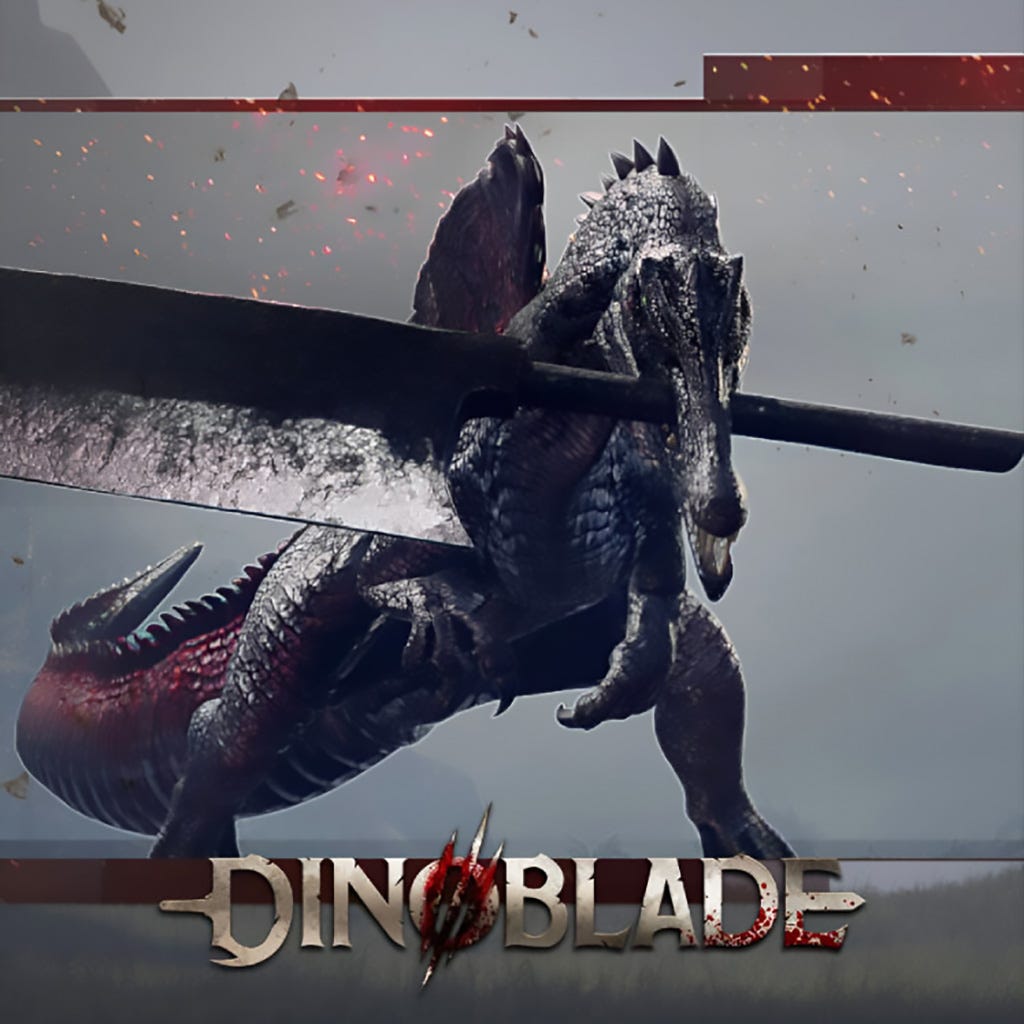
Every so often, a game arrives with a premise so wonderfully absurd that it immediately grabs your attention. A Spinosaurus wielding an enormous great sword sounds like the sort of idea that belongs in a late-night conversation between friends rather than in a fully realised action RPG. Yet Dinoblade doesn’t treat its concept as a joke. Instead, it commits to it completely, building a surprisingly satisfying adventure around prehistoric warriors, towering bosses, and fast, weighty combat.
Developed by Team Spino, Dinoblade throws players into a world reshaped by an ancient catastrophe, where dinosaurs have evolved beyond simple predators into armed combatants locked in a desperate struggle for survival. As a young Spinosaurus burdened with the responsibility of preventing extinction, you journey across sprawling wildernesses, through dangerous territories ruled by colossal Alpha dinosaurs, and towards a mystery that slowly reveals itself as something much bigger than simple survival.
It is undeniably eccentric, but beneath the spectacle lies a genuinely enjoyable action RPG that understands exactly what makes its unusual premise work. Rather than relying solely on novelty, Dinoblade backs up its imagination with engaging combat, rewarding exploration, and a surprising amount of heart.
Gameplay
Combat is where Dinoblade earns its place among modern indie action games. While comparisons to Soulslike titles are inevitable, the experience leans just as heavily into stylish character action. Every encounter revolves around learning attack patterns, managing stamina, and knowing exactly when to strike, dodge, or commit to a risky parry.
The oversized great sword feels appropriately powerful. Each swing carries convincing weight, forcing players to think about positioning rather than wildly mashing attack buttons. Landing a perfectly timed heavy strike against an aggressive Alpha dinosaur delivers the sort of satisfying impact that makes difficult encounters worth the effort.
Enemy variety steadily expands throughout the adventure. Smaller dinosaurs test your ability to control crowds, while elite opponents introduce increasingly complex attack combinations that demand patience and observation. The Alpha bosses are undoubtedly the stars of the show. Each one feels distinct, both visually and mechanically, and demands new strategies rather than simply increasing health bars.
Success rarely comes through brute force alone. Learning animations, recognising openings, and maintaining composure during lengthy battles gradually turn seemingly impossible encounters into memorable victories. Every defeat teaches something valuable, encouraging improvement rather than frustration.
The pacing benefits enormously from this structure. Quiet stretches of exploration naturally build anticipation before another major confrontation, creating a satisfying rhythm that carries the campaign forward.
Progression That Rewards Experimentation
Victory brings meaningful progression rather than simple numerical increases. Defeated bosses unlock new abilities, expanded move sets, and powerful upgrades that let players shape their preferred combat style over time.
Some players favour aggressive combinations built around relentless offence, while others prefer defensive builds that focus on careful parries and counterattacks. The system never becomes overwhelmingly complicated, yet it offers enough flexibility to encourage experimentation without punishing curiosity.
Hidden legendary weapons scattered throughout the world further reinforce exploration. Discovering a new blade tucked away behind a forgotten path or guarded by a particularly dangerous enemy always feels worthwhile. These discoveries rarely trivialise combat, but they provide enough variety to keep battles fresh throughout the campaign.
Unlocking Boss Rush Mode after completing the story also adds welcome longevity. For players who enjoy mastering combat systems, it becomes the ultimate test of everything learned during the adventure.
A World Worth Exploring
Despite its prehistoric setting, Dinoblade avoids visual repetition. Each biome has its own identity, making the world feel far larger than its individual regions might initially suggest.
Dry canyons create natural arenas for tense duels against territorial predators. Dense jungles limit visibility, heightening tension as enemies emerge unexpectedly from thick vegetation. Mist-covered valleys create an almost mythical atmosphere, while volcanic regions reinforce the growing sense that this ancient world is slowly collapsing beneath its own history.
Exploration is consistently rewarding because the environments rarely serve merely as corridors between boss fights. Hidden routes, optional encounters, collectable weapons, and environmental storytelling encourage players to stray from the main path.
Although the overarching narrative remains relatively straightforward, the world itself tells much of the story. Broken ruins, forgotten battlefields, and mysterious relics hint at a civilisation that existed long before the events of the game. The mystery unfolds gradually without interrupting gameplay through excessive exposition.
That restraint ultimately works in the game’s favour. Rather than constantly explaining itself, Dinoblade trusts players to piece together much of its history by observation.
Presentation
Given its independent origins, Dinoblade delivers an impressive visual package. The dinosaur designs are imaginative without abandoning recognisable anatomy, allowing each species to retain its distinctive silhouette even when wielding oversized weapons.
Combat animations deserve particular praise. Sword swings feel fluid, dodges transition naturally into counterattacks, and successful parries carry a satisfying visual impact that reinforces every well-timed defensive move. The animation team clearly understood that convincing movement would sell the game’s unusual premise more effectively than photorealistic graphics ever could.
Environmental detail occasionally varies from one region to another. Certain landscapes appear richly layered with vegetation and atmospheric effects, while others feel comparatively sparse. These fluctuations are understandable within the scope of an indie production, but they do become noticeable during longer exploration sessions.
Character models outside combat also reveal the project’s modest budget. Facial animation is limited, and some interactions lack the polish seen in larger productions. Fortunately, the strength of the combat and world design ensures these issues remain relatively minor distractions.
Audio
The soundtrack strikes an enjoyable balance between adventure and danger. Sweeping orchestral themes accompany exploration, creating a genuine sense of scale as players journey across prehistoric landscapes. During boss encounters, the music shifts to heavier compositions that heighten tension without becoming overpowering.
Sound effects are equally effective. Every sword impact lands with satisfying force, while the thunderous roars of rival dinosaurs reinforce their intimidating presence long before combat begins.
Ambient audio quietly enhances exploration. Wind sweeps through canyon walls, insects buzz in dense jungles, and distant calls echo across open plains, helping the world feel alive even in quieter moments.
Voice acting is used sparingly, allowing environmental storytelling and music to carry much of the emotional weight. That approach suits the adventure surprisingly well.
Where the Cracks Begin to Show
For all its creativity, Dinoblade cannot entirely hide its indie budget. The user interface occasionally feels rough around the edges. Menu navigation lacks the smooth responsiveness of bigger productions, while inventory management can become awkward when comparing newly discovered equipment. These frustrations are never severe enough to damage the overall experience, but they interrupt the otherwise polished flow.
Camera behaviour also struggles during several larger boss encounters. When enormous dinosaurs close the distance in confined arenas, maintaining visibility can be more challenging than the fight itself. While manual adjustment helps, there are moments when the camera briefly becomes an additional opponent.
Some side content also lacks the same level of imagination as the main campaign. Optional encounters often rely on familiar enemy combinations rather than introducing entirely new mechanics. Given how inventive the core premise is, these repeated encounters stand out more than they otherwise might. None of these issues derail the adventure, but they do remind you that this remains an ambitious indie project rather than a blockbuster production.
Final Verdict
Dinoblade could easily have been remembered as nothing more than “the game where dinosaurs have swords.” Instead, it delivers something far more substantial. Beneath its wonderfully ridiculous premise lies a genuinely engaging action RPG, with satisfying combat, memorable boss encounters, rewarding exploration, and enough progression to keep players invested from beginning to end.
Its Souls-inspired foundations are balanced by faster, more expressive combat that rewards both patience and aggression, while its prehistoric setting gives the adventure a genuinely unique identity. Technical rough edges and occasional presentation issues prevent it from reaching true greatness, but they never overshadow the sheer enthusiasm behind every part of the experience.
Most importantly, Dinoblade never apologises for its imagination. It embraces its outlandish concept wholeheartedly, and that confidence makes the adventure surprisingly easy to believe in. Sometimes the best games are the ones willing to take an idea that sounds impossible on paper and prove it can work. In the end, fighting a Tyrannosaurus with a giant sword feels exactly as exhilarating as you hoped it would.