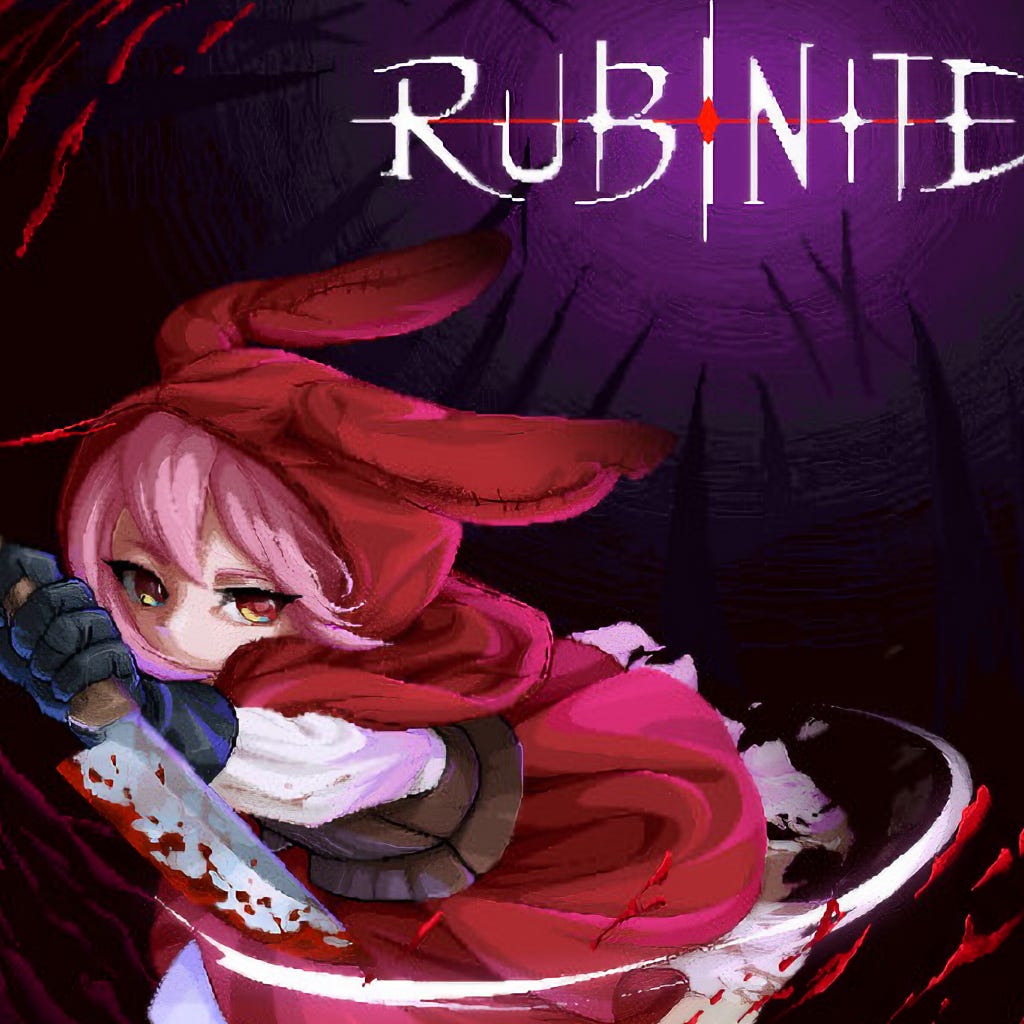
Some games win players over with sprawling worlds, dozens of side quests and endless systems to master. Rubinite takes the opposite approach. It strips away almost everything that might distract from its central idea, placing its faith in precise combat, memorable boss encounters and a bleak fantasy world that rewards patience over panic. It is an ambitious decision for a small independent project, and while it occasionally exposes the game’s limitations, it also allows its greatest strengths to shine far brighter.
Developed by Cup Dog Games, Rubinite follows Princess Ruby, the exiled heir to the fallen Scarlet Kingdom. Her homeland has been consumed by a horrifying plague, twisted by mysterious Bloodstained creatures and brought to ruin by forces beyond human understanding. Determined to reclaim everything she has lost, Ruby embarks on a dangerous journey driven as much by revenge as by hope. The narrative never overwhelms players with lengthy cutscenes, instead allowing the world itself to tell much of the story through haunting environments, unsettling enemies and subtle environmental details.
There is a quiet confidence to Rubinite’s storytelling. Rather than spelling out every mystery, it trusts players to piece together the tragedy surrounding the Scarlet Kingdom. That restraint gives the adventure a lingering melancholy that fits perfectly with its dark fantasy setting and helps elevate what could have been a fairly straightforward tale of revenge.
Gameplay
Combat is where Rubinite truly earns its place. At first glance, it resembles many other action games, with light attacks, dodges and carefully timed movement at the core of every encounter. It quickly becomes clear, however, that swinging wildly at enemies is rarely the right approach. Every battle revolves around the game’s defining mechanic, Focus, which transforms combat from simple action into something far more deliberate.
Using Focus lets Ruby study her opponents, revealing vulnerable points hidden beneath layers of corrupted flesh and armour. These brief openings create opportunities to unleash devastating attacks that deal meaningful damage. Without taking the time to identify these weaknesses, even the sharpest blade feels almost useless. It is an elegant system that rewards observation and discipline rather than frantic button presses.
The mechanic creates a satisfying rhythm that carries through the entire adventure. Players spend as much time reading animations and anticipating attacks as they do striking enemies. Every successful hit feels deserved because it follows careful preparation rather than blind aggression. The result is combat that remains engaging even after dozens of encounters.
Timing also plays a significant role in every battle. Dodging too early leaves Ruby exposed, while reacting too late often results in brutal punishment. Learning these timings gradually becomes second nature, creating a genuine sense of improvement that goes beyond simple character progression. By the time the credits roll, players are not simply stronger because of upgraded equipment. They are genuinely better at understanding the game’s language.
Boss Design
Rubinite proudly wears its boss-rush identity, and thankfully those bosses rarely disappoint. Each major encounter introduces a unique enemy with its own attack patterns, visual identity and combat philosophy. Rather than relying on inflated health bars alone, every battle feels like a carefully designed puzzle that demands patience before rewarding precision.
The Bloodstained themselves are wonderfully grotesque creations. Ancient cultists, monstrous parasites and plague-ridden horrors all possess distinctive silhouettes that make every confrontation memorable. Their animations are fluid and expressive, making attacks readable without ever becoming predictable. Players quickly learn that recognising subtle movements often means the difference between victory and another return to the checkpoint.
Difficulty steadily increases throughout the campaign without feeling artificially inflated. Later bosses combine multiple attack phases, deceptive feints and increasingly dangerous combinations that constantly test concentration. These encounters become thrilling examinations of everything the player has learned rather than simple endurance contests.
Not every fight reaches the same standard. A handful rely too heavily on extended invulnerability phases that briefly interrupt the excellent pacing established elsewhere. These moments create unnecessary downtime, with players simply waiting for another opening instead of actively participating in the fight. Thankfully, such frustrations remain relatively uncommon across the full adventure.
Progression and Customisation
Although Rubinite is focused almost entirely on boss encounters, progression still feels meaningful thanks to its Pureblood and Talisman systems. Every defeated Bloodstained grants valuable resources that can be transformed into powerful Talismans, allowing Ruby to develop new strengths and tailor her abilities to individual playstyles. The system strikes a pleasing balance between accessibility and meaningful choice.
Some Talismans improve defensive capabilities, helping players survive particularly punishing encounters. Others focus on boosting offensive potential or enhancing specific combat mechanics, encouraging experimentation between battles. Finding combinations that complement personal playstyles becomes an enjoyable process rather than an overwhelming exercise in number crunching.
Importantly, progression never replaces player skill. Stronger equipment certainly helps, but success still depends on learning attack patterns and mastering the Focus mechanic. The game never allows statistics alone to carry players through difficult encounters, ensuring every victory feels genuinely earned.
Visuals and Atmosphere
Rubinite immediately impresses with its gorgeous pixel art. Every location captures the sorrow of a once-magnificent kingdom slowly being consumed by corruption. Crumbling castles, haunted forests and blood-stained temples are filled with intricate environmental details that create a world rich in atmosphere despite its relatively focused structure.
Character animation is equally impressive. Ruby moves with graceful precision, while enemies display smooth attack animations that remain visually spectacular without sacrificing clarity. Given how heavily combat relies on recognising enemy tells, this readability becomes one of the game’s greatest strengths. Even during chaotic encounters, players rarely feel confused about what has happened.
Lighting also deserves recognition. Flickering torches, crimson skies and glowing corruption create striking visual contrasts that reinforce the game’s sombre mood. The combination of pixel art and modern lighting effects gives Rubinite a distinctive identity that feels nostalgic yet contemporary.
Audio
The soundtrack complements the game’s atmosphere beautifully without constantly demanding attention. Quiet piano melodies accompany exploration, giving way to sweeping orchestral pieces during major confrontations. The music knows when to step forward and when to remain subtle, allowing emotional moments to breathe naturally.
Sound effects also land with satisfying impact. Every successful strike lands with reassuring weight, while enemy attacks produce appropriately intimidating audio cues that reinforce the danger of each encounter. Environmental ambience fills otherwise silent areas with unsettling life, making the Scarlet Kingdom feel abandoned yet strangely alive beneath its layers of decay.
Although voice acting is largely absent, its omission never feels like a weakness. Rubinite relies on visual storytelling and atmosphere to convey emotion, and in many ways the silence enhances the lonely nature of Ruby’s journey.
Final Verdict
Rubinite succeeds because it knows exactly what experience it wants to deliver. Rather than chasing trends or cluttering its world with unnecessary distractions, it focuses almost entirely on crafting meaningful boss encounters built around a genuinely clever combat system. The Focus mechanic elevates every battle, transforming what could have been another competent action game into something that demands patience, observation and precision.
Its relatively narrow scope means players seeking expansive exploration or lengthy role-playing systems may find the experience somewhat limited. A little more variety between boss encounters would also have strengthened the overall pacing. Even so, the quality of the combat, beautiful pixel presentation and consistently engaging encounters ensure those shortcomings rarely overshadow the adventure itself.
Rubinite proves that independent developers do not always need enormous budgets to create memorable action games. With satisfying progression, excellent boss design and a haunting fantasy world full of personality, it delivers an experience that feels carefully crafted from beginning to end. It is challenging without becoming unfair, stylish without sacrificing clarity and rewarding enough to keep determined players coming back for one more attempt.