The Disgaea series has spent years building a loyal following thanks to its wonderfully absurd storytelling, impossibly deep tactical combat, and a levelling system that treats five digits as merely the starting point. It is a franchise that embraces excess in every conceivable way, from overpowered characters to ridiculous damage numbers and an endless loop of upgrading equipment long after the credits have rolled. Disgaea Mayhem takes that familiar universe and asks a simple question. What happens when you throw away the tactical grid and replace it with frantic real-time action?
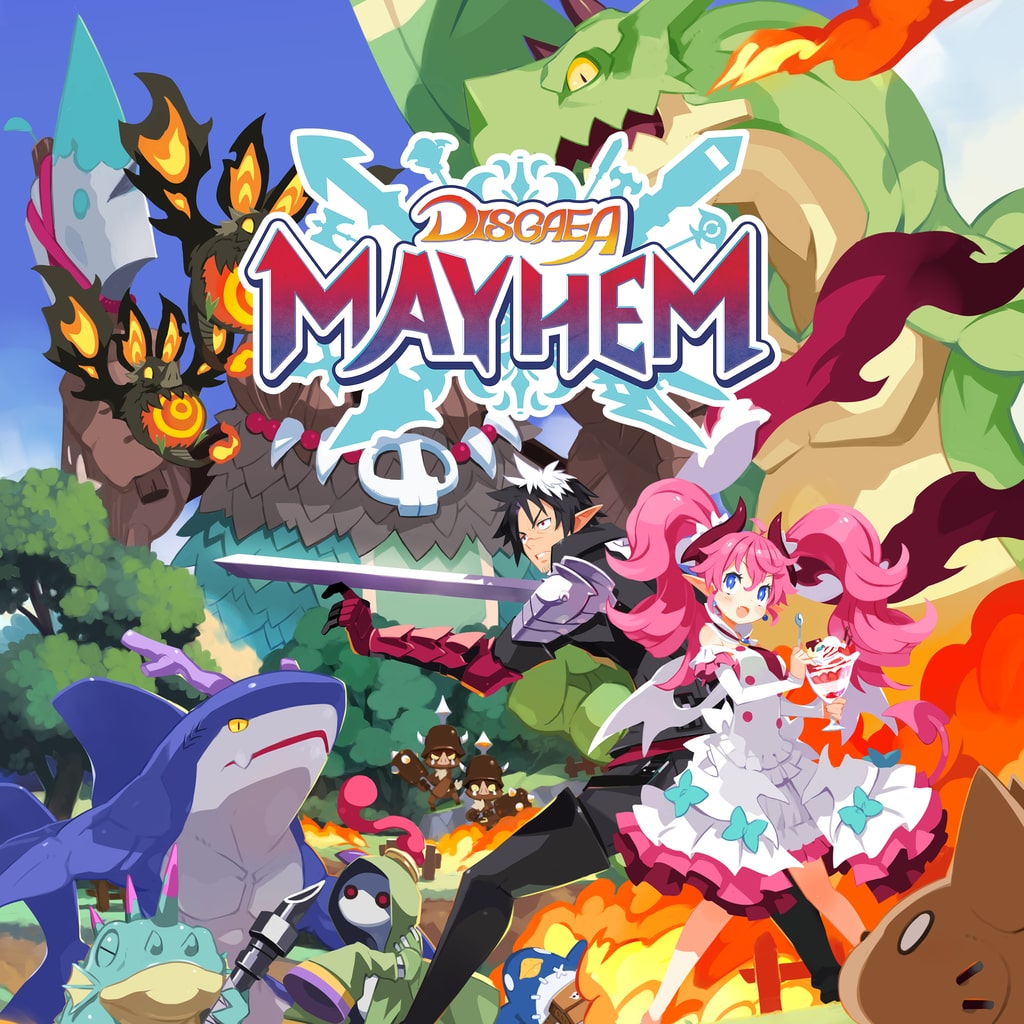
The answer is a game that feels both familiar and strangely experimental. Instead of carefully positioning units across colourful battlefields, you’re charging headfirst into swarms of enemies as the gruff mercenary N.A., slicing, smashing, and blasting demons into the air while helping Princess Tichelle recover her beloved stash of flan. It’s a wonderfully ridiculous premise, even by Disgaea standards, and one that immediately captures the series’ trademark sense of humour.
Whether that gamble pays off depends largely on what you expect. If you’re searching for another sprawling strategy epic, this is not it. If you’re willing to embrace something lighter that still carries the unmistakable DNA of Nippon Ichi Software, there’s genuine fun to be found beneath its rough edges.
Gameplay
From the opening battle, Disgaea Mayhem makes its intentions clear. Combat is fast, flashy, and entirely focused on crowd control. Rather than plotting careful moves one square at a time, you’re dashing across arenas, chaining together lengthy combos, launching enemies into the air, and unleashing special attacks that fill the screen with colourful explosions.
N.A. has access to several weapon classes, each with its own attack patterns and abilities. Fists offer rapid close-quarters assaults, Spears provide greater reach, while Handguns allow for ranged pressure. None of the weapons reinvent the hack-and-slash formula, but they all feel distinct enough that swapping between them remains enjoyable throughout the campaign.
The controls are responsive, which is perhaps the game’s greatest strength. Dodging feels reliable, attacks land with satisfying impact, and there’s enough mobility to keep battles flowing at a brisk pace. Fans of Musou-inspired games will immediately understand the rhythm. Dash into a crowd, clear dozens of enemies, trigger a devastating special move, then repeat as another wave arrives.
Unfortunately, repetition settles in surprisingly quickly. Most missions take place in fairly simple arena environments where the objective rarely changes. Defeat enemies, survive another wave, capture a point, then move on. While the combat itself remains entertaining, the lack of variety means later missions begin to blend together.
That wouldn’t necessarily be a major issue if the campaign lasted twenty or thirty hours. Instead, the story wraps up in roughly four to five hours, leaving the impression that the adventure ends just as it is finding its rhythm.
The Soul of Disgaea Still Lives
Although the combat shifts dramatically away from strategy, Disgaea Mayhem wisely refuses to abandon the systems that helped make the series so beloved.
The Dark Assembly returns, allowing players to pass bills that unlock new features and improvements through the wonderfully corrupt political system of the Netherworld. The Item World once again encourages obsessive players to strengthen equipment by venturing inside individual items, while Chara World and Reincarnation make welcome appearances for those who enjoy endlessly improving their favourite characters.
These mechanics provide far more longevity than the campaign alone suggests. Once the credits roll, players who enjoy chasing ever-increasing statistics can continue building N.A. towards absurd levels of power.
Reaching level 9,999 is as gloriously excessive as ever, and seeing damage numbers spiral completely out of control still delivers the same addictive satisfaction longtime fans expect.
The downside is that progression quickly becomes unbalanced. Certain systems interact in ways that allow determined players to become overwhelmingly powerful far earlier than intended. Once that happens, encounters lose much of their challenge. Instead of carefully mastering enemy patterns, you’ll often erase entire battlefields with little resistance.
For some Disgaea fans, that’s practically part of the appeal. Becoming hilariously overpowered has always been woven into the series’ identity. Others may wish the difficulty curve offered a little more resistance before it completely collapsed.
Magichange Brings Some Welcome Variety
Perhaps the most interesting addition is the Magichange system. Rather than simply serving as companions, recruited monsters can temporarily transform into specialised weapons in battle. Activating Magichange alters N.A.’s moveset, grants new elemental abilities, and encourages experimentation with different monster companions.
It’s a clever mechanic because it captures one of Disgaea’s defining traits. Monsters aren’t just background decorations. They actively become part of your combat style.
While the feature doesn’t radically transform every encounter, it provides enough variety to prevent battles from feeling completely one-dimensional. Discovering combinations that suit your preferred playstyle adds another welcome layer to an otherwise straightforward action system.
Characters and Presentation
If you’ve spent any time with the Disgaea series, you’ll already know what to expect from its humour. Characters effortlessly bounce between dramatic fantasy storytelling and complete nonsense, often within the same conversation.
Princess Tichelle’s obsession with recovering her missing pudding sounds utterly ridiculous on paper, yet the writing commits so fully to the premise that it somehow works. The game’s charm lies in treating absurd situations with complete sincerity, allowing the comedy to emerge naturally.
N.A. also makes for a surprisingly likeable protagonist. His gruff personality plays well against the more eccentric supporting cast, creating entertaining exchanges throughout the short campaign.
Visually, Disgaea Mayhem successfully adapts the series into full 3D action. Character models remain colourful and expressive, while special attacks explode across the screen with satisfying spectacle. Enemy variety is respectable, even if the environments themselves feel repetitive and somewhat lacking in personality.
Performance remains solid throughout, with combat maintaining a smooth pace even during larger encounters. Given how many enemies often occupy the battlefield simultaneously, the technical side deserves praise.
The soundtrack complements the action well, delivering energetic battle themes alongside the quirky melodies that have become synonymous with the franchise. Voice acting also captures the series’ trademark humour, keeping even simple conversations entertaining.
A Fun Detour Rather Than a New Direction
Perhaps the biggest challenge facing Disgaea Mayhem is expectation. Had it launched as a completely original action RPG, many players might have seen it as an enjoyable, if repetitive, hack-and-slash adventure. Carrying the Disgaea name inevitably invites comparison with one of gaming’s deepest strategy franchises.
As a replacement, it simply doesn’t offer the same depth. Tactical planning gives way to button-mashing, and while progression systems remain wonderfully addictive, the combat itself lacks the strategic complexity longtime fans may crave.
Viewed instead as an experimental side story, the game becomes much easier to appreciate. It successfully translates many familiar mechanics into an entirely different genre without losing the series’ personality. Not every idea lands perfectly, but there’s undeniable affection for the source material throughout.
Its greatest flaw isn’t the genre shift. It’s simply that there’s not enough of it. With more mission variety, a longer campaign, and better balancing, this could easily have stood alongside the stronger spin-offs in the franchise.
Verdict
Disgaea Mayhem is an enjoyable curiosity that proves the Netherworld can survive beyond its traditional tactical roots. The responsive combat, entertaining cast, and addictive progression systems ensure there’s always another level to chase, another weapon to upgrade, or another absurd statistic waiting to climb even higher.
The short campaign, repetitive mission structure, and easily exploitable progression prevent it from reaching the heights of the mainline entries, but it never loses the infectious charm that has defined the series for so many years. Fans willing to embrace something different will find a lighthearted action RPG that understands exactly why people fell in love with Disgaea in the first place.
It may not become the future of the franchise, but as a brief excursion into hack-and-slash territory, it’s an entertaining slice of Netherworld chaos that’s worth experiencing, even if the pudding disappears a little sooner than you’d hoped.