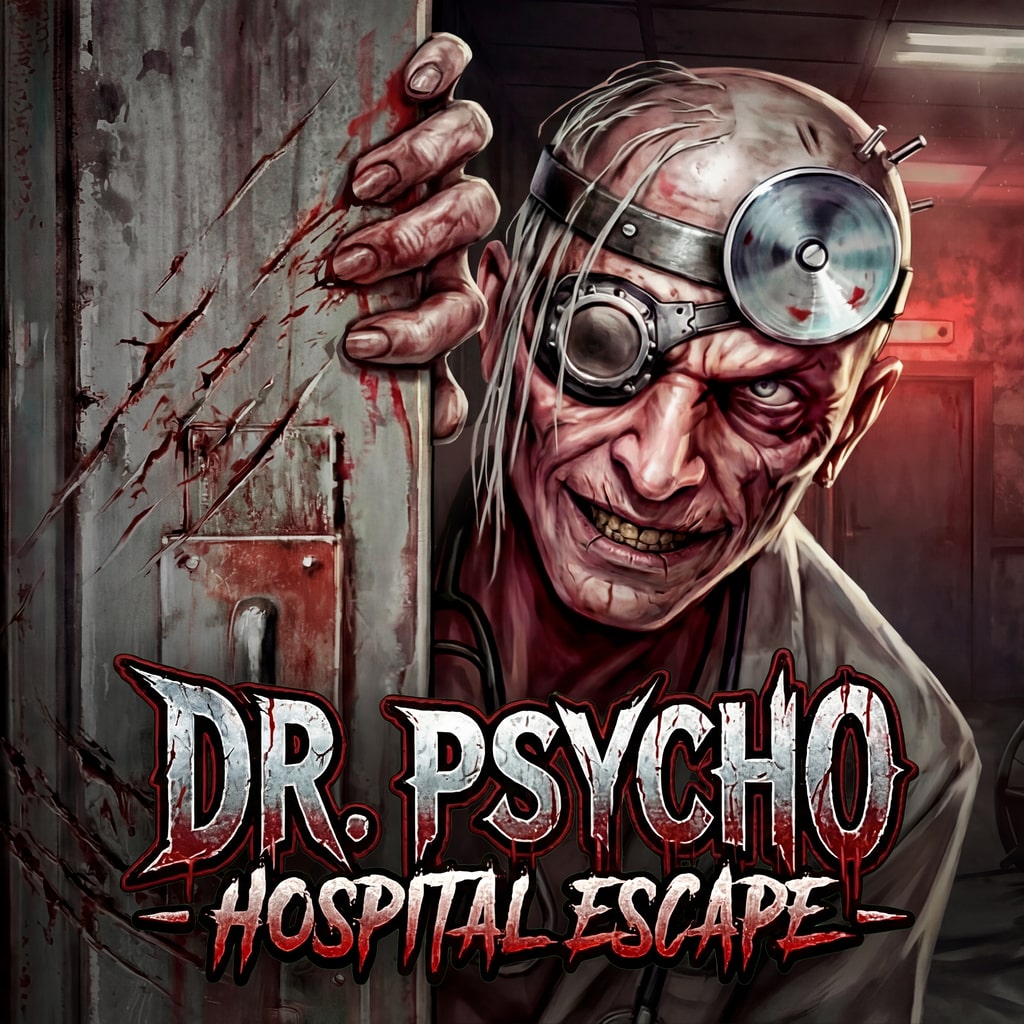
Dr. Psycho: Hospital Escape begins in the most uncomfortable way possible for a horror game: confusion without explanation. You wake up inside an abandoned psychiatric clinic. No context, no guidance, just the feeling that you are already late for something you do not understand.
The environment does the storytelling immediately. Flickering lights. Rusted equipment. Hallways that feel too narrow for comfort and too long to trust. It is not a place designed for people anymore, if it ever was. And somewhere inside it, Dr. Psycho is watching.
The premise is simple, but effective. Escape the facility before time runs out, while avoiding a presence that is unpredictable, unstable, and always closer than you would like.
Stealth That Demands Patience, Not Power
There is no combat in Dr. Psycho: Hospital Escape. No way to fight back, no clever weapon upgrade system to rely on. Survival is entirely about avoidance, timing, and understanding space.
You move slowly through corridors, checking corners before committing, listening for footsteps that might not always be consistent. The game builds tension not through constant jump scares, but through uncertainty. You rarely know exactly where danger is until it is already too late.
Hiding becomes second nature. Under beds. Inside lockers. Behind whatever cover the environment offers. Each hiding spot feels like a temporary reprieve rather than safety. That sense of fragility defines the experience. You are always one bad decision away from failure, and the game never lets you forget it.
The Three-Day Clock That Changes Everything
One of the most important systems in Dr. Psycho: Hospital Escape is its strict three-day in-game time limit. It is not just a narrative device. It is a constant pressure mechanic that shapes how you explore.
Every action matters. Every detour costs time. Every moment spent hiding is a moment you are not progressing toward escape.
This creates an interesting tension between caution and urgency. Moving too quickly increases risk. Moving too slowly risks running out of time entirely. The game forces you to constantly balance these competing pressures. There is no perfect run. Only better decisions under pressure.
A Facility That Feels Like It Is Breathing
The hospital itself is the game’s strongest asset. It is not just a backdrop for stealth encounters. It feels like a living system of decay and surveillance.
Rooms are inconsistent in size and purpose. Some feel clinical and abandoned, while others feel deliberately altered, as if someone has been experimenting with the layout. That unpredictability keeps exploration tense, even in areas you have already visited.
Sound design plays a huge role here. Distant metallic clangs, muffled movement behind walls, and sudden silences that feel more threatening than noise. The absence of clarity is often more effective than explicit danger. You are never fully alone, even when nothing is visible.
Dr. Psycho and the Unpredictable Threat
The titular Dr. Psycho is not a traditional antagonist with clearly defined patterns. He moves unpredictably through the environment, sometimes appearing where you least expect him, sometimes leaving you alone long enough to think you are safe. That unpredictability is what makes him effective. You cannot reliably plan around him. You can only react.
Encounters with him are rarely long, but they are always tense. A single mistake in timing or positioning can undo several minutes of careful progress. There is a sense of intelligence to his presence, even when behaviour becomes erratic. It keeps you cautious in a way scripted patterns would not.
Exploration Under Pressure
Exploration in Dr. Psycho: Hospital Escape is not relaxed discovery. It is structured anxiety. You are constantly searching for keys, tools, and environmental clues that will help you progress deeper into the facility. But every search carries risk. The longer you stay in one area, the more exposed you become.
This turns even simple navigation into a decision-making process. Do you fully clear a room or move on quickly? Do you investigate a noise or avoid it entirely? The game rarely gives you enough information to feel completely confident. That uncertainty is intentional, and it works.
Simplicity That Supports Tension
From a mechanical standpoint, Dr. Psycho: Hospital Escape is intentionally minimal. There are no complex systems to master, no layered progression trees, and no elaborate crafting mechanics. Movement, hiding, and observation are the core tools. Everything else exists to support those fundamentals.
This simplicity helps maintain focus. The game is not trying to overwhelm you with mechanics. It is trying to keep you in a constant state of awareness. That said, the lack of mechanical depth may limit long-term engagement for some players. Once you understand the systems, there is little that significantly changes how you approach situations.
Where Repetition Begins to Show
Because the core loop is so tightly focused, repetition becomes noticeable over longer sessions. Certain encounters and hiding patterns begin to feel familiar after a while.
The three-day structure helps mitigate this by forcing urgency, but it does not completely remove the sense that you are operating within a relatively small mechanical space. This is a game designed for intensity, not long-form variety. Whether that feels satisfying or limiting depends on how you engage with it.
Final Verdict
Dr. Psycho: Hospital Escape is a focused survival horror experience that excels at building tension through limitation. Its reliance on stealth, time pressure, and unpredictable enemy behaviour creates a consistent sense of anxiety that never fully lets up.
It does not aim to reinvent the genre or offer deep systemic complexity. Instead, it delivers a compact, high-pressure loop that thrives on atmosphere and restraint. For players who enjoy short, intense horror experiences built around stealth and survival, it succeeds in creating something genuinely tense and memorable.