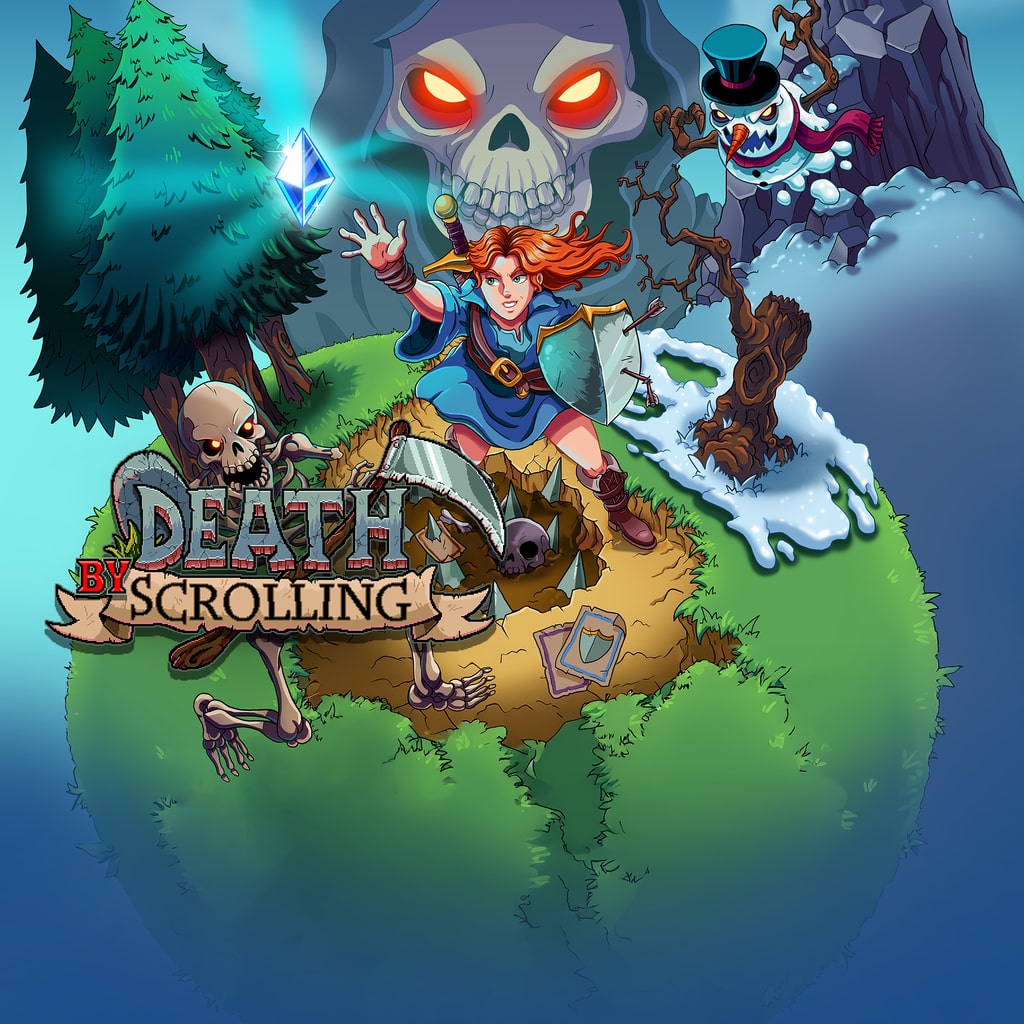
There is something immediately fitting about a game called Death By Scrolling arriving in an era defined by constant digital motion. Released on PC (Steam) in October 2025 and brought to PlayStation 5, Xbox Series X|S, and Nintendo Switch on April 16, 2026, the game is developed by Terrible Toybox and published by MicroProse.
It is an action roguelike set in a bureaucratic version of the afterlife, specifically Purgatory, Inc., where souls must literally ascend through endlessly scrolling vertical levels to earn their passage. The concept is immediately strong: a game about escaping death by constantly moving upwards while everything beneath you becomes increasingly lethal. In execution, it is a fast, chaotic, and frequently funny experience that blends arcade intensity with a light roguelike structure and a distinctly sarcastic sense of humour.
Premise & World Design
The setting of Death By Scrolling is one of its defining features. Purgatory, Inc. is presented as a corporate-managed afterlife where even salvation comes with fees, paperwork, and increasingly aggressive billing. The Ferryman, traditionally a symbolic guide to the afterlife, is reimagined here as a bureaucratic figure charging exorbitant prices for passage.
You play as one of several damned souls attempting to ascend through this vertical purgatory. Each character has unique perks and abilities, offering slight variations in playstyle, though the core objective remains the same: keep moving upwards or be consumed by the ever-present danger below.
The world is presented in a deliberately absurd tone. Dialogue is filled with deadpan humour, corporate satire, and lightly surreal descriptions of hellish bureaucracy. While not every joke lands consistently, the overall tone reinforces the idea that this is an afterlife run like a poorly managed service industry.
Core Gameplay Loop
At its heart, Death By Scrolling is a vertically scrolling action-survival game. The screen constantly moves upwards, forcing players to keep pace or risk being caught in the fiery destruction rising from below. This creates a constant sense of urgency that defines every moment of gameplay.
Unlike traditional platformers or roguelikes, there is no safe pause in movement. Even moments of decision-making must be made on the move, which transforms every encounter into a high-pressure situation.
Combat is fast and reactive. Players face a wide variety of enemies, from minor hellish pests to larger demonic entities that serve as mini-bosses. Encounters are rarely static; enemies often appear in clusters or alongside environmental hazards, forcing rapid prioritisation.
The game’s design encourages improvisation. You are rarely fully prepared for what comes next, and survival depends on quick adaptation rather than long-term planning.
Characters & Abilities
One of the more interesting structural elements is the roster of playable characters. Each offers distinct abilities that subtly shape how runs unfold. Some characters focus on mobility, enabling faster vertical traversal. Others emphasise combat efficiency or resource collection.
This variety helps sustain replayability, as each character effectively alters the rhythm of play. However, the differences are not always dramatic, so long-term variation depends more on situational upgrades than on foundational mechanics.
Still, the system works well within the game’s arcade-inspired structure. It encourages experimentation without overwhelming players with complexity.
Progression, Loot & Vendors
Progression in Death By Scrolling centres on collecting gold and gems during runs. These resources are used to purchase upgrades from vendors that appear mid-run, introducing temporary strategic decisions.
Upgrades range from combat enhancements to movement modifiers and utility boosts. The randomness of vendor offerings ensures that no two runs feel identical, though it also introduces unpredictability that can sometimes feel limiting.
The economy is intentionally tight. Players rarely acquire everything they want, forcing prioritisation. This reinforces the game’s core tension between immediate survival and long-term optimisation.
Bonus runs and side quests appear at the top of levels, offering additional rewards for players willing to take risks. These segments often break up the intensity of the main loop, providing brief moments of structured objectives amid the chaos.
Enemy Design & Combat Flow
Enemy variety is one of the game’s stronger aspects. The underworld is populated by a mix of comedic and menacing designs, ranging from bizarre, crawling creatures to more imposing demonic bosses.
Combat is built around avoidance and positioning rather than static engagement. Because the screen is constantly moving, players are rarely able to hold a defensive position for long. Instead, combat becomes a fluid process of engagement and disengagement.
Boss encounters introduce larger-scale challenges, often requiring pattern recognition while maintaining upward momentum. These moments are among the game’s most intense, though they can occasionally suffer from visual clutter due to overlapping effects and rapid movement.
Tone, Writing & Humour
The humour in Death By Scrolling is deliberately tongue-in-cheek. It leans heavily into satire of afterlife bureaucracy, presenting death not as a metaphysical mystery but as a poorly managed corporate service.
Some jokes are genuinely sharp, particularly those that exaggerate modern administrative frustrations into absurd afterlife equivalents. Others rely on repetition or simple absurdity, which may not resonate with all players.
The narration and dialogue contribute significantly to the game’s identity, helping to maintain levity even when gameplay becomes overwhelming. However, the humour occasionally competes with the intensity of the action, leading to tonal whiplash in certain moments.
Visuals & Performance
Visually, the game adopts a stylised, slightly exaggerated aesthetic that prioritises readability over realism. This is crucial given the constant motion and density of on-screen activity.
Enemy silhouettes are generally clear, and environmental hazards are distinct enough to support split-second decision-making. However, during particularly chaotic sequences, visual clarity can degrade, especially when multiple effects overlap.
On modern consoles, performance is stable. The PS5 and Xbox Series X|S versions maintain consistent frame rates, while the Switch version, though slightly reduced in fidelity, remains fully playable and responsive.
Replayability & Leaderboards
Replayability is a core pillar of the experience. Procedural variation in enemy placement, vendor offerings, and upgrade availability ensures that runs rarely feel identical.
Online leaderboards add a competitive layer, encouraging players to optimise routes and survival strategies. This system significantly extends the game’s lifespan for those inclined towards score chasing or speed-based play.
Final Verdict
Death By Scrolling is a fast, chaotic, and mechanically tight arcade roguelike that thrives on constant motion and controlled panic. Its vertical design creates a distinctive pressure loop that keeps players engaged, while its upgrade systems and character variety provide enough depth to sustain repeated runs.
However, its reliance on visual density and occasional randomness can lead to moments of confusion or imbalance. The humour, while often effective, is not consistently strong enough to carry weaker sections of the gameplay.
Even so, its core concept is executed with confidence. It knows exactly what kind of experience it wants to deliver: relentless upward motion, constant risk, and the absurdity of trying to escape bureaucracy even in death.