Few games embrace chaos with such elegance as Hell Is Other Demons. Developed by Cuddle Monster Games and published by Kongregate, this frenetic action-platformer takes the best parts of old-school arcade design — tight controls, brutal challenge, and stylish minimalism — and fuses them with a striking visual identity and an adrenaline-pumping synthwave soundtrack. The result is an infernal symphony of mayhem that rewards skill, patience, and a healthy love for pixelated carnage.
This is not a game for the faint of heart. Hell Is Other Demons demands precision, aggression, and adaptability. But once you find your rhythm amid the chaos, it delivers one of the most satisfying gameplay loops in the modern indie scene.
Descent Into the Abyss
From the opening moments, Hell Is Other Demons sets the tone perfectly. There’s no lengthy exposition, no overwrought cutscenes, and no hand-holding. You are a nameless demon rising against the oppressive hierarchy of Hell itself. Why? Who knows — and who cares? The story exists more as a mood than a narrative. It’s a tale of rebellion painted in neon blood, and the simplicity works in its favor.
The game wastes no time getting you into the action. Each level drops you into a single-screen arena where waves of enemies spawn in increasingly intense patterns. Your goal: survive, destroy, and emerge victorious. The design is reminiscent of Super Crate Box and Downwell, but with an extra layer of verticality and customization that makes each run feel distinct.
The campaign is structured as a series of escalating challenges spread across various hellish biomes. Each area introduces new enemies, environmental hazards, and bosses that test both reflex and strategy. It’s a straightforward loop — fight, upgrade, repeat — yet the execution is so refined that it rarely feels repetitive.
The Dance of Death
The magic of Hell Is Other Demons lies in its movement. Every jump, dash, and shot feels fluid and deliberate. You can double jump, air dash, wall bounce, and fire in any direction, creating a sense of aerial freedom that’s both exhilarating and essential. Combat feels like a dance — one where precision and timing matter more than brute force.
Enemies come at you in carefully choreographed waves, each with unique attack patterns. Learning their behaviors is crucial, as death comes quickly and often. Yet, rather than frustration, the game inspires mastery. Each failure feels like part of the process — another step toward perfecting your rhythm.
As you progress, you’ll earn gems to purchase new weapons, upgrades, and passive abilities. The customization system is deceptively deep. You might equip a spread shot for crowd control, or a powerful laser for boss fights. You can adjust your jump height, dash range, or even add bullet deflection abilities. These tweaks allow you to tailor your playstyle to your strengths — or experiment with builds that completely change the game’s flow.
The difficulty curve is steep but fair. The first few worlds ease you into the mechanics, but by the midgame, the screen becomes a kaleidoscope of bullets, lasers, and explosions. The term “bullet hell” isn’t just a genre label here — it’s a promise. Yet even in its most chaotic moments, the game remains readable. Enemy telegraphs are clear, hitboxes are precise, and deaths always feel earned.
The Neon Inferno
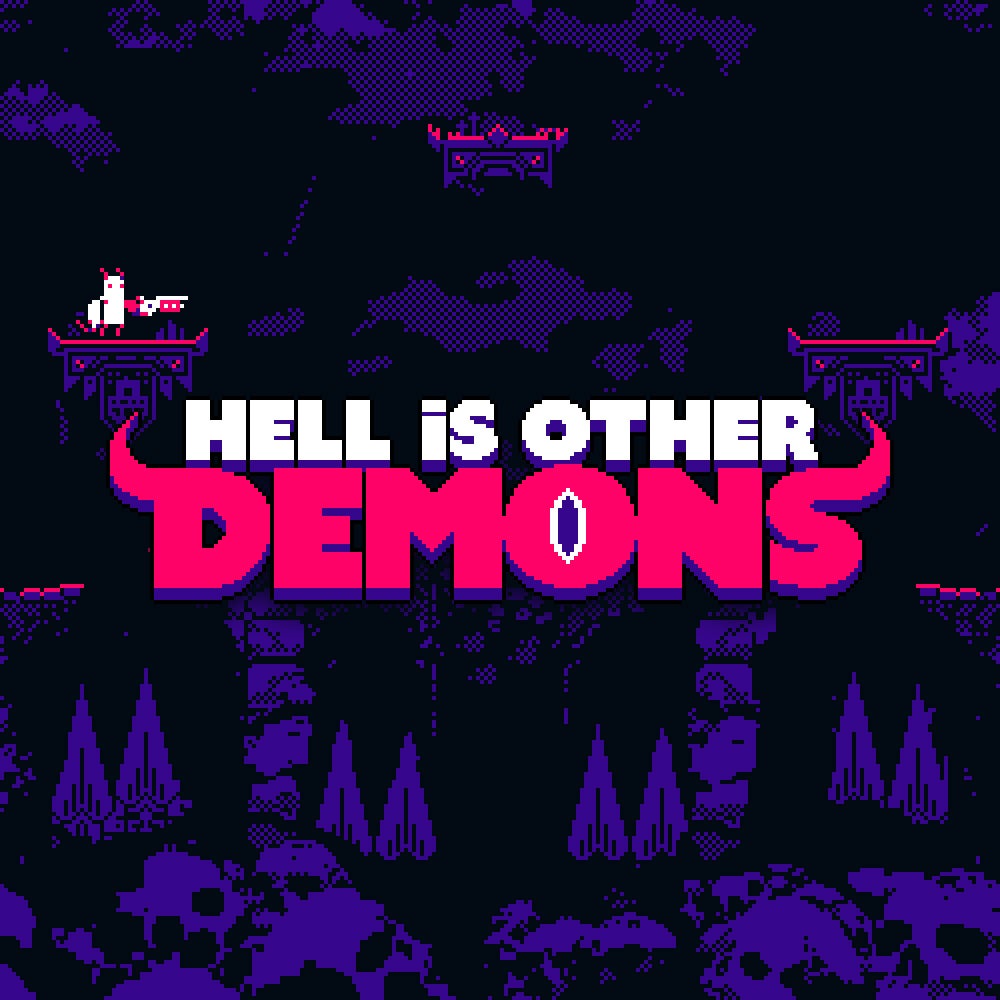
Visually, Hell Is Other Demons is a masterclass in minimalism. The pixel art style is bold and confident, using a limited color palette of deep blacks, blazing reds, and searing magentas. Each level feels like it’s been dipped in neon fire, glowing with infernal energy.
The game’s aesthetic evokes the spirit of early arcade shooters while layering it with modern visual flair. The clean outlines, punchy effects, and dynamic backgrounds give each stage a sense of motion and intensity. When the action heats up, the screen becomes a pulsating storm of color — a mesmerizing chaos that somehow remains legible.
Complementing the visuals is an absolutely phenomenal synthwave soundtrack by Rémi Gallego (a.k.a. The Algorithm). It’s loud, relentless, and utterly perfect for the game’s tone. The pulsing beats and distorted melodies drive the pace of combat, syncing beautifully with the rhythm of destruction. It’s one of those soundtracks that makes you lean into the chaos rather than flee from it.
Boss Battles and Brutality
If the regular levels test your skill, the boss fights test your endurance. Each boss in Hell Is Other Demons feels distinct, with multi-phase encounters that force you to adapt on the fly. Some flood the screen with projectiles, others reshape the arena mid-fight, and all of them hit like a freight train.
These battles are where the game’s design brilliance shines brightest. The bosses aren’t just larger versions of standard enemies — they’re tests of everything you’ve learned. Defeating them feels immensely satisfying, not because you’ve outgunned them, but because you’ve out-danced them. You’ve learned their rhythm, their timing, their tells — and you’ve turned chaos into art.
And if the campaign isn’t enough, there’s an endless arcade mode that pushes your skills to their limits. It’s a pure test of endurance and reflex, offering leaderboard competition for those who crave that extra challenge.
Small Sins of Design
For all its strengths, Hell Is Other Demons isn’t flawless. The minimalist presentation, while stylish, can occasionally make it difficult to distinguish between certain enemy projectiles and background elements, especially in the more chaotic later stages.
Additionally, while the upgrade system adds depth, it doesn’t evolve dramatically over time. Once you’ve found a build that suits your style, there’s little incentive to experiment beyond curiosity. Some players might also find the constant barrage of action exhausting over long sessions — this is a game best enjoyed in bursts, not marathons.
Redemption Through Fire
What makes Hell Is Other Demons so addictive is its purity of purpose. It doesn’t try to reinvent the wheel — it perfects it. Every element, from the controls to the level design to the pulsating music, serves the same goal: flow. It’s a game about precision in chaos, about learning to move with instinct rather than panic.
It’s easy to compare it to Celeste for its mechanical tightness or DOOM for its aggressive energy, but Hell Is Other Demons stands firmly in its own infernal identity. It’s both homage and evolution — a love letter to arcade-era difficulty dressed in modern indie swagger.
Final Verdict
Hell Is Other Demons is a masterful distillation of arcade action — fast, furious, and addictive as sin. With its hypnotic visuals, pulse-pounding soundtrack, and perfectly tuned combat, it’s the kind of game that reminds you why challenge can be so exhilarating when it’s done right.
It’s not an easy ride, and it doesn’t want to be. But for those willing to dive headfirst into its crimson chaos, it offers an experience that burns bright long after the final demon falls.