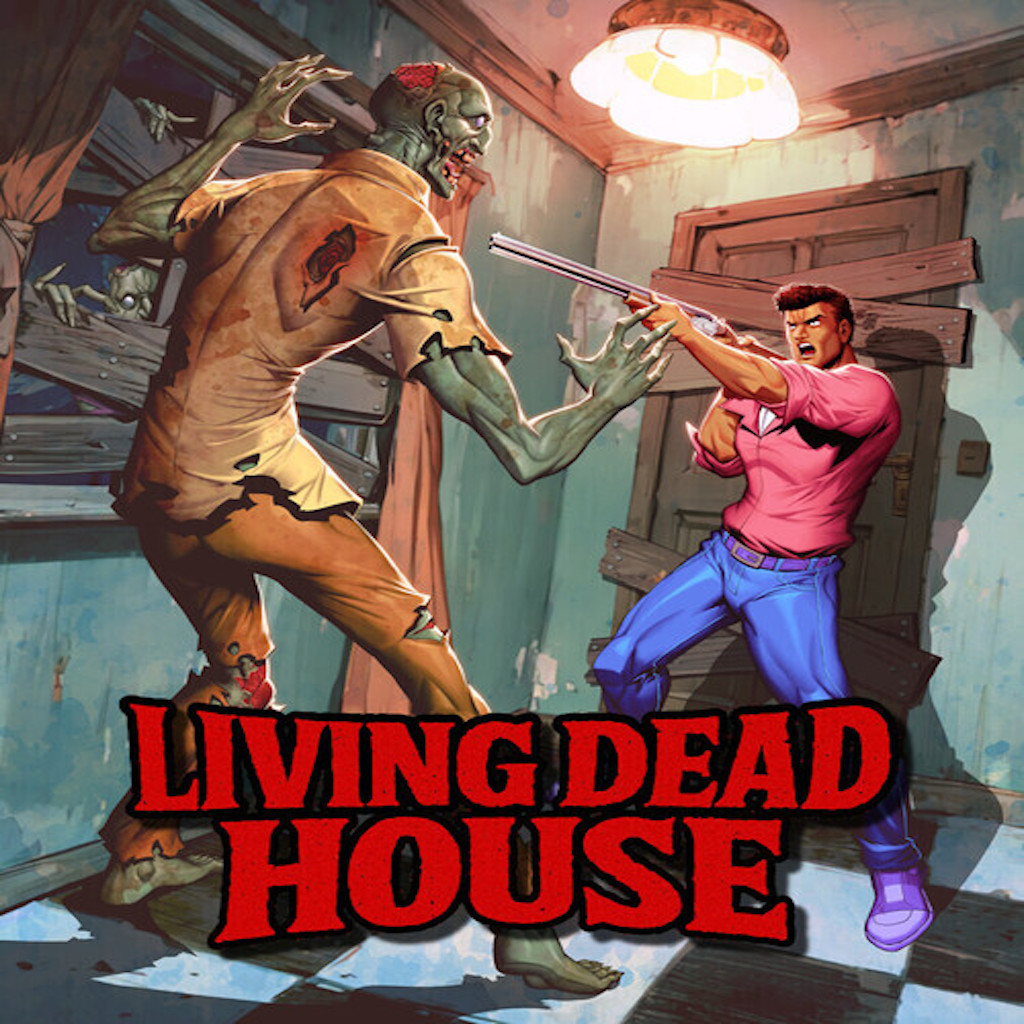
There is a particular kind of elegance in arcade design that modern games rarely attempt to replicate. Before sprawling open worlds and multi-layered systems became the norm, games were often confined to a single screen, where clarity, speed, and repetition defined the entire experience. Living Dead House, developed by Deprecated Games and published on consoles by Flynn’s Arcade, is a deliberate return to that philosophy—except this time, it is drenched in horror aesthetics and undead panic.
Released on 2 April 2026 across PC and Nintendo Switch, this retro-inspired arcade survival game takes the structural DNA of classics like BurgerTime and reimagines it through a survival horror lens. Instead of constructing food, you are constructing survival. Instead of avoiding quirky food enemies, you are evading relentless zombies. And instead of chasing high scores as an abstract goal, you are simply trying to make it to sunrise.
It is simple, relentless, and surprisingly effective.
A Single Screen of Terror
At its core, Living Dead House is a single-screen arcade survival game. Each stage takes place inside a multi-storey house, where the player must move between floors, set traps, collect weapons, and fend off waves of undead attackers.
The straightforward design is immediately obvious. There are no sprawling maps, no complex navigation systems, and no lengthy tutorials. You are dropped into a confined space and told to survive. That is all.
This approach to design is what creates the game’s tension. Every movement is important. Each weapon collected feels significant. Every second spent on one floor is a second not spent defending another.
The house itself becomes a puzzle-like structure, where spatial awareness is just as essential as reflexes. Knowing when to descend, when to hold position, and when to leave a floor entirely is crucial for survival.
Arcade Roots with a Horror Skin
The influence of classic arcade games is unmistakable. The game’s structure—enemy waves, confined arenas, escalating difficulty—feels directly inspired by the golden age of arcade design. However, where traditional arcade games often lean towards abstract or playful aesthetics, Living Dead House fully commits to its horror identity.
The result is a fascinating contrast: mechanical simplicity wrapped in atmospheric dread.
Enemies behave predictably yet aggressively, moving in patterns that gradually become more complex as stages progress. Zombies are not particularly intelligent, but their persistence creates pressure. The game does not rely on surprise mechanics or randomness; instead, it builds tension through density and escalation.
This approach keeps the experience fair, even when it becomes challenging. Death rarely feels cheap—it feels earned through hesitation or mismanagement of space.
Survival Through Systems
Although the game has an arcade structure, it adds a light survival layer through its weapons and item system. Players can gather a small arsenal of six tools, each offering different tactical benefits. Some are for crowd control, while others are more situational, providing brief moments of safety or area denial.
These tools are limited, encouraging players to use them carefully rather than rely on them constantly. The scarcity of resources makes each encounter more meaningful, forcing players to decide when to conserve and when to use their tools.
Additionally, environmental traps are vital for survival. Setting and triggering these hazards becomes a key part of managing larger groups of enemies. The interplay between movement, trap placement, and weapon usage creates an enjoyable rhythm of preparation and quick reactions.
The game also features collectible letters hidden across stages, which eventually unlock a powerful super weapon. This mechanic offers a long-term incentive for exploration within the otherwise tightly controlled levels.
Presentation: Retro Horror Done Right
Visually, Living Dead House stands out as one of its strongest aspects. The game showcases detailed 16-bit pixel art that feels both nostalgic and expressive. Environments are rich with character, from creaking wooden floors to dimly lit corridors that seem claustrophobic even within a single-screen layout.
What enhances the presentation further are its optional visual filters. Players can toggle a CRT-style display or switch to a black-and-white mode reminiscent of 1960s horror cinema. These filters are not mere gimmicks—they effectively deepen the game’s atmosphere, turning already tense encounters into something more cinematic and unsettling.
The CRT filter, in particular, adds a touch of authenticity that reinforces the game’s arcade heritage, while the monochrome mode subtly reduces visual clarity to heighten tension without compromising readability.
Sound and Atmosphere
The soundtrack combines chiptune energy with horror undertones, creating a distinctive auditory identity. Tracks are lively in tempo but subtly unsettling in tone, balancing arcade urgency with horror tension.
Sound effects are essential for gameplay feedback. Zombie movements, weapon use, and trap activations are clearly conveyed through audio cues, helping players stay aware even during chaotic moments.
The result is a unified sensory experience where sound and visuals work together to reinforce the game’s core loop: survive, adapt, repeat.
Difficulty and Replayability
Living Dead House is not a forgiving game, but it is a fair one. Difficulty gradually increases across its 20 stages, introducing more aggressive enemy waves and tighter spatial constraints.
Early levels serve as training grounds, helping players understand movement and basic survival mechanics. As the game progresses, later stages require precise timing, efficient resource management, and strong spatial awareness.
The inclusion of local cooperative play adds another layer of replayability. Playing with a friend introduces new strategic options, especially in dividing responsibilities across the floors of the house.
Leaderboards further extend the game’s longevity by motivating players to improve their performance and optimise survival strategies for higher scores.
However, despite these features, the core gameplay loop remains quite consistent throughout. The challenge does increase, but the fundamental structure does not change much from its original design.
Strengths and Limitations
The greatest strength of Living Dead House lies in its focused design. It knows exactly what it is—a single-screen arcade survival game with horror aesthetics—and it fully commits to that identity.
Its mechanics are tight, its presentation is cohesive, and its pacing is consistently engaging. The combination of trap-setting, weapon management, and spatial control creates a satisfying loop that rewards both quick thinking and long-term planning.
However, its simplicity is also its limitation. While the game introduces new weapons and enemies over time, it does not significantly expand its mechanical complexity. Players who master its systems early may find later stages more demanding rather than meaningfully different.
Additionally, while the horror theme is well-executed visually and atmospherically, it rarely ventures into genuine narrative depth. The story is minimal, serving primarily as context for gameplay rather than a driving force.
Final Verdict
Living Dead House is a confident and well-crafted arcade survival game that effectively combines retro single-screen design with horror aesthetics. Its strength lies in its clear purpose, tight mechanics, and atmospheric presentation.
Although it does not radically reinvent the arcade formula it draws from, it refines it into a focused, replayable experience that thrives on tension and simplicity. It is a game about endurance, awareness, and controlled panic—and it consistently delivers that experience from start to finish.
For fans of retro arcade design and survival-focused action, this is a captivating and atmospheric tribute to a long-forgotten style of game design.