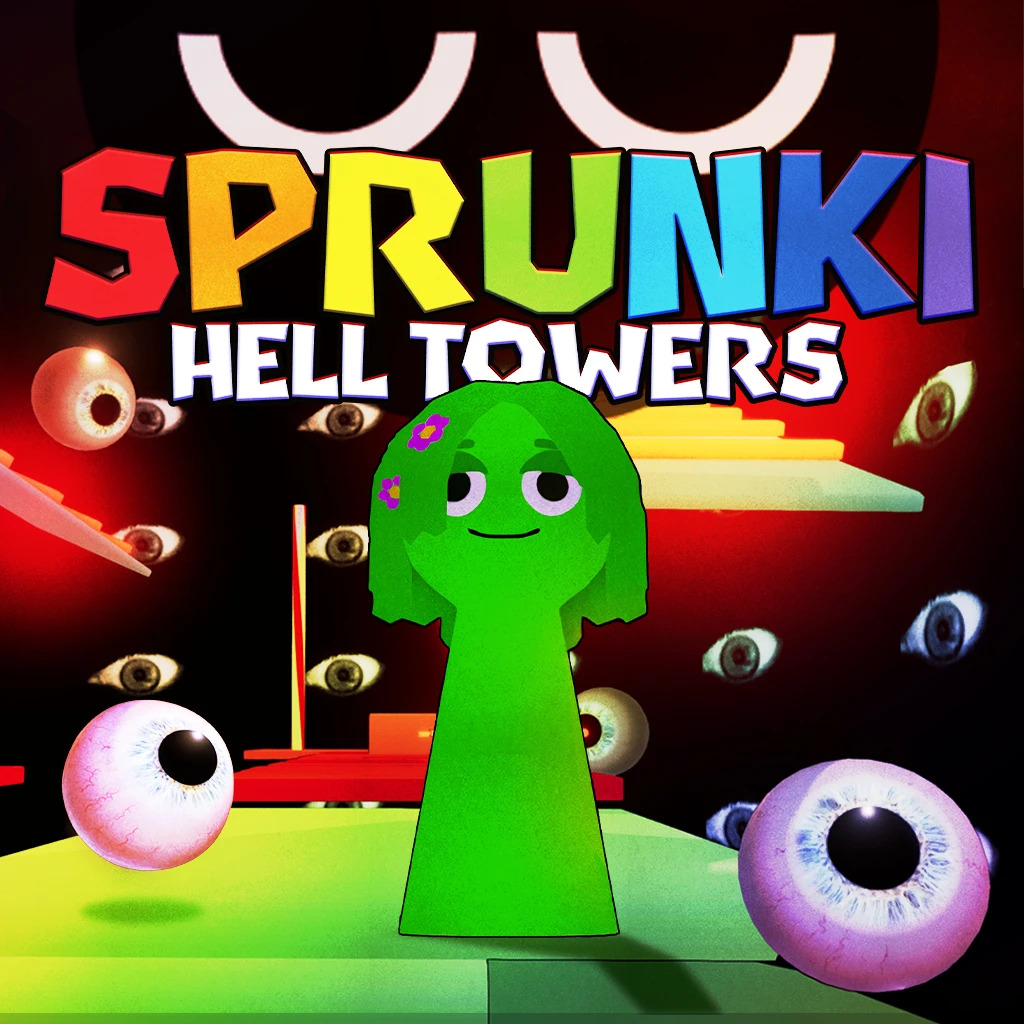
There is a peculiar yet undeniable allure to games that take a simple premise and expand it vertically. Whether it’s climbing, ascending, or navigating increasingly hostile layers of design, vertical progression always carries an inherent sense of escalation that horizontal movement struggles to match. Sprunki Hell Towers, developed and published by RandomSpin, fully embraces this concept, delivering a compact yet challenging tower-climbing platformer focused on precision, rhythm, and repetition.
Released digitally on April 2, 2026, for Nintendo Switch and PlayStation 4 at a notably budget-friendly price, it positions itself somewhere between an arcade challenge and visual experiment. It heavily draws from the visual identity of “Sprunki” culture—originally popularised through Incredibox-style musical mod aesthetics—and transforms it into something more oppressive, structured, and markedly more punishing.
It is colourful. It is chaotic. And at times, it is surprisingly intense for something so small in scale.
A Tower Built on Rhythm and Risk
At its core, Sprunki Hell Towers is a vertical action-platformer. Players choose a Sprunki character and try to ascend a series of increasingly difficult towers, each filled with hazards, moving platforms, enemies, and boss encounters called “dark challengers.”
The gameplay is straightforward: climb, survive, repeat. Yet within that simplicity lies the game’s main challenge—every mistake counts.
Movement is precise and intentional. Jumps require careful timing, enemy patterns must be memorised, and environmental hazards need to be anticipated rather than reacted to. There’s no room for improvisation in later levels; success relies on repetition and mastery.
This design approach aligns the game with precision platformers, though with a stronger arcade-like feel. Unlike expansive story-driven platformers or titles focused on exploration, Sprunki Hell Towers concentrates solely on execution.
From Brightness to Dread
One of the game’s most intriguing design choices is its tonal progression. Early towers are bright, colourful, and almost playful in appearance. The Sprunki aesthetic is most recognisable here, with vibrant environments and lively visual flair.
However, as players ascend, the tone gradually shifts. Colours become subdued. Environments darken and become more oppressive. The once cheerful visual identity begins to fade, replaced by increasingly claustrophobic architecture and more hostile enemy designs.
This slow transformation is not just visual—it underpins the game’s difficulty curve. As the visual tone intensifies, so does the gameplay challenge. The result is a cohesive sense of escalation that effectively links presentation and mechanics.
It is a subtle yet powerful way of reinforcing progression without relying on narrative exposition.
Precision Platforming at Its Core
The gameplay loop in Sprunki Hell Towers is centred around precision. Players must navigate tightly designed obstacle sequences where timing is crucial. Platforms move in predictable yet challenging patterns, enemies patrol fixed routes, and environmental hazards punish hesitation.
What makes the system effective is its fairness. The game is explicitly built on the idea that failure is always the player’s responsibility. There are no randomised traps or unpredictable behaviours. Everything follows a pattern, and everything can be learned.
This design approach fosters a strong sense of progression. Early frustration gradually shifts into mastery as players internalise movement patterns and enemy behaviours.
The learning curve is steep but steady. Once a section is mastered, it rarely feels arbitrary in retrospect.
Boss Encounters and “Dark Challengers”
Each tower ends with encounters against “dark challengers,” boss-like enemies that act as both mechanical tests and pacing shifts. These fights often introduce new movement rules or layered hazard patterns that must be navigated under pressure.
Instead of relying on complex combat systems, these encounters focus on survival and pattern recognition. Players need to avoid, outmaneuver, and survive rather than directly overpower foes.
This emphasises the game’s core identity as a precision platformer rather than an action-combat hybrid. Success depends on understanding rhythm rather than exploiting systems.
However, while these encounters are mechanically sound, they sometimes lack variety in structure. The differences between bosses mainly lie in pattern complexity rather than entirely new mechanics, which can make later fights feel familiar despite increased difficulty.
Music, Identity, and Sprunki Energy
One of the game’s key features is its use of music and stylistic identity. Drawing from its Sprunki-inspired roots, the game incorporates rhythmic and atmospheric audio elements into its gameplay loop.
Music changes dynamically with tower progression, starting with cheerful, almost playful tones before shifting into more intense and layered compositions as the difficulty increases. This reinforces the emotional journey of ascent, reflecting the visual descent into darker themes.
The sound design also serves a functional purpose. Audio cues signal hazards, enemy movements, and timing windows, making sound an essential part of gameplay rather than merely atmospheric embellishment.
The result is a cohesive audiovisual identity that enhances both gameplay clarity and thematic development.
Difficulty and Structure
Sprunki Hell Towers features three difficulty levels—Easy, Medium, and Hard—each significantly changing the challenge curve. While the core mechanics stay the same, enemy density, timing windows, and platform behaviour become more demanding at higher levels.
The Easy level acts as an introduction, helping players grasp movement and timing without too much pressure. Medium reveals the game’s full mechanics, while Hard requires near-perfect execution.
Importantly, difficulty is built around consistency rather than randomness. This ensures that repeated attempts feel worthwhile rather than frustrating.
However, the game’s strict design might not suit all players. Those unfamiliar with precision platformers may find it punishing, especially in later towers where minor mistakes can reset significant progress.
Presentation and Performance
Visually, the game features a stylised, slightly surreal aesthetic that reflects its Sprunki origins. Characters are expressive, environments are bold, and transitions between tower stages are visually distinctive.
Despite its modest scale, the game maintains strong readability, which is crucial for a platformer of this kind. Hazards are clearly recognisable, and foreground/background separation is generally effective.
Performance remains stable across platforms, with smooth frame pacing enhancing the precision needed for accurate platforming. This technical consistency is vital given the game’s dependence on timing and repetition.
Strengths and Limitations
The strongest aspect of Sprunki Hell Towers is its commitment to fair, pattern-based difficulty. It respects the player’s ability to learn and improve, offering a consistent challenge that rewards persistence.
Its audiovisual design is also notably strong, particularly in how it integrates tonal shifts into both gameplay and atmosphere. The gradual transition from bright to oppressive environments is handled with care and cohesion.
However, the game’s mechanical variety is somewhat limited. While towers introduce new arrangements and escalating difficulty, the core systems remain largely unchanged throughout, which can lead to a sense of repetition during longer play sessions.
Additionally, while its difficulty structure is well-designed, it may be too rigid for players seeking a more forgiving or exploratory platforming experience.
Final Verdict
Sprunki Hell Towers is a focused and challenging vertical platformer that succeeds through precision, consistency, and atmospheric tension. It offers a tightly controlled experience centred on mastery rather than experimentation, rewarding players who are willing to learn its systems and adapt to its growing challenges.
Although it does not significantly expand its mechanical foundation, it executes its core ideas with confidence and clarity. For fans of arcade-style precision platformers, it offers a demanding and stylistically distinctive climb worth undertaking.