Some games aim for realism when sending players into space. Others aim for spectacle. Apolune 2 instead offers something far rarer: controlled chaos powered by physics, comedy, and cooperative panic.
Originally released on PC in 2021, Lost Astronaut Studios’ quirky indie title has finally arrived on Xbox consoles in February 2026, bringing its unusual blend of resource management, arcade shooting, and party-game mayhem to a wider audience. On paper, the concept sounds simple — mine asteroids, defend your station, upgrade your gear — but in practice, Apolune 2 becomes a wonderfully unpredictable sandbox where teamwork, mistakes, and laughter collide every few seconds.
It’s part roguelite survival game, part couch co-op comedy, and part physics experiment gone delightfully wrong.
Life as an OreCorp Employee
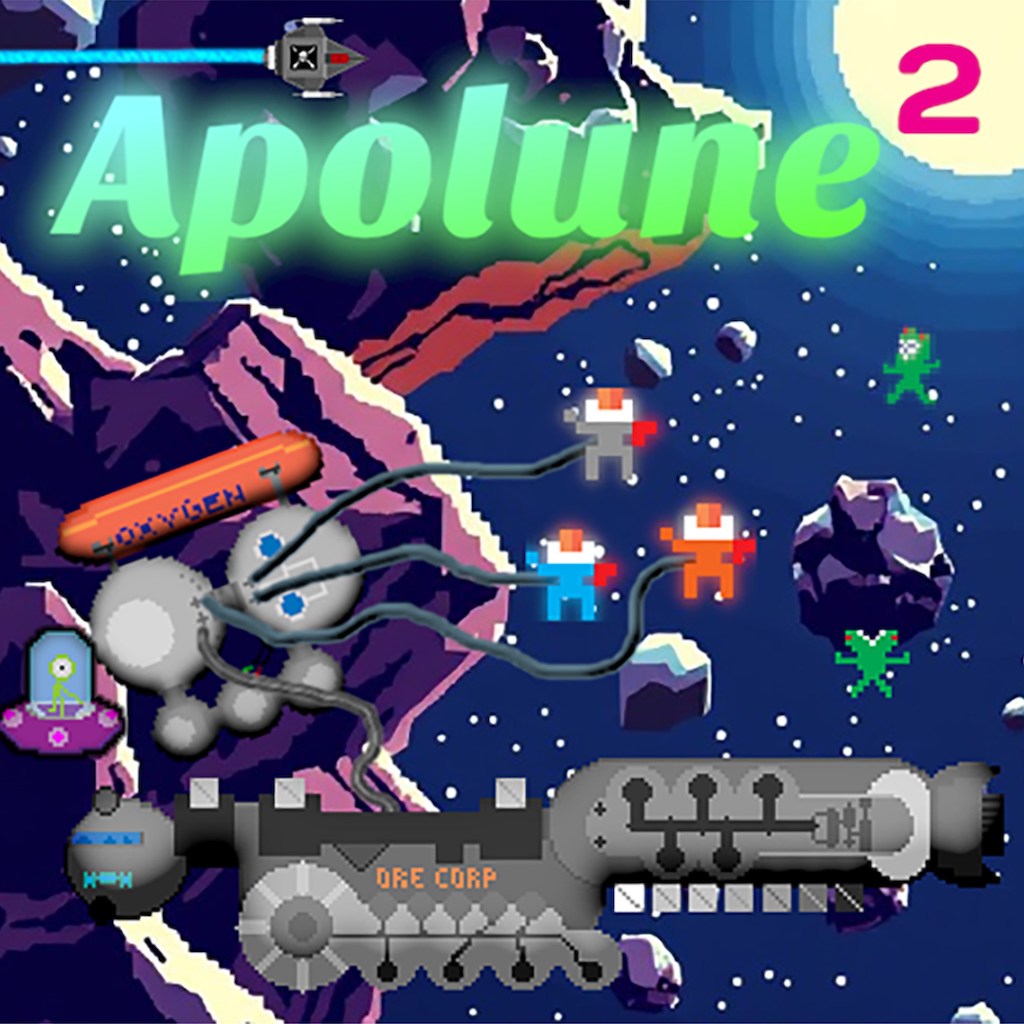
The premise wastes no time setting the tone. You are an asteroid miner employed by OreCorp, a vaguely dystopian yet hilariously mundane space corporation obsessed with productivity — and apparently with ice cream.
Your job sounds straightforward:
- Mine asteroids for ore
- Sell resources for “spacebucks”
- Upgrade equipment
- Repair your station
- Survive alien and pirate attacks
But the twist lies in how you move through space. Instead of free flight, your astronaut is tethered to the station by a cable, creating a physics-based movement system that defines the entire experience.
The tether turns every action into a balancing act. Drift too far and you swing wildly. Accelerate too quickly and you spiral into hazards. Try coordinating with teammates, and suddenly the screen becomes a ballet of tangled astronauts desperately trying not to crash into each other.
It’s intentionally messy — and that mess is where Apolune 2 finds its identity.
The Tether Mechanic: Genius Through Chaos
At first, movement feels awkward. Momentum carries you further than expected, and simple tasks like lining up with an asteroid can feel surprisingly difficult.
Then something clicks.
You learn to swing efficiently, using momentum to slingshot towards resources or retreat quickly from danger. Skilled players eventually move with surprising elegance, turning what initially felt clumsy into a satisfying expression of mastery.
In multiplayer, however, elegance quickly gives way to comedy.
Players bump into each other, collide mid-flight, accidentally yank teammates into danger, or panic-fire weapons while spinning uncontrollably through space. These emergent moments feel unscripted and genuine — the hallmark of great party games.
The physics system isn’t just a gimmick; it’s the beating heart of the experience.
Mining, Managing, and Surviving
Beneath the chaos lies a surprisingly solid gameplay loop.
Mining asteroids provides resources used to:
- Purchase weapons
- Upgrade mining tools
- Improve station defenses
- Repair damaged systems
- Extend survival runs
Every expedition becomes a risk-reward decision. Do you venture farther from safety for better ore, or stay close as enemies begin spawning more aggressively?
The roguelite structure ensures no session plays the same. Randomised encounters, merchant appearances, and escalating threats create constant tension between greed and survival.
Because repairs and oxygen management matter, the game subtly encourages teamwork — someone mines, someone guards, someone rushes back to fix damage.
When cooperation works, the experience feels fantastic. When it fails, it becomes a hilarious disaster management.
Combat: Retro Arcade Energy
Combat adopts a classic 2D arcade shooter style. Weapons fire quickly, and enemies approach in waves, ranging from small alien pests to aggressive pirate ships.
Gunplay is intentionally simple yet effective. Success depends less on complex mechanics and more on positioning — complicated by momentum and tether physics.
Fighting while drifting through space adds a unique challenge rarely seen in traditional shooters. You’re not just aiming; you’re managing velocity, distance, and orientation simultaneously.
Later encounters become genuinely intense as enemy numbers increase and environmental hazards compound the chaos.
It’s never a hardcore bullet-hell experience, but it delivers enough pressure to keep players engaged.
Built for Couch Co-Op
While Apolune 2 works perfectly well solo, multiplayer is clearly the intended way to play.
On Xbox, up to four players can join locally, and the game shines brightest when friends share the same screen.
Communication becomes essential:
- Calling out incoming enemies
- Coordinating mining routes
- Preventing station collapse
- Arguing over who caused the latest disaster
The cooperative chaos echoes classics like Overcooked or Lovers in a Dangerous Spacetime, where teamwork and failure generate equal amounts of fun.
Even losing feels entertaining because failures are usually ridiculous rather than frustrating.
Lo-Fi Style with Personality
Visually, Apolune 2 embraces a retro lo-fi aesthetic. Sprites are simple yet expressive, environments are colourful, and animations prioritise readability over realism.
The minimalist approach works well, especially during multiplayer chaos, where clarity matters more than visual complexity.
The soundtrack complements the tone with upbeat, quirky tracks that reinforce the comedic sci-fi setting. Sound effects lean into humour, ensuring explosions and mishaps feel playful rather than stressful.
It’s not technically flashy, but it has undeniable charm.
Accessibility and Pick-Up-and-Play Design
One of the game’s greatest strengths is accessibility. Controls are simple, tutorials are brief, and new players can grasp the basics within minutes.
This makes Apolune 2 ideal for casual gatherings. Players don’t need prior experience to jump in, yet mastery still rewards repeated play.
Sessions can last anywhere from 10 minutes to over an hour, depending on skill level, making it flexible for both short bursts and longer gaming nights.
Where It Stumbles
Despite its strengths, Apolune 2 isn’t without issues.
The biggest drawback is repetition. While procedural elements help, objectives remain largely consistent across runs. After extended play, progression can feel familiar rather than evolving.
Single-player also lacks the same magic as co-op. Without human chaos, the physics system feels more demanding than amusing.
Additionally, menus and upgrade explanations can be unclear, especially for new players trying to understand optimal strategies.
Finally, performance is stable overall, but the screen can become visually crowded during four-player sessions, briefly affecting readability.
A Hidden Party-Game Gem
What makes Apolune 2 memorable isn’t any single mechanic — it’s how all its systems collide.
Physics-based chaos, cooperative survival, arcade shooting, and satirical humour combine into something uniquely unpredictable. Few games capture the feeling of shared failure and laughter as effectively.
It may not have the scale of bigger roguelites, but it delivers something equally valuable: personality.
Pros & Cons
Pros
- Brilliant physics-based tether mechanic
- Fantastic local co-op experience
- Accessible pick-up-and-play design
- Funny, lighthearted tone throughout
- Addictive survival gameplay loop
Cons
- Repetition sets in during long sessions
- Solo play less engaging than multiplayer
- Occasionally cluttered screen in co-op
- Limited long-term progression depth
Final Verdict
Apolune 2 is a chaotic little triumph — a space survival game that recognises that fun doesn’t always come from precision or polish, but from shared unpredictability.
Its console debut feels perfectly suited to couch multiplayer, turning asteroid mining into a comedy of errors powered by clever physics and strong cooperative design.
While it lacks long-term complexity, its moment-to-moment gameplay is consistently entertaining, especially with friends.
For players seeking a quirky co-op experience that values laughter as much as survival, Apolune 2 is an easy recommendation.