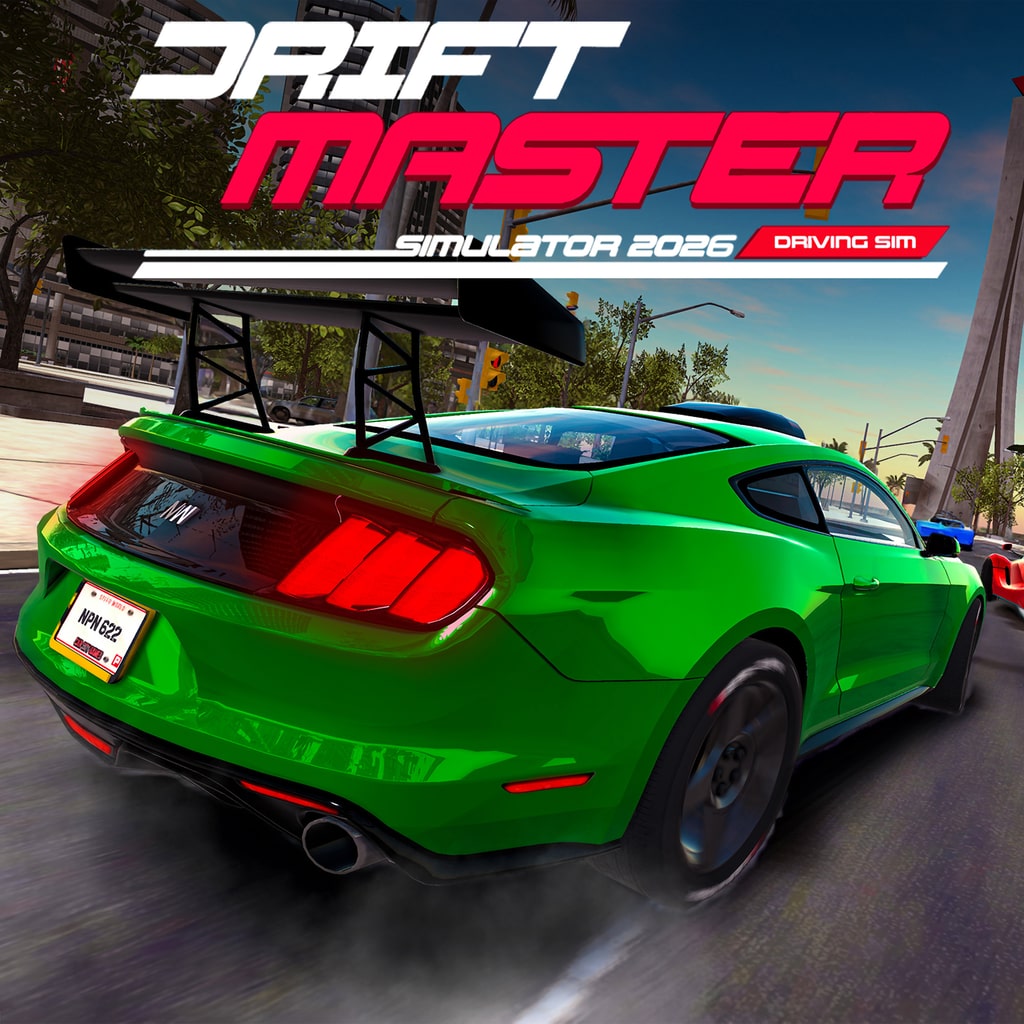
Drift Master 2026 Simulator – Driving Sim does not try to sell you a dream of open highways or festival crowds. There is no grand career narrative, no cinematic framing. Instead, it places you on a track, hands you a car, and asks a simple question: can you control the slide? That clarity defines the entire experience.
From the first turn, it becomes clear that this is not about racing in the traditional sense. Winning is not crossing a finish line first. It is about how you move through space, how you manage momentum, and how well you can hold a drift without losing control. The game strips driving down to its most expressive element and builds everything around it.
Learning the Language of Drifting
The handling model sits comfortably in the arcade space, but there is enough nuance to reward practice. Cars respond quickly, sometimes sharply, and the transition from grip to slide happens faster than you might expect.
At first, that can feel unforgiving. You will oversteer, spin out, and misjudge corners more often than you would like. But slowly, something shifts. You begin to understand how the car wants to move. You learn when to ease off the throttle, when to commit, and when to let the drift carry you.
That balance becomes the core of the experience. It is not about perfection in a strict sense. It is about rhythm. About feeling the car rather than forcing it. When you get it right, even for a few seconds, it feels effortless.
Five Modes, Five Ways to Fail and Improve
Drift Master 2026 structures its gameplay around five distinct modes, each offering a slightly different challenge.
Checkpoint mode is the most straightforward, asking you to maintain speed and control while hitting specific markers. Park mode slows things down, focusing on precision and careful positioning rather than aggressive movement. Break mode introduces tighter constraints, forcing you to manage stopping distance alongside drifting control.
Prototype and Stunt modes push things further, introducing more experimental layouts and demanding manoeuvres that test your understanding of the mechanics. These modes are where the game becomes more expressive, allowing you to approach challenges in multiple ways.
This variety helps keep the experience from feeling repetitive, even if the underlying mechanics remain consistent. Each mode highlights a different aspect of driving, encouraging you to adapt rather than rely on a single approach.
Cars as Tools, Not Just Rewards
With 50 vehicles to unlock, Drift Master 2026 offers a steady stream of progression. These cars are not just cosmetic additions. Each one feels slightly different in how it handles, how it accelerates, and how it responds to input.
Tuning plays a significant role here. Adjustments to suspension, engine performance, and other parameters allow you to shape how a car behaves. It is not an overly complex system, but it is meaningful enough to matter.
You might soften suspension for smoother control or tweak power output to better manage acceleration during drifts. These decisions add a layer of personalisation that helps the game feel less static over time.
That said, the differences between vehicles are not always dramatic. While tuning can refine your experience, it does not completely transform it.
A Loop Built on Repetition
At its heart, Drift Master 2026 is a game about repetition. You attempt a course, fail, adjust, and try again. Progress is measured not just in unlocked cars or completed objectives, but in your growing understanding of how to control the vehicle.
This loop can be satisfying in short bursts. There is a clear sense of improvement, a gradual tightening of your control that makes each run feel slightly better than the last.
But over longer sessions, that repetition can begin to show its limits. Without a broader framework or evolving challenges, the experience risks feeling static. You are doing the same things in slightly different contexts, and while that is enough for a while, it does not always sustain long-term engagement.
Presentation That Stays in the Background
Visually, Drift Master 2026 is functional. Tracks are clear, environments are readable, and the focus remains firmly on the road ahead. There is little in the way of visual flair or memorable design, but nothing actively detracts from the experience.
Sound design follows a similar path. Engine noise, tyre screech, and environmental audio do their job without standing out. It is all serviceable, but rarely striking.
This is a game that prioritises mechanics over atmosphere. Whether that feels refreshing or underwhelming will depend on what you expect from it.
Accessibility Over Simulation
One of the defining aspects of Drift Master 2026 is its accessibility. It does not aim to replicate the full complexity of real-world driving physics. Instead, it offers a simplified model that captures the essence of drifting without overwhelming the player.
For newcomers, this is a strength. The game is easy to pick up and understand, even if mastery takes time. For experienced players, it may feel limited. There is only so much depth within the system, and those looking for a more realistic simulation may find it lacking.
Still, the game knows its audience. It is not trying to compete with high-end simulators. It is offering something lighter, more immediate.
Final Verdict
Drift Master 2026 Simulator – Driving Sim is a straightforward, mechanics-driven driving game that finds its strength in the simple act of controlling a drift. It offers enough variety through its modes and vehicles to stay engaging in short sessions, and its accessible handling makes it easy to jump into.
However, its modest presentation and limited depth prevent it from standing out in a crowded genre. It is a game built for quick play rather than long-term immersion. For players looking for a focused, no-frills drifting experience, it delivers what it promises.