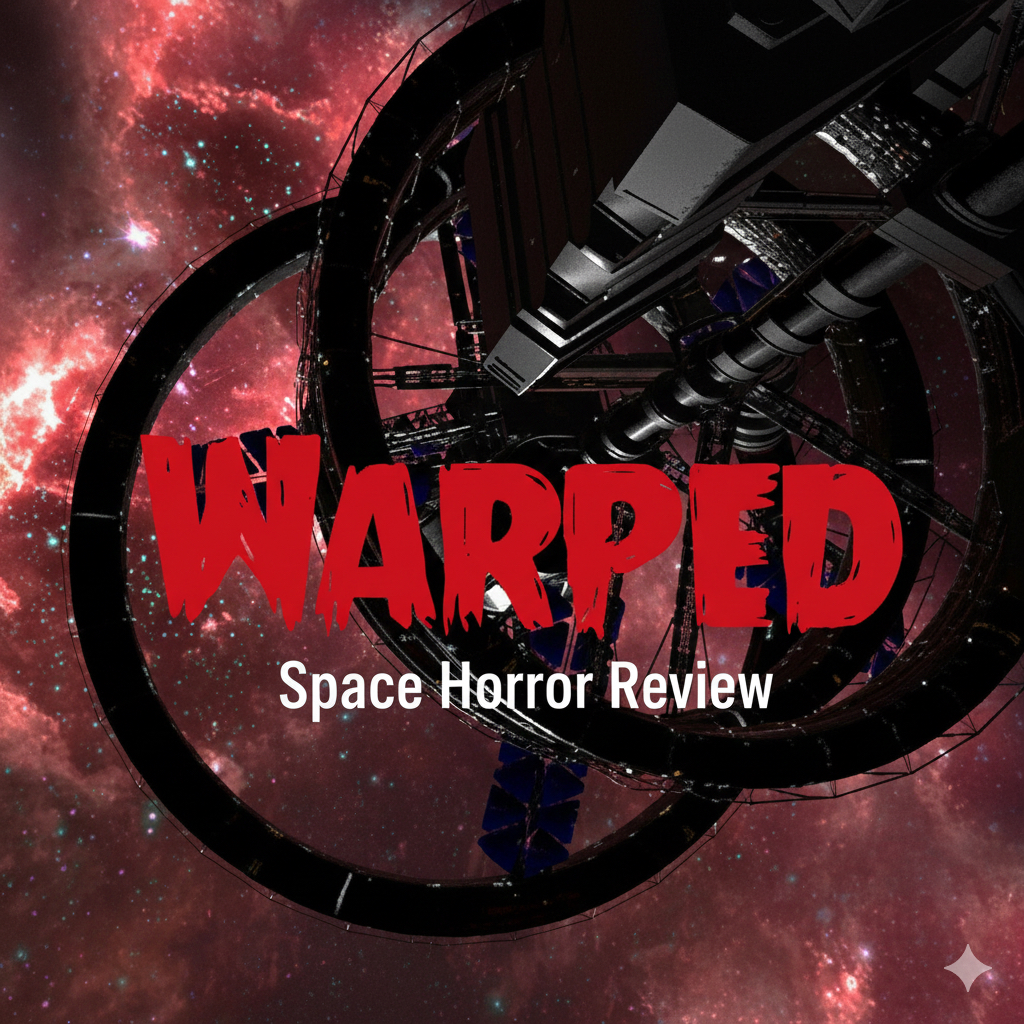
Space horror thrives on isolation, uncertainty, and the quiet dread of systems failing far from help. Warped – Space Horror understands this lineage and leans into it with confidence, presenting a tightly focused experience that favours psychological unease over bombast. Rather than chasing constant jump scares or overwhelming the player with enemies, Warped builds tension through atmosphere, environmental storytelling, and the slow unravelling of reality aboard a derelict spacecraft. The result is a game that is unsettling in a sustained, methodical way — one that values restraint and implication as its primary tools of fear.
This is not a sprawling epic nor a mechanically dense survival sim. Warped – Space Horror is a compact, narrative-driven experience designed to be absorbed rather than conquered. Its success depends largely on how receptive the player is to ambiguity, slow pacing, and horror that creeps rather than lunges. For those attuned to that wavelength, Warped delivers a memorable descent into cosmic paranoia.
Premise and Narrative Structure
Warped – Space Horror places players in the role of a lone survivor — or possibly the last conscious crew member — aboard a deep-space research vessel that has gone catastrophically wrong. The exact circumstances of the disaster are unclear at the outset. Logs are fragmented, corridors are sealed or twisted, and the ship itself appears to be subtly rearranging its internal structure. From the opening moments, the game establishes a sense of dislocation: you are not simply lost in space, but unmoored from certainty itself.
Narrative delivery is deliberately indirect. Story fragments are uncovered through environmental clues, audio logs, terminal messages, and visual anomalies rather than linear exposition. The game avoids clear answers, instead encouraging players to piece together events through implication. Themes of identity erosion, temporal distortion, and existential dread permeate the experience, with the titular “warping” referring not only to the ship’s physical structure but to perception, memory, and causality.
Importantly, Warped resists the urge to overexplain its mysteries. While there is a discernible narrative arc, much of the story is left open to interpretation. This ambiguity will frustrate players who prefer clean resolutions, but it is central to the game’s psychological impact. Horror here is not about what is revealed, but about what remains unknowable.
Gameplay and Interaction
Mechanically, Warped – Space Horror is minimalist by design. Players explore the ship from a first-person perspective, navigating dimly lit corridors, interacting with consoles, opening sealed doors, and occasionally solving environmental puzzles. There is no traditional combat system; survival depends on observation, timing, and avoidance rather than confrontation.
Puzzles are integrated naturally into the environment. Restoring power to a sector, rerouting life support, or recalibrating navigation systems often requires piecing together incomplete information scattered across the ship. These challenges are rarely complex in isolation, but they are made tense by limited resources, unreliable lighting, and the ever-present sense that something is watching — or waiting.
Movement is intentionally deliberate. The character’s pace reinforces vulnerability, and the absence of sprinting or combat abilities keeps players grounded in the reality of their situation. This design choice amplifies tension, though it can occasionally feel restrictive, particularly during backtracking sequences. Still, the game largely avoids busywork, ensuring that each task feels purposeful rather than padding.
Notably, Warped includes subtle sanity and perception mechanics. Visual distortions, audio hallucinations, and shifting environments become more pronounced as the game progresses. These effects are not governed by explicit meters or HUD elements; instead, they manifest organically, blurring the line between gameplay feedback and narrative device. It is often unclear whether an anomaly represents danger, story progression, or psychological breakdown — and that uncertainty is precisely the point.
Atmosphere and Presentation
Atmosphere is where Warped – Space Horror excels most decisively. Visually, the game embraces a stark, industrial sci-fi aesthetic. Corridors are narrow and utilitarian, punctuated by flickering lights, warning strobes, and the cold glow of malfunctioning terminals. The ship feels functional rather than fantastical, grounding the horror in a believable setting that makes its distortions more disturbing.
Lighting is used masterfully. Darkness is not merely an absence of light but a dynamic presence, shaped by emergency systems, moving shadows, and sudden power fluctuations. At times, the environment appears to subtly change when not directly observed, reinforcing the sense that the ship is alive — or at least hostile.
Sound design is equally crucial. Ambient noise — the hum of failing machinery, distant metallic groans, static-laced communications — creates a constant undercurrent of unease. Music is sparse, often absent entirely, allowing silence to become oppressive. When audio cues do spike, they are measured and deliberate rather than startling, reinforcing tension rather than releasing it.
Voice work, when present, is understated and effective. Audio logs feel personal and fragmented, conveying fear and confusion without melodrama. The restraint in performance enhances believability and keeps the focus on atmosphere rather than exposition.
Pacing and Psychological Impact
Warped – Space Horror is unapologetically slow-paced. Progression unfolds gradually, with long stretches of exploration punctuated by moments of narrative escalation or environmental shock. This pacing is integral to the game’s identity, but it will not suit all players. Those expecting frequent action or constant stimulation may find the experience languid.
However, the slow burn allows dread to accumulate naturally. Rather than delivering discrete scares, the game sustains a low-level anxiety that intensifies over time. By the latter stages, the player is primed to distrust every sound, shadow, and system prompt. The horror becomes internalised, driven as much by anticipation as by actual events.
Replayability is limited in a mechanical sense, but thematic replay value is strong. Subsequent playthroughs allow players to notice details that were previously overlooked, reinterpret narrative fragments, and develop new theories about the game’s events. Multiple endings or outcomes are hinted at, though differences are subtle rather than dramatic.
Strengths and Limitations
Strengths:
- Exceptionally strong atmosphere built through sound, lighting, and environmental design
- Effective psychological horror that prioritises tension over shock
- Cohesive thematic focus on isolation, perception, and existential dread
- Minimalist mechanics that reinforce vulnerability and immersion
Limitations:
- Slow pacing may alienate players seeking action-driven horror
- Limited mechanical variety and interactivity
- Narrative ambiguity may feel unsatisfying to those wanting clear answers
- Occasional backtracking can disrupt momentum
Final Verdict
Warped – Space Horror is a disciplined, atmospheric descent into sci-fi dread that understands the power of suggestion. It does not aim to overwhelm or entertain in conventional ways; instead, it seeks to unsettle, disorient, and linger in the player’s mind. Its restraint is its greatest strength, even if that same restraint limits its appeal.
For fans of psychological horror, environmental storytelling, and slow-burn tension, Warped – Space Horror is a compelling and carefully crafted experience. It may not redefine the genre, but it executes its vision with confidence and coherence, offering a haunting journey through the dark void between stars.