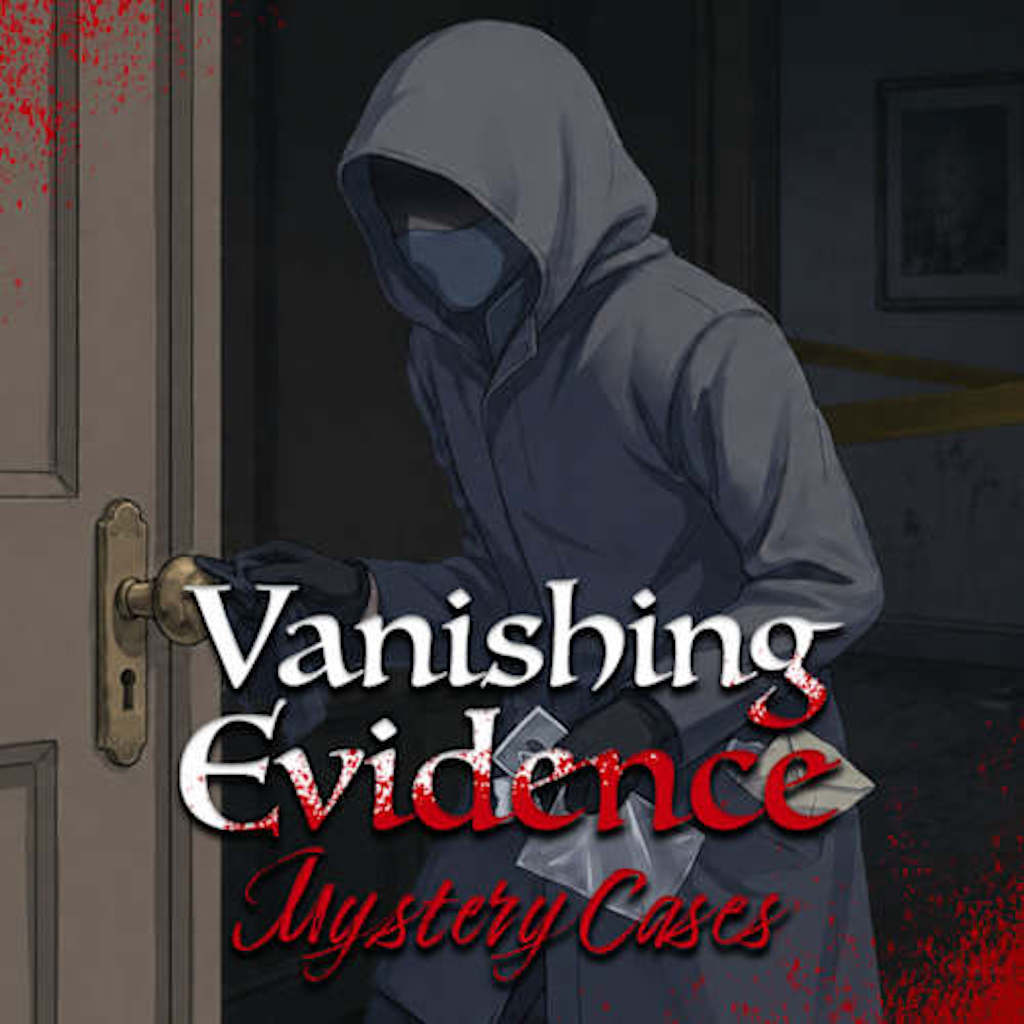
There is something wonderfully simple about a good observation puzzle. Give me an interesting image, a question, and one tiny detail to find, and suddenly I am leaning towards the screen as though the fate of an entire investigation depends on spotting a suspicious footprint. Vanishing Evidence: Mystery Cases takes that familiar formula and gives it a rather deliciously devious twist. Instead of playing the detective trying to uncover the truth, you are working for the person who desperately wants that truth buried. Your job is not to find the evidence. It is to make it disappear.
That small change in perspective gives the game its identity. Each case presents an illustrated scene with a collection of details, objects and potential clues, while a prompt tells you what your client needs removed. You study the image, identify the incriminating piece of evidence and select it before watching it vanish from the scene. It is a compact concept, but there is a satisfying little spark of mischief behind it, because every correct answer feels like you have just helped someone get away with something they probably should not.
A Different Kind of Detective
The first thing that makes Vanishing Evidence: Mystery Cases appealing is how it turns the traditional mystery puzzle on its head. Most detective games reward you for noticing everything suspicious, connecting the dots and eventually putting the culprit behind bars. Here, you are effectively standing on the other side of the crime scene, with a mop in one hand and a very questionable set of instructions in the other. The objective is to read the situation carefully and work out which detail could cause the most trouble for your client.
That makes observation feel different from the outset. You are not simply scanning a picture for something unusual because the game asks you to find a clue. You need to understand the request and then consider what in the scene actually matches it. A prompt might direct your attention towards footprints, personal belongings, an object connected to the crime or another suspicious detail, meaning the challenge is as much about interpretation as it is about eyesight.
There is also something pleasingly immediate about the structure. You read the case prompt, examine the illustration and select the evidence that needs to disappear. If you get it right, the offending item vanishes and you can move on. There is no complicated inventory system to wrestle with or a lengthy tutorial to sit through, which makes Vanishing Evidence particularly easy to pick up when you only have a few minutes to spare.
Searching for the Right Clue
The core gameplay is deliberately straightforward, but that does not mean it is completely mindless. The best moments come when a scene initially seems obvious, only for you to realise that several details are competing for your attention. A pair of footprints might seem important, but are they the footprints the prompt refers to? An abandoned object might look suspicious, but does it actually fit the circumstances of the case?
That process creates the game’s little moments of deduction. You are constantly filtering the information presented to you rather than simply clicking on anything that looks remotely interesting. When you finally identify the correct piece of evidence, there is a satisfying sense of completion as it disappears from the illustration. It is a small reward, but one that works because the game has encouraged you to look carefully before committing to an answer.
The bite-sized nature of the cases is another strength. Vanishing Evidence: Mystery Cases is clearly designed to work in short sessions, whether you fancy solving a handful of puzzles before bed or want something to occupy you for a few minutes between larger games. There is no need to remember complicated systems from one session to the next, and each case essentially gives you a fresh little observation challenge.
Simple Controls, Accessible Puzzles
Control schemes do not get much more accessible than this. Button and touch controls are supported, allowing players to select the evidence that catches their eye without having to learn a complicated set of commands. That simplicity keeps the focus exactly where it should be, on examining the scene and interpreting the question.
There is also something rather relaxing about the absence of unnecessary mechanical clutter. You are not fighting enemies, racing against a timer or managing resources while simultaneously trying to spot a tiny object hidden in the corner of an illustration. The challenge comes from observation and deduction, which makes Vanishing Evidence an easy recommendation for anyone who enjoys casual puzzle games but wants something with a little more personality behind the premise.
Of course, the simplicity may also limit the experience for players looking for a substantial detective adventure. This is not a sprawling investigation with dozens of suspects, forensic laboratories and elaborate branching narratives. Its ambitions are considerably more modest, and the game is at its best when appreciated as a focused puzzle experience rather than as something attempting to compete with a full-scale detective RPG.
The Pleasure of Making Evidence Disappear
Visually, the illustrated scenes serve their purpose well. The key in an observation game is readability. If the artwork is too cluttered or the details are poorly defined, the challenge quickly becomes frustrating rather than enjoyable. Vanishing Evidence understands that the illustrations need to contain enough information to make searching interesting while still allowing the player to identify the relevant details through careful examination.
There is a certain charm to the way each scene becomes its own little crime story. You are encouraged to examine the surroundings, notice the objects scattered around, and think about how they relate to the prompt. Even without an elaborate narrative, the illustrations invite you to imagine what happened before you arrived and, more importantly, what your client desperately wants you to erase.
That premise gives otherwise familiar hidden-object mechanics a darker sense of humour. You are essentially participating in the cover-up, one missing clue at a time. It is hardly the most morally upright profession in gaming, but it does make for an amusing change of perspective.
A Little More Sinister Than It Looks
What I particularly like about Vanishing Evidence: Mystery Cases is that it understands the appeal of compact puzzle games. There is no need for every game to be an enormous adventure demanding dozens of hours of your life. Sometimes you just want to sit down, look at a picture, and have your brain wrestle with one deceptively simple question.
The premise also gives the experience a little more character than a standard spot-the-difference game. You are not merely finding something because the game says there is something to find. You have a reason to care about the object you are searching for because removing it could change the outcome of the fictional case. That creates a tiny sense of responsibility, albeit one pointed in a decidedly questionable direction.
There is an amusing tension in knowing that you are helping the wrong person. In another game, finding the evidence would be the heroic act. Here, finding it is merely the first step towards making sure nobody else does. That inversion is simple, but it is enough to give the familiar observation formula its own personality.
Verdict
Vanishing Evidence: Mystery Cases is a clever little puzzle game that proves you do not need an enormous budget or complicated mechanics to make observation feel rewarding. Its biggest strength is undoubtedly the central premise, which puts the player in the unusual position of cleaning up after a crime rather than solving one. That gives every otherwise familiar search puzzle a mischievous edge, while the bite-sized structure makes it wonderfully easy to dip into whenever you fancy a quick mental workout.
It will not satisfy players expecting a sprawling detective adventure filled with interrogations, forensic laboratories and elaborate conspiracy plots. That simply is not what this game is trying to be. Instead, it focuses on the satisfaction of reading a prompt, studying an illustration, identifying the one detail that matters, and watching the incriminating evidence disappear before your eyes.
There is something strangely satisfying about that final moment. You have spotted the clue, understood why it matters, and erased it from existence. The case may now be a little harder to solve, and somewhere out there a fictional criminal is probably breathing a sigh of relief.
For fans of casual observation puzzles, illustrated mysteries and games that can be enjoyed in short bursts, Vanishing Evidence: Mystery Cases is an enjoyable little diversion with a premise that gives it just enough personality to stand apart. It is simple, accessible and occasionally mischievous, and sometimes that is all a good puzzle game needs to be.