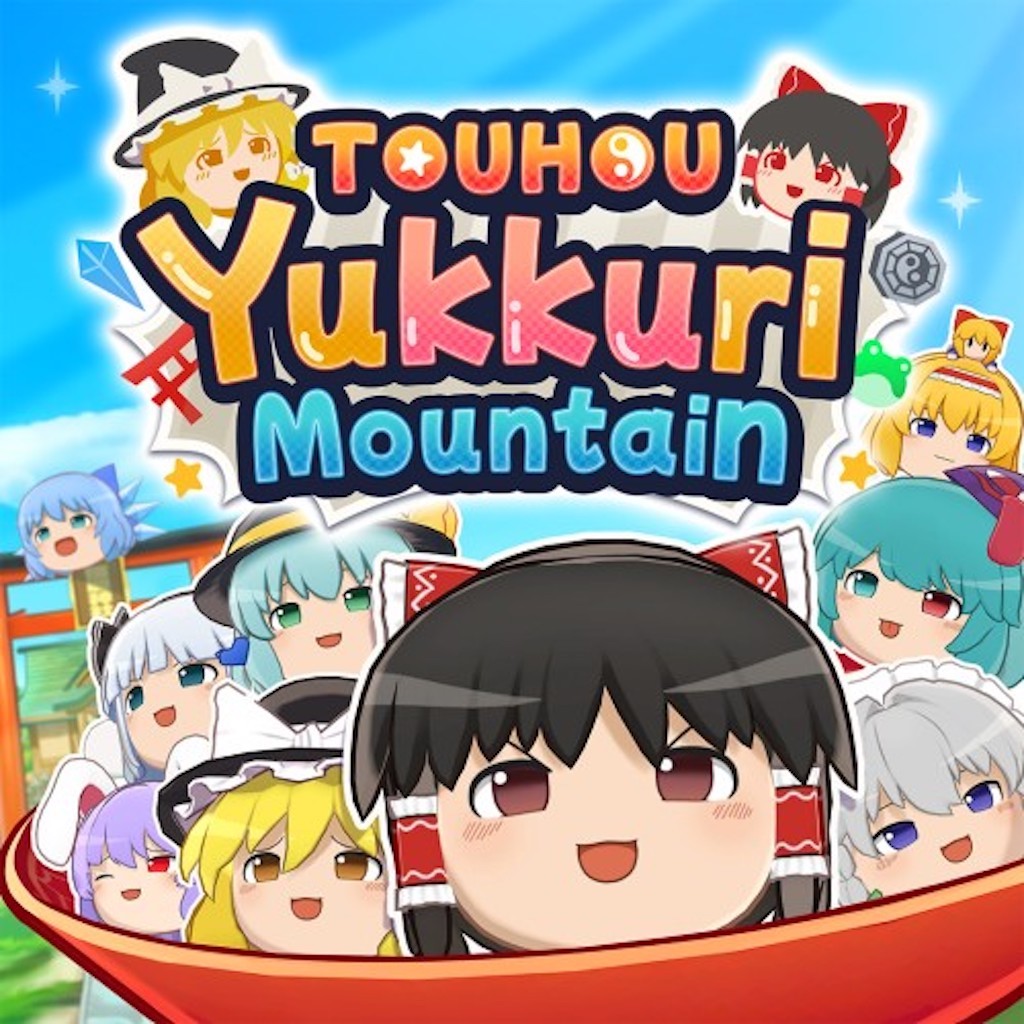
Puzzle games often live or die by a single question: “Just one more round?” The best examples create an endless cycle of near misses, personal bests, and the nagging belief that the next attempt will finally be the one when everything clicks. Touhou Yukkuri Mountain understands this perfectly. On paper, it is another entry in the ever-growing family of merge puzzle games inspired by the runaway success of Suika Game. In practice, however, it feels far more distinct.
Developed and published by BeXide Inc., Touhou Yukkuri Mountain takes the familiar fruit-merging formula and gives it a wonderfully eccentric Touhou makeover. Instead of dropping apples, melons, and oranges into a container, players stack the iconic Yukkuri heads that have become internet-famous among Touhou fans. The result is a game that feels immediately approachable while offering enough personality and customisation to carve out its own identity.
What begins as a simple exercise in dropping cartoon heads into a bowl quickly becomes a surprisingly intense battle against physics, probability, and your own greed.
Take It Easy… Until Everything Goes Wrong
The basic gameplay loop is easy to understand. Yukkuri characters descend from the top of the screen, and your goal is to position them inside a large bowl. Whenever two matching Yukkuri touch, they merge into a larger character. Larger merges create bigger characters, which in turn unlock even larger forms further up the evolutionary ladder.
Anyone familiar with merge puzzlers will instantly understand the appeal. The satisfaction of creating a perfectly timed merge remains as compelling as ever. Watching two identical characters combine into something larger triggers the same rewarding response every time.
What sets Touhou Yukkuri Mountain apart from many of its competitors is its use of full 3D physics. Characters bounce, roll, wobble, and shift around in ways that can be both helpful and devastating. Every drop carries a degree of unpredictability, and a carefully organised stack can turn into a disaster within seconds.
This constant tension is what keeps the experience engaging. There is never complete control over the outcome, but there is always enough influence to make success feel earned rather than random. The game continually challenges players to balance planning with adaptation.
The Physics Are Both Friend and Enemy
The game’s physical simulation is the greatest source of excitement. Every Yukkuri has a soft, jelly-like quality that makes stacking feel alive. Larger characters exert more influence on the pile, shifting the balance of the entire bowl as they settle into place.
Some of the most memorable moments arise from situations that initially seem catastrophic. A giant Yukkuri begins to roll towards the edge. Smaller characters scatter beneath it. The entire structure looks moments away from collapse. Then, almost miraculously, several accidental merges occur in succession, stabilising the pile. Those moments create genuine drama.
Conversely, there are occasions when a perfectly reasonable placement triggers an unexpected chain reaction that sends your carefully constructed mountain tumbling into failure. While this unpredictability can occasionally feel frustrating, it also contributes heavily to the game’s addictive quality. Every round tells a slightly different story.
Importantly, failure rarely feels unfair. Most losses stem from taking risks that seemed worthwhile at the time. The temptation to squeeze one more character into an already crowded bowl becomes impossible to resist, and the game gleefully punishes overconfidence.
Chasing Chains
Scoring well requires more than simply creating larger characters. The real skill lies in setting up chain reactions. When one merge triggers another, and then another, the score multiplier escalates rapidly. Suddenly, a seemingly modest move can spark an explosion of points.
These chain opportunities become the driving force behind long-term mastery. Casual players can enjoy the basic merge mechanics immediately, but dedicated players will discover a deeper layer centred on positioning and preparation.
Creating successful chains delivers some of the game’s biggest thrills. There is an undeniable sense of satisfaction when a carefully arranged stack erupts into a cascade of merges that dramatically reshapes the board. Few puzzle games capture the excitement of momentum quite as effectively.
Worldwide rankings further enhance the competitive side of the experience. High-score enthusiasts will find plenty of reasons to keep returning as they refine their strategies and chase higher numbers.
Reimu and Marisa Steal the Show
One of Touhou Yukkuri Mountain’s smartest additions is its live commentary system. Throughout gameplay, Reimu and Marisa react to your actions with energetic banter, observations, and playful exchanges. Rather than serving as passive background decoration, the duo actively responds to the flow of the match.
Pull off an impressive chain and they celebrate. Come dangerously close to overflowing the bowl and panic sets in. Their reactions lend personality to moments that might otherwise feel mechanically repetitive.
What makes this feature particularly successful is how naturally it integrates into the experience. The commentary creates the impression that someone is sharing the journey with you, adding warmth and humour to even the most routine sessions.
For longtime Touhou fans, these interactions provide an extra layer of enjoyment. For newcomers, they simply make the game feel more lively and welcoming.
Customisation Adds Longevity
Many merge games rely entirely on score chasing to maintain player interest. Touhou Yukkuri Mountain goes a step further by introducing a surprisingly robust progression system. Points earned during play can be spent to unlock new Yukkuri characters. With thirty available variations, there is plenty to collect over time.
More impressively, players can customise the evolution hierarchy itself. Rather than accepting a fixed progression tree, the game allows you to rearrange character growth paths to suit personal preference.
This may sound like a minor feature, but it fundamentally changes the experience. Favourite characters can become ultimate forms, while less popular ones can be moved earlier in the chain. Every player’s mountain can feel uniquely their own. It is a feature that perfectly complements the game’s fan-driven appeal while providing meaningful reasons to keep experimenting.
A Surprisingly Strong Party Game
While the single-player mode remains the main attraction, local multiplayer deserves recognition. Supporting up to four players, the competitive mode transforms the typically thoughtful puzzle formula into a frantic social experience. Friends quickly discover that keeping composure is far more difficult when everyone is shouting about imminent disasters and miraculous recoveries.
The core mechanics translate remarkably well to multiplayer settings. Rounds remain easy to understand, so newcomers can join without lengthy explanations. At the same time, experienced players retain opportunities to demonstrate skill through smarter positioning and chain management. It is not a replacement for dedicated party-game giants, but it provides a welcome alternative that can generate plenty of laughter.
Final Verdict
Touhou Yukkuri Mountain succeeds by understanding exactly what makes merge puzzle games compelling, while adding enough personality to avoid feeling like a simple imitation. The core gameplay remains wonderfully addictive, driven by excellent physics, satisfying chain reactions, and a constant push for higher scores.
The Touhou theme is more than cosmetic dressing. Reimu and Marisa’s commentary, the extensive character roster, and the evolution customisation system all contribute to a package that feels genuinely crafted for fans rather than merely licensed for convenience. Even players with little familiarity with Touhou can appreciate the game’s charm and accessibility.
Some may find the physics occasionally unpredictable, and the overall structure remains rooted in a relatively simple concept. Yet the game’s charm, replayability, and surprising depth consistently outweigh those concerns.
What starts as a casual diversion quickly becomes the sort of game that steals entire evenings. You promise yourself one final attempt, watch a near-perfect chain unfold, and suddenly another hour has disappeared. That alone speaks volumes about how effectively Touhou Yukkuri Mountain captures the genre’s addictive magic.