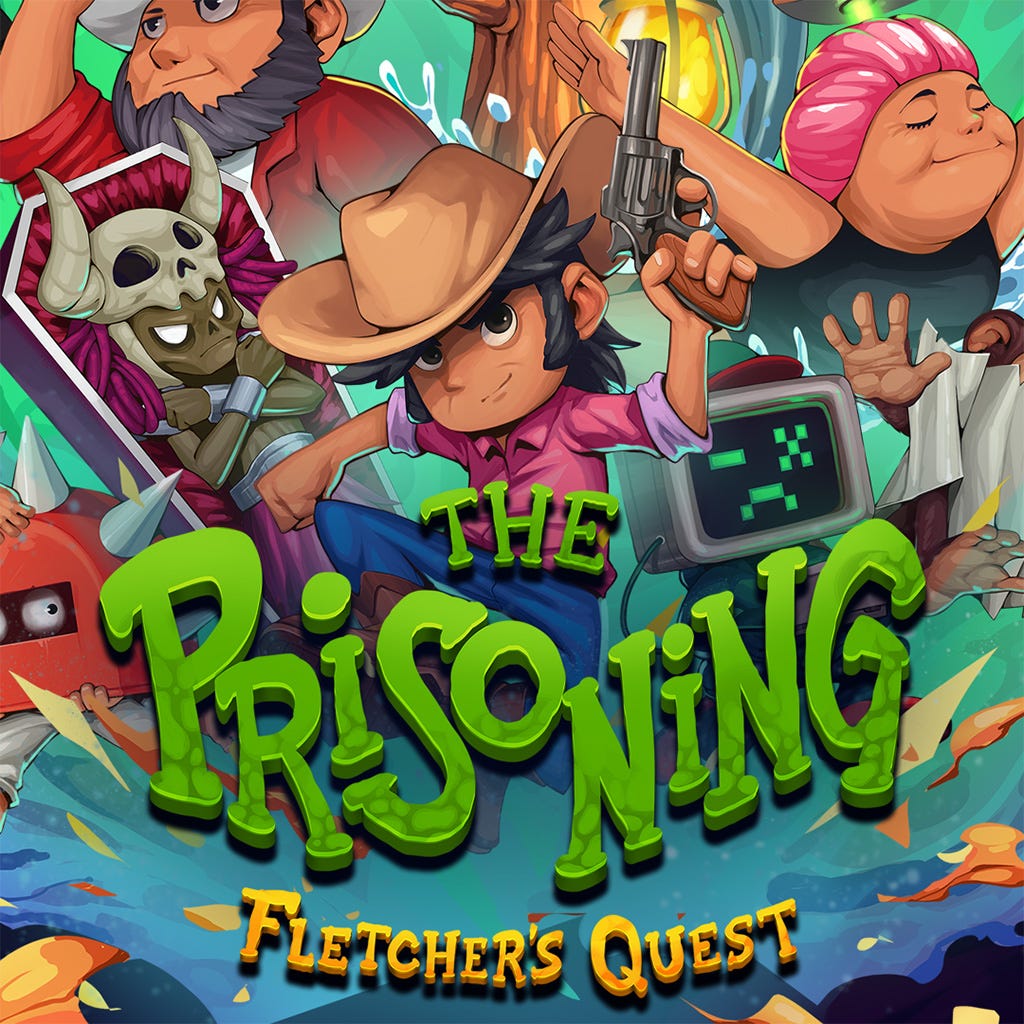
There’s a particular kind of indie game that feels less like entertainment and more like a confessional booth with a controller attached. The Prisoning: Fletcher’s Quest, developed by Elden Pixels and published by the newly resurrected Acclaim, plants its flag squarely in that uncomfortable territory. It’s a “Metroidvania-lite,” a platformer, a procedural experiment, and a therapy session disguised as a joke that keeps laughing a little too long.
Marketed with self-deprecation, surreal humor, and a barrage of deliberately unhelpful bullet points, The Prisoning dares you not to take it seriously—then quietly forces you to anyway.
Trapped Inside a Developer’s Head
You play as Fletcher, a burned-out game developer who, after a psychologist visit that goes catastrophically sideways, becomes trapped inside his own subconscious. This mental landscape is not abstract in the artsy sense; it’s literal, hostile, and cluttered with intrusive thoughts, self-loathing metaphors, and pixelated anxieties that want you very dead.
What makes this premise work is its honesty. The Prisoning is based on real events, and while the game constantly undermines itself with jokes, disclaimers, and absurdity, there’s a rawness beneath the humor. This isn’t burnout as an aesthetic—it’s burnout as a level design philosophy.
Rooms feel cramped. Enemies feel aggressive. Progress often feels like pushing forward despite exhaustion rather than overcoming it.
Metroidvania-Lite, Whatever That Means
Structurally, The Prisoning sits somewhere between a traditional Metroidvania and a roguelite. Progression is semi-procedural: instead of a fully handcrafted map, the game pulls from a large pool of predesigned rooms that shuffle each run. This keeps exploration unpredictable without descending into chaos.
The upside is replayability. No two playthroughs are quite the same, and backtracking never becomes rote. The downside is cohesion—some transitions feel abrupt, and certain rooms appear in contexts that feel more mechanically logical than emotionally resonant.
Still, for a game that openly admits it doesn’t fully understand what “procedurally generated” means, the execution is surprisingly competent.
Movement, Combat, and Control
Mechanically, The Prisoning is tight. Movement is responsive, jumps are precise, and combat is snappy without being overwhelming. Fletcher gains access to upgrades, weapons, and abilities at a steady pace, ensuring the game never stagnates.
Combat leans aggressive. You can kill almost everything that moves, and the game encourages you to do so. Enemies are plentiful and often obnoxious, reinforcing the sense that Fletcher’s mind is not a safe place to linger.
Boss fights are a standout. Each is thematically tied to a specific anxiety or emotional obstacle—deadlines, imposter syndrome, self-doubt—and while not mechanically revolutionary, they’re memorable due to their presentation and tone. These encounters feel less like skill checks and more like confrontations with unresolved thoughts.
Humor as a Coping Mechanism
The Prisoning’s humor is relentless, self-aware, and frequently juvenile. Jokes about peanut allergies, honky-tonk nudity, and gladiator movies fly past at a rate that borders on hostile. At times, it feels like the game is daring you to roll your eyes.
But that’s intentional. The humor functions as a shield. When the game lets its guard down—during quieter moments, subtle environmental storytelling, or particularly bleak enemy designs—the contrast hits harder. Beneath the sarcasm is a game deeply uncomfortable with sincerity, which paradoxically makes its emotional beats feel more authentic.
The inclusion of full-frontal pixel nudity is less about shock value and more about stripping away dignity—both literally and metaphorically. It’s awkward, unnecessary, and effective in the way only something deeply personal can be.
Anxiety as Level Design
What separates The Prisoning from other indie platformers is how anxiety is baked into its systems. Enemy placement often feels unfair by design. Healing opportunities are limited. Death can feel abrupt and unceremonious.
Yet the game rarely feels cruel. Instead, it feels honest about what it’s portraying. Anxiety doesn’t wait its turn. Burnout doesn’t scale nicely. The Prisoning captures that sense of being overwhelmed by making the player slightly uncomfortable at all times.
Importantly, the game allows you to opt out. If you don’t want to engage with the story, themes, or meta-commentary, you can bulldoze forward and treat it as a mechanically solid platformer. That flexibility is a kindness—not a cop-out.
Audio and Presentation
Visually, The Prisoning embraces chunky pixel art with exaggerated animations and grotesque character designs. It’s expressive rather than pretty, favoring emotional clarity over detail.
The chipmusic soundtrack, self-described as “what we could afford,” is excellent. Tracks oscillate between frantic and melancholic, perfectly matching the game’s mood swings. It’s the kind of soundtrack that burrows into your head, looping alongside Fletcher’s thoughts.
Final Verdict
The Prisoning: Fletcher’s Quest is messy, loud, and occasionally exhausting—but that’s the point. It’s a game about burnout made by people who clearly lived it, and it refuses to sand down its rough edges for mass appeal.
Not every joke lands. The procedural structure can undermine narrative flow. Some players will bounce hard off its tone. But for those willing to engage with its chaos, The Prisoning offers something rare: a mechanically competent platformer that uses its design to communicate emotional truth rather than distract from it.
It’s not just a game you play—it’s a game you endure, laugh at, and maybe recognize yourself in more than you expected.