There are plenty of adventure games that want you to take their stories seriously. There are others that want to make you laugh, and then there is The Immortal John Triptych, which looks you straight in the eye, places a Renaissance painting in front of you, discusses sin, death, God, war and the meaning of existence, and then makes a joke about somebody’s backside. It is gloriously ridiculous, surprisingly clever and unlike almost anything else you are likely to play. More importantly, it has the confidence to remain completely committed to its own peculiar vision.
Created by Joe Richardson, The Immortal John Triptych brings together Four Last Things, The Procession to Calvary and Death of the Reprobate in one beautifully assembled anthology. These are not simply three games thrown into a bundle and left to fend for themselves. The Triptych has been lovingly remastered with a unified interface, quality-of-life improvements, full controller support, manual saves for Four Last Things, additional scenes and an expanded soundtrack. It feels like the definitive way to experience Richardson’s wonderfully strange corner of Renaissance-inspired adventure gaming.
What makes the collection particularly special is that its three adventures feel connected without becoming dependent on one another. Recurring characters, ideas and a shared world create a sense of continuity, but each game has its own personality and rhythm. Together they form a journey through religious fanaticism, war, morality, mortality and divine judgement that somehow manages to be both genuinely thoughtful and absolutely stupid in equal measure. Somehow, it works.
A Pilgrimage Unlike Any Other
At its heart, The Immortal John Triptych is a traditional point-and-click adventure, though Richardson gives the formula enough personality to feel refreshingly distinctive. You explore locations, talk to eccentric characters, collect objects and use your inventory to solve increasingly strange problems. The verb-coin interface makes interactions straightforward, while the inventory system keeps everything manageable without stripping away the pleasure of experimentation.
The puzzles are perhaps the biggest surprise. With a game this committed to absurdity, you might expect the solutions to be equally random, but that is rarely the case. Richardson’s puzzles generally follow a wonderfully consistent internal logic, so even the strangest solutions tend to make sense once you understand what the game is asking of you. There is particular joy in discovering the answer to a problem that initially seems completely nonsensical, only to realise the clues were sitting there waiting for you all along.
That makes the collection considerably more satisfying than a simple joke adventure. Beneath all the silliness lies a genuine understanding of what makes classic adventure games tick. Characters have bizarre requests, objects have unexpected uses, and seemingly insignificant details can become crucial later. You are encouraged to investigate rather than simply click everything in sight, and the resulting sense of discovery gives the humour even more impact.
Three Tales, One Glorious World
Four Last Things introduces the world with an irreverent story centred on the seven deadly sins. It is perhaps the most immediately traditional of the three adventures, yet it establishes Richardson’s particular style beautifully. The journey takes you through villages, churches and countryside locations populated by strange characters, and your quest becomes increasingly ridiculous as you attempt to satisfy the game’s many bizarre demands.
Then comes The Procession to Calvary, which arguably pushes the formula into even stranger territory. Here, the player is thrown into a world of religious warfare and absurd political intrigue, with the tyrannical Heavenly King John at the centre. The writing is sharper, the jokes more confident, and the situations increasingly surreal as you pursue your objective.
Finally, Death of the Reprobate provides the closing chapter, sending you on a quest involving good deeds, death and divine consequences. It is also arguably the most confident game of the three, benefiting from everything Richardson learned while creating the previous adventures. Played together, the trilogy feels like watching an artist gradually become more comfortable with their canvas, even though that canvas happens to contain severed heads, religious iconography and an astonishing number of terrible people.
Renaissance Paintings Have Never Been This Funny
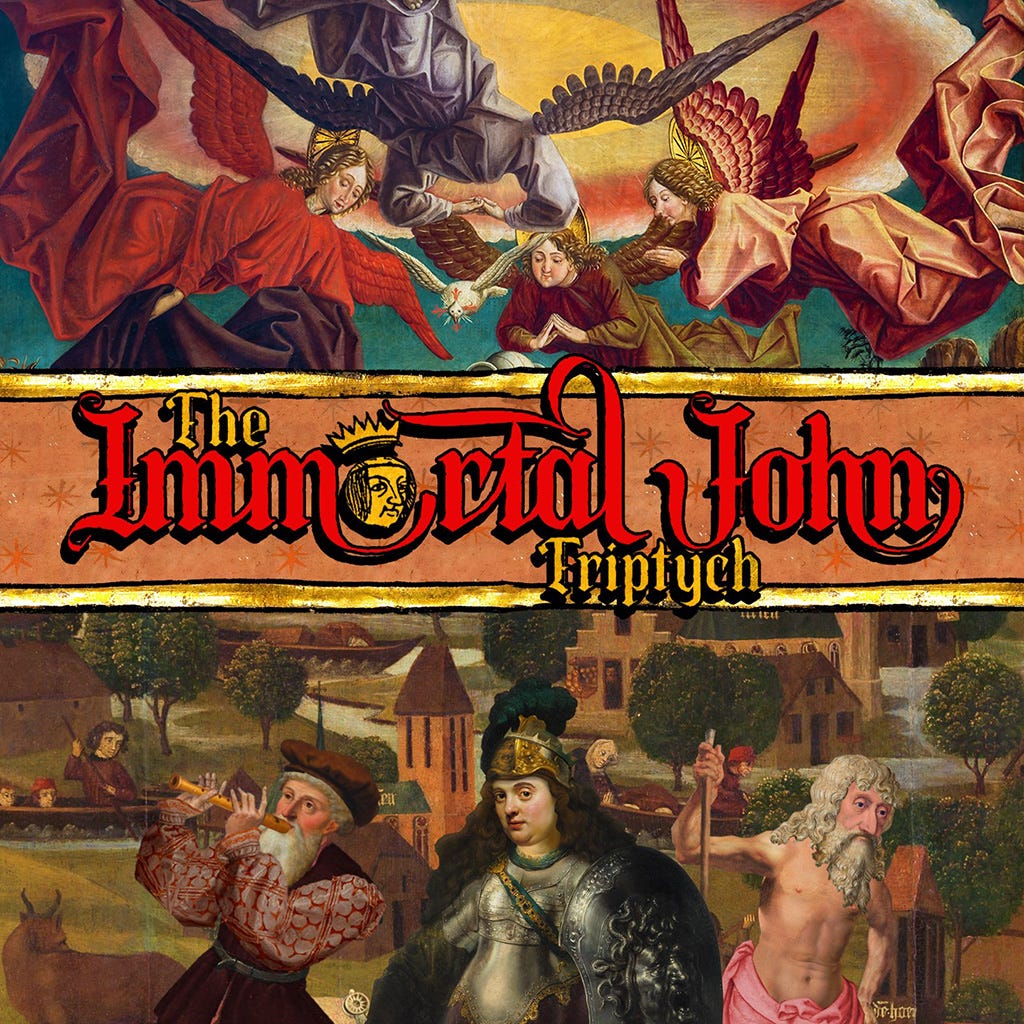
The visual presentation is unquestionably the star of the show. Richardson builds his world almost entirely from Renaissance, Rococo and Romantic artwork, cutting out characters and objects from genuine paintings and placing them in interactive scenes. It should not work as well as it does, yet the effect is extraordinary.
There is something inherently funny about watching solemn historical figures suddenly become animated characters in completely ridiculous situations. Faces painted centuries ago to convey dignity, suffering or religious devotion are suddenly taking part in conversations about bodily functions and absurd errands. The contrast between the grandeur of the artwork and the stupidity of what is happening creates much of the game’s humour without Richardson needing to force the joke.
Yet there is real artistic appreciation behind it all. The Triptych does not simply use old paintings as a cheap visual gimmick. It understands their composition, colour and atmosphere, bringing hundreds of pieces of artwork together to create a world that somehow feels coherent. The accompanying time-lapse videos are a particularly lovely addition, offering a glimpse into the painstaking process of turning these paintings into playable environments.
Comedy With Something to Say
The humour will obviously be subjective. If you are allergic to toilet humour, deliberately stupid jokes, or characters behaving like complete idiots, there will be moments when The Immortal John Triptych tests your patience. Richardson has no interest in keeping his comedy respectable simply because the artwork surrounding it happens to be hanging in museums. A fart joke can sit comfortably alongside a discussion of death, faith and the nature of morality.
Personally, that contrast is part of the charm. The games understand that highbrow and lowbrow comedy need not be enemies. Richardson can spend time exploring serious themes before undercutting them with an outrageous gag, and somehow the joke often makes the serious moment more memorable rather than less.
There is also a lovely sense of warmth beneath the irreverence. For all its grotesque characters and cynical observations, these games are not cruel for the sake of it. There is affection for the adventure game genre, for historical art, and genuine enthusiasm for storytelling. The result feels less like mockery and more like an artist having an enormous amount of fun with things they clearly love.
Music From Another Age
The soundtrack deserves plenty of praise too. Classical compositions provide the foundation, while Eduardo Antonello’s original contributions and new recordings expand the collection’s musical identity. The use of authentic period instruments gives the world an atmosphere that feels strangely convincing despite everything unfolding on screen.
Music adapts to the unfolding action and helps establish a sense of place throughout the three adventures. It can be peaceful one moment and dramatically appropriate the next, creating an amusing contrast when paired with the ridiculous situations unfolding in front of you. The expanded soundtrack is therefore more than a nice extra. It adds another layer of authenticity to an experience built around deliberately anachronistic comedy.
A Collection That Understands Preservation
The remastering is not revolutionary, but it is exactly what this collection needed. The unified interface makes moving between the three games considerably more comfortable, while controller support removes one of the few barriers for players who prefer not to use a mouse and keyboard. Manual saves for Four Last Things are especially welcome, and the additional scenes give returning players a reason to revisit familiar territory.
The deleted content and bonus material are also worthwhile additions. Rather than simply presenting the three games as they originally appeared, The Immortal John Triptych feels like an opportunity for Richardson to gather everything together and put a proper bow on this strange creative journey.
Final Verdict
The Immortal John Triptych is magnificent. It is funny, strange, beautiful, clever and occasionally utterly ridiculous, often within the space of a single conversation. Joe Richardson has created something that feels wonderfully personal, and bringing Four Last Things, The Procession to Calvary and Death of the Reprobate together makes it easier than ever to appreciate how distinctive that achievement is.
There are adventure games with bigger budgets, more elaborate cinematics and considerably more complicated mechanics. None of that matters here. The joy of The Immortal John Triptych comes from its imagination, its writing, its puzzles and the sheer audacity of combining centuries-old artwork with comedy that can be astonishingly childish.
It is also a reminder that indie games do not need to follow established rules to be memorable. Richardson has taken a genre many assumed had disappeared, mixed it with Renaissance art, classical music, religious satire and an unhealthy enthusiasm for silliness, and somehow produced three genuinely wonderful adventures.
Whether you are a lifelong fan of point-and-click adventures or someone who simply appreciates games with a personality of their own, this is an anthology worth experiencing. It is a celebration of art history, comedy and adventure gaming that should leave you smiling long after the credits have rolled. And if nothing else, it proves that Renaissance paintings are considerably funnier when somebody gives them a button for a backflip.